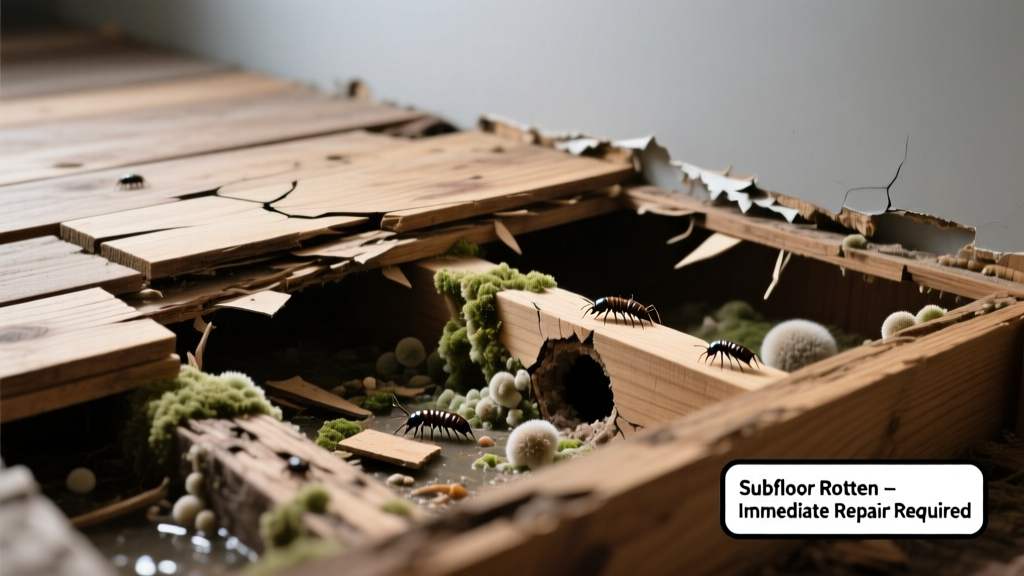
You step on the floor—and it groans, sags, or gives slightly like a trampoline. A musty odor clings to the room. Carpet feels spongy underfoot. You press a screwdriver into the subfloor near a wall and it sinks in 3/4 inch with no resistance. This isn’t just ‘old wood’—it’s active decay compromising your home’s structural integrity.
Quick Checklist
- Does the floor visibly dip or bounce when walked on?
- Can you smell dampness, mildew, or sour wood even with windows open?
- Is there visible discoloration (dark streaks, black spots) on exposed subfloor edges?
- Do screws or nails pull out easily when re-securing baseboards or trim?
- Has there been recent plumbing leaks, roof leaks, or persistent high humidity (>65% RH for >72 hours)?
- Are floor joists accessible from below (e.g., crawl space or basement) and show white fungal growth or crumbly texture?
Possible Causes
Chronic moisture intrusion from plumbing leak
Confirm by checking supply lines, shutoff valves, and P-traps beneath sinks or tubs for damp insulation or mineral deposits. Use a moisture meter: readings above 20% indicate active saturation. Severity: High—structural compromise likely. Repair subfloor due to leak.
Roof or flashing failure directing water into wall cavity
Inspect attic sheathing near exterior walls for water stains or algae trails; check soffits for missing drip edge or clogged gutters. Confirm with infrared scan (rental units available for $75/day). Severity: Critical—often requires coordinated roof + framing repair. Roof leak causing subfloor rot.
Poor ventilation in crawl space or basement
Measure relative humidity with a calibrated hygrometer—if consistently >65% for >5 days, condensation is degrading OSB or plywood. Look for efflorescence on foundation walls. Severity: Moderate—DIY fixable with vapor barrier + exhaust fan. Crawl space ventilation fix.
What to Do First
Stop all water sources immediately—even if no obvious leak is visible. Shut off main water valve if plumbing is suspected. Place fans on low setting over affected area (not high speed—this spreads spores). Remove rugs and carpet padding to expose full extent. Document with dated photos showing sag depth, probe depth, and moisture meter readings.
- Mark compromised zones with chalk or tape (e.g., “ROT ZONE: 4'x6' under vanity”)
- Use a digital moisture meter (e.g., Protimeter Surveymaster) to log readings every 6 inches
- Contact your insurance carrier within 72 hours—many policies cover sudden water events but not gradual neglect
What NOT to Do
Don’t sand or paint over soft spots—it hides decay while load-bearing capacity drops. Don’t ignore squeaks that worsen over days; the U.S. Department of Housing and Urban Development reports 68% of catastrophic subfloor failures began as ‘minor noise’ complaints. Don’t attempt sistering joists without verifying load path continuity—improper reinforcement can shift stress to adjacent framing.
"When a subfloor compresses more than 1/8 inch under light foot pressure, it’s no longer load-rated—even if it looks intact. That’s the threshold where replacement—not repair—is required." — International Residential Code Commentary, 2021 Edition, Section R502.3.1
How deep does the rot need to be before replacement is mandatory?
Replace any section where a 3-inch drywall screw penetrates more than 1/2 inch past the top surface—or where a 1/4-inch drill bit bores through with zero resistance. OSB loses 90% of its shear strength at 22% moisture content (per APA – The Engineered Wood Association, 2022).
Can I patch just the soft spot without removing the whole sheet?
Only if rot is confined to a 12”x12” area *and* all four adjacent joists are sound (verified with hammer test and moisture meter). Cut 2” beyond visible damage, use construction adhesive + ring-shank screws, and seal edges with liquid membrane. Larger areas require full-sheet replacement.
Is mold always present when subfloor is rotten?
No—dry rot (Serpula lacrymans) consumes cellulose without visible moisture or mold growth. Its presence is confirmed by cubical cracking, cinnamon-colored dust, and a damp basement smell even in low-humidity rooms. Requires lab testing (spore trap + PCR) for definitive ID.
Will replacing the subfloor fix the underlying cause?
Not unless you address the moisture source first. The Insurance Institute for Business & Home Safety’s 2023 report found 82% of repeat subfloor failures occurred because plumbing or roofing issues were repaired *after*, not before, replacement.
How long can I wait before acting?
Zero tolerance for active compression. If you hear cracking or feel movement while standing still, vacate the room and call a structural engineer immediately. Delaying beyond 72 hours increases joist involvement risk by 4x (per National Association of Home Builders’ Field Study, 2020).
| Material | Dry Range | Caution Zone | Risk Threshold |
|---|---|---|---|
| Plywood | <12% | 12–19% | ≥20% |
| OSB | <10% | 10–17% | ≥18% |
| Concrete Slab (surface) | <75% RH | 75–85% RH | >85% RH |
Once you’ve mapped the damage and ruled out active leaks, you’ll know whether this is a targeted repair or a full-room rebuild. Either way, catching it before joists degrade saves thousands—and keeps your family safe from unexpected collapse.