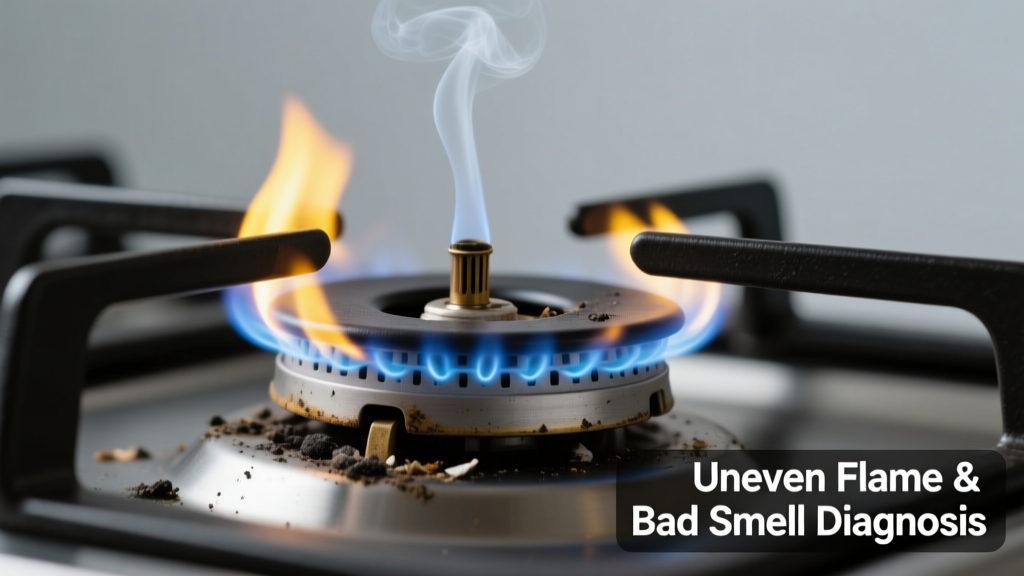
You turn the knob, hear the click—and instead of a steady blue ring of flame, you get sputtering yellow tips, lazy flickering, and that unmistakable acrid, sulfur-like stink—like rotten eggs or burnt plastic. It’s alarming, but not always an emergency. Most causes are fixable in under 20 minutes with basic tools.
Quick Checklist
- Does the smell happen only when the burner is lit—or also when it’s off?
- Is the flame mostly yellow or orange (not blue) at the tips?
- Do other burners behave the same way—or just this one?
- Did the issue start right after cleaning the cooktop or moving the stove?
- Can you hear a faint hissing sound near the burner base or gas line?
- Is there visible rust, corrosion, or white powder buildup around the burner cap or base?
Possible Causes
Clogged burner ports or misaligned cap
Confirm by removing the burner cap and inspecting the small gas outlet holes with a toothpick or needle—look for food debris, grease, or mineral deposits. Shine a flashlight: if holes are blocked or the cap sits crooked, airflow distorts and incomplete combustion creates yellow flames + odor. Severity: DIY-safe. Fix clogged burner ports.
Faulty or dirty gas valve or regulator
Test by turning the knob slowly: if flame surges unpredictably or won’t stay lit below medium, the valve may be gummed up or failing. A sticky knob or inconsistent response across all burners points here. Severity: Intermediate—cleaning possible, but replacement often needed. Clean or replace gas valve.
Gas leak at connection or flex line
Smell plus hissing + flame instability on multiple burners? Turn off gas immediately and apply soapy water to the supply line connections—if bubbles form, it’s leaking. According to the U.S. Consumer Product Safety Commission’s 2022 Gas Appliance Incident Report, 17% of stove-related CO incidents involved undetected flex line cracks or loose fittings. Severity: Call a licensed technician—do not attempt repair yourself.
What to Do First
- Turn off the burner and let it cool completely.
- Shut off the main gas valve behind the stove (usually a quarter-turn handle).
- Remove and soak the burner cap and grate in warm vinegar-water (1:1) for 15 minutes.
- Use a straight pin—not a paperclip—to gently clear each port hole; avoid enlarging them.
- Re-seat the cap firmly, aligning the notch with the igniter electrode.
What NOT to Do
- Don’t spray degreaser directly into burner ports—it can leave residue that burns and smells worse.
- Don’t ignore a persistent rotten-egg odor—even if flame looks normal. That smell means added mercaptan, signaling unburned gas.
- Don’t force a stuck control knob; it may shear internal valve parts and worsen leakage risk.
- Don’t use matches or lighters to test ignition—your stove’s spark igniter is calibrated for safe gas release timing.
Why does my stove burner smell like burning plastic only when I first turn it on?
This is usually residual manufacturing oil or protective coating burning off—a one-time event on new stoves or after deep cleaning. But if it repeats daily or lingers past 90 seconds, inspect the drip tray beneath the burner: melted plastic liners or warped foil can emit that odor when heated. Replace with a stainless steel tray for long-term safety.
Is a yellow flame always dangerous?
No—but it’s always inefficient and potentially hazardous. A healthy gas flame should be >90% blue with just faint blue tips. The U.S. EPA estimates that yellow-flame stoves emit up to 3× more carbon monoxide than properly adjusted ones (EPA Indoor Air Quality Guide, 2021). If yellow dominates the outer cone, combustion is incomplete—soot and CO build up faster.
Can a dirty igniter cause bad smells and uneven flames?
Not directly—but a cracked, coated, or mispositioned igniter prevents reliable sparking, leading to gas buildup before ignition. That excess gas then burns violently, creating popping sounds, orange flare-ups, and acrid smoke. Clean with isopropyl alcohol and a soft brush; realign so tip is 1/8" from burner base.
Why does only one burner smell—and only on high heat?
Likely port restriction or warped burner head. High heat increases gas velocity, amplifying turbulence through partial blockages. Check for dents or warping: hold the burner head against a flat surface—if light passes underneath, replace it. Burner head replacement guide.
My stove is electric—why does it smell bad and spark unevenly?
This symptom doesn’t apply to electric coil or induction stoves. If you’re seeing uneven heating or burning smells on an electric unit, you likely have a damaged coil element, cracked ceramic glass, or overheating wiring—different failure modes entirely. See our electric stove coil diagnosis page.
"Never assume a 'small' gas smell is harmless. In homes with poor ventilation, just 50 ppm of CO over 8 hours can trigger headaches and nausea—levels easily reached by a single malfunctioning burner." — National Fire Protection Association, Gas Cooking Safety Bulletin, 2023
| Flame Appearance | Most Likely Cause | Action Priority |
|---|---|---|
| Blue base + yellow tips | Mild air/gas mix imbalance or minor port clog | Low: Clean cap & reseat |
| Flickering orange throughout | Severe clog, wet burner, or regulator issue | Medium: Inspect valve & lines |
| Lifting off burner, roaring sound | Gas pressure too high or orifice oversized | High: Shut off gas; call pro |
| Intermittent flame + sulfur smell | Gas leak or failing valve seal | Emergency: Evacuate & call utility |
If the smell vanishes after cleaning and realigning—and flame stabilizes to steady blue—you’ve likely solved it. If not, or if you detect any hissing, dizziness, or nausea while troubleshooting, stop immediately and contact your local gas utility. Your safety isn’t worth saving 20 minutes.