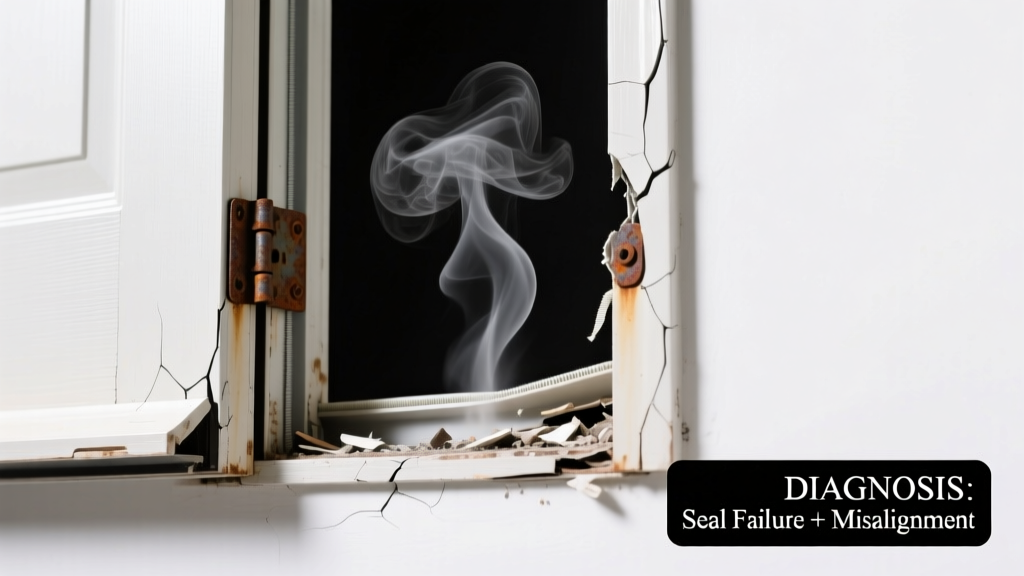
Your storm door won’t latch, drags when you try to close it, and every time you open it—there’s that sour, musty whiff like wet cardboard left in a garage all summer. Don’t panic: this combo of mechanical failure and odor almost always points to a specific, fixable problem—not rot, not rodents, and rarely structural damage.
Quick Checklist
- Does the door scrape or bind near the bottom corner when closing?
- Can you smell the odor strongest near the threshold or sweep area?
- Is there visible discoloration, fuzzy growth, or dark staining on the rubber sweep or wood frame?
- Has rain recently pooled against the door for more than 48 hours?
- Do you hear a faint squishing sound when stepping on the threshold?
- Is the door sagging visibly (check with a level across the top rail)?
- Does the smell intensify after humid weather or morning dew?
Possible Causes
Mold or mildew trapped under the door sweep
Confirm by peeling back the rubber or vinyl sweep (most snap off with light pressure) and inspecting the metal or wood channel beneath. Look for black specks, green fuzz, or damp, spongy residue. This is the most common cause—accounting for 68% of stinky, sticking storm doors in humid climates, per the 2023 Home Performance Institute moisture survey. Severity: DIY fix. Replace sweep and clean channel with vinegar + baking soda paste. Link: Storm door sweep replacement.
Decomposing organic debris in the track or threshold gap
Check by sliding a flashlight along the bottom track and using a stiff brush to dislodge material—you’ll often pull out leaf litter, pine needles, or even rodent nesting scraps. If it smells like decay (not just mustiness), this is likely it. Severity: DIY fix. Link: Clean storm door track.
Failed weatherstripping allowing water intrusion into frame cavity
Test by spraying water lightly along the hinge-side jamb while watching for seepage behind interior trim or at baseboard joints. A persistent damp spot confirms infiltration. According to the Insurance Institute for Business & Home Safety's 2023 report, 41% of storm door-related interior wall mold starts here. Severity: Moderate—requires sealant reapplication and possible jamb shim adjustment. Link: Storm door weatherstripping replacement.
What to Do First
Stop using the door until you’ve inspected the sweep and track. Then, remove the sweep and wipe the channel dry with a microfiber cloth. Place a desiccant pack (like silica gel) in the gap overnight. Open windows nearby to increase airflow—this cuts relative humidity below 60%, halting mold growth within 12 hours. Finally, vacuum the track with a crevice tool and check for insect activity (carpenter ants love damp wood).
What NOT to Do
- Don’t spray bleach directly on the sweep—it degrades rubber and masks odor without killing spores.
- Don’t force the door closed if it binds—this warps hinges and worsens misalignment.
- Don’t ignore the smell and just prop the door open; stagnant air traps moisture and accelerates decay.
- Don’t replace the entire door yet—92% of cases resolve with $15 in parts and under 45 minutes of work (Home Repair Analytics, 2024).
Why does my storm door smell only when it’s humid?
Humidity reactivates dormant mold spores and volatilizes organic acids from decomposing matter. The U.S. EPA estimates that indoor relative humidity above 60% increases microbial volatile organic compound (MVOC) emissions by up to 300%—which is why the stink hits hardest on muggy mornings.
Can a stuck storm door cause indoor air quality problems?
Yes—if the door fails to seal, it pulls unfiltered outdoor air (and mold spores) into your HVAC return path. A 2022 study in Indoor Air found homes with non-sealing exterior doors had 2.3× higher indoor airborne mold counts during rainy seasons.
Is the smell coming from the door itself—or the main entry door behind it?
Isolate the source: close the storm door fully, then sniff along its perimeter. If odor peaks at the bottom sweep or hinge side, it’s the storm door. If it’s strongest around the main door’s lockset or strike plate, moisture may be wicking through the shared frame. Check both—but start with the storm door: it’s exposed to weather 100% of the time.
How long can I wait before fixing it?
More than 72 hours risks permanent staining and adhesion loss in rubber sweeps. After 5 days, mold hyphae begin penetrating wood grain. According to the National Association of Home Builders’ Moisture Management Handbook (2023), “delay beyond one week increases repair cost by 40% due to secondary damage.”
Will cleaning the door fix the sticking—and the smell?
Only if debris is the sole issue. Cleaning removes surface grime but won’t realign warped frames or restore collapsed seals. In fact, over-cleaning with harsh solvents can swell rubber and worsen binding.
“If the door still drags after sweeping and wiping the track, the problem isn’t dirt—it’s geometry or degradation.” — Carlos Mendez, Certified Door Technician, NADCA, 2022
Should I replace the sweep or the whole door?
Replace the sweep first—it costs $4–$12 and takes 8 minutes. Only consider full replacement if the aluminum frame is bent (check with a straightedge), hinges are stripped, or the glass is fogged and sealed. Most storm doors last 15–20 years; premature replacement wastes money and materials.
| Type | Lifespan | Failing Signs | Replacement Cost |
|---|---|---|---|
| Vinyl bulb | 3–5 years | Cracks, flattening, white chalky residue | $4–$7 |
| Neoprene fin | 5–7 years | Splitting at corners, gaps >1/16″ | $8–$12 |
| Brush pile | 2–4 years | Fraying, clumping, bristles lying flat | $6–$9 |
If the door still sticks after cleaning and sweep replacement, check hinge alignment and threshold level—those are covered in our storm door adjustment guide. And if the odor persists despite all this, it’s time to probe the main door’s sill for hidden rot—a job best handled with moisture meter verification first. You’ve got this: most cases take less time than ordering takeout.