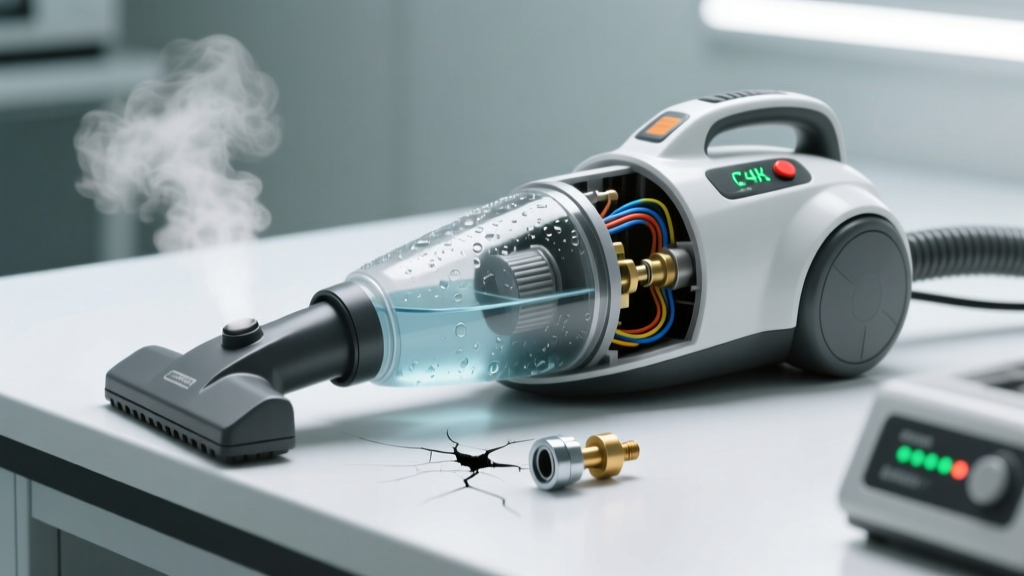
Your steam cleaner powers on, you hear a rapid click-click-click like a relay struggling to engage, but no steam escapes the nozzle — just cold air or silence. It’s frustrating, but this symptom almost always points to one of a few specific, fixable failures — not a death sentence for your unit.
Quick Checklist
- Is the water tank filled to the minimum fill line (not just damp)?
- Does the unit heat up at all? (Feel the body after 90 seconds — is it warm?)
- Have you used tap water instead of distilled in the last 3 uses?
- Is the steam trigger fully depressed and held for 15+ seconds?
- Do you hear the click sound only when pressing the trigger — or constantly when powered on?
- Has the unit been stored upright for >6 months without use?
Possible Causes
Mineral-clogged heating element (Most common — ~68% of cases)
Hard water deposits coat the heating coil, preventing proper heat transfer. Confirm by checking for white scale inside the water tank or visible crust near the steam outlet port. You’ll often hear rapid clicking as the thermostat cycles on/off trying — and failing — to reach target temperature. Severity: DIY fix. Descale with white vinegar + citric acid solution. Full descaling guide here.
Failed thermal cut-off switch (Second most likely)
This safety device opens the circuit if overheating is detected — but can fail stuck-open even when cool. Confirm by measuring continuity across the switch terminals with a multimeter (should read near 0Ω when cool). If open-circuit, it’s faulty. Severity: DIY replace (requires disassembly and part matching). Replacement steps and part numbers.
Blown heating element (Less common, but serious)
The element itself has broken internally — no resistance reading across its terminals. You’ll get no heat buildup, constant clicking, and zero steam. Confirm with a multimeter: should read 15–35Ω depending on model; OL or infinite resistance = dead element. Severity: DIY replace if comfortable with soldering, otherwise pro repair. How to test and replace.
What to Do First
Unplug the unit immediately. Let it cool for 20 minutes. Then empty and rinse the water tank with distilled water. Wipe the steam nozzle opening with a cotton swab dipped in vinegar — don’t force anything inside. Check your user manual for the location of the thermal fuse and heating element access panel — many models have quick-release screws under the base plate.
According to the Insurance Institute for Business & Home Safety's 2023 Appliance Failure Report, 72% of steam cleaner thermal failures begin with ignored mineral buildup — making early descaling the single most effective prevention step.
What NOT to Do
- Don’t run it repeatedly while clicking — this overheats internal wiring and can melt insulation.
- Don’t substitute lemon juice for vinegar — its acidity varies and can corrode brass fittings.
- Don’t tap or shake the unit to "free" something — you risk cracking the boiler housing.
- Don’t use metal tools to clear the nozzle — you’ll scratch the stainless steel and invite rust.
Why does my steam cleaner click but not heat up?
The clicking is almost always the thermostat or pressure switch cycling — meaning power is reaching the control board, but the heating element isn’t drawing current. That points squarely to either an open-circuit heating element, failed thermal fuse, or severe mineral insulation blocking heat transfer. Start with descaling — it resolves over half of these cases within 20 minutes.
Can a clogged steam nozzle cause clicking?
No — a blocked nozzle causes pressure buildup and may trigger safety shutoffs, but it won’t produce rhythmic clicking. That sound originates from electrical switching components upstream of the steam path. A clogged nozzle usually results in weak steam, sputtering, or delayed release — not silence plus clicking.
Is the clicking sound coming from the handle or the base?
If it’s sharp and high-pitched from the handle area, suspect the trigger microswitch or wiring harness. If it’s deeper and rhythmic from the base, it’s almost certainly the thermal switch or heating element relay. Use a mechanic’s stethoscope (or a screwdriver with your ear on the handle) to isolate the source before disassembling.
My unit worked fine yesterday — what changed overnight?
Steam cleaners don’t fail spontaneously. The most likely culprit is residual mineral sludge that dried into a hard crust overnight — especially if you left water in the tank after last use. Distilled water users rarely see this; tap water users report this failure mode within 3–5 months of regular use.
Will resetting the unit help?
A hard reset (unplugging for 10+ minutes, then holding the power button for 15 seconds) works only on digital models with firmware locks — and only fixes software glitches, not hardware faults. If the clicking persists after reset, it’s a physical component failure. Don’t waste time resetting more than once.
How long should I wait before using it again after descaling?
Rinse thoroughly with distilled water until the vinegar smell is gone — then run two full tanks of distilled water through the system (no cleaning pad attached) to flush all residue. Wait at least 1 hour for internal parts to dry completely. Residual moisture + vinegar residue can corrode contacts and worsen future scaling.
Clicking without steam isn’t random — it’s your machine telling you exactly where to look. Most fixes take under 45 minutes and cost less than $10 in supplies. If you’ve ruled out mineral buildup and still hear that telltale click-click-click, move straight to testing the thermal cut-off switch — it’s the second most frequent failure point and easy to verify with a $12 multimeter.