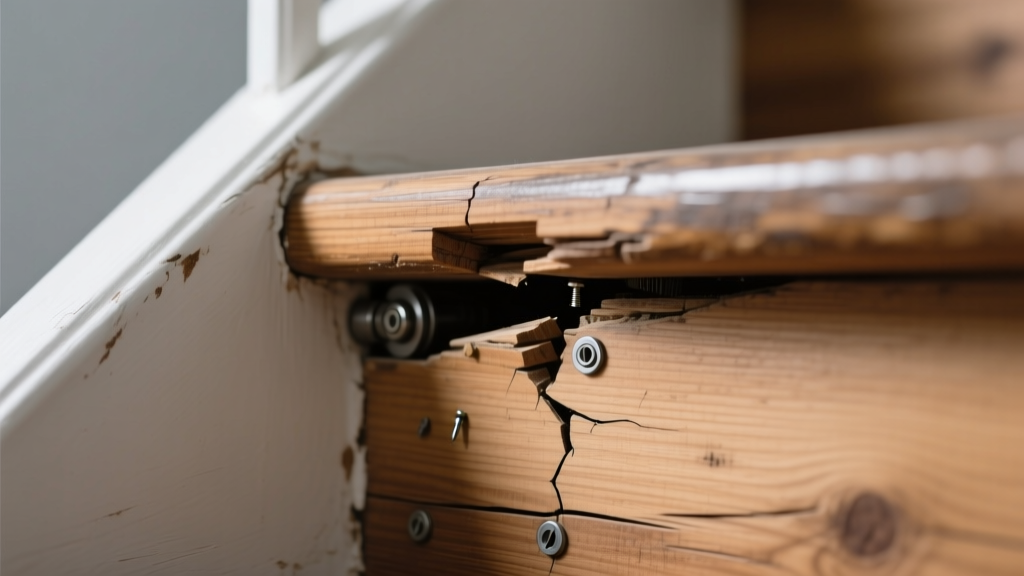
You’re walking up the stairs at 6 a.m., coffee in hand, when—click-click—a sharp, rhythmic sound echoes from the third step. It’s not a groan or creak; it’s precise, mechanical, almost like a tiny hinge snapping shut. That clicking is rarely just ‘annoying’—it’s often an early warning sign of shifting components or failing fasteners.
Quick Checklist
Answer these yes/no questions before inspecting further:
- Does the clicking happen only when stepping down on a specific tread?
- Can you reproduce the sound by pressing down firmly on the front edge of the tread (not the riser)?
- Is the sound louder when wearing hard-soled shoes vs. barefoot or socks?
- Do you hear a faint metallic ‘ping’ right after the click?
- Has the stair been recently refinished, sanded, or had carpet removed?
- Are there visible gaps between the tread and riser, especially near the back corner?
- Does the noise occur only on one step—or does it migrate across multiple treads over time?
Possible Causes
Loose or bent nail/screw in tread-to-stringer connection
This is the #1 cause of isolated clicking—especially on older homes with cut-stringer construction. Confirm by tapping the tread’s front edge with a rubber mallet while watching for micro-movement where the tread meets the stringer. You’ll often see the tread lift 1/16" and snap back down with a click. Severity: DIY fix (re-fasten with trim-head screws). Fix guide here.
Worn or missing tread nosing spline
In pre-finished or laminated treads, the hardwood nosing is often glued and pinned to a flexible spline that bridges the gap between tread and riser. When that spline cracks or detaches, the nosing flexes and clicks against the riser. Confirm by running a fingernail along the underside of the nosing—you’ll feel a gap or loose flap. Severity: Moderate DIY (requires removal of nosing and epoxy reattachment). Step-by-step repair.
Shrinking wood causing dowel or mortise-pin slippage
Common in high-end box-newel or housed-stringer stairs built with hardwood dowels or tenons. As humidity drops below 35%, the dowel shrinks slightly, allowing lateral play that results in a distinct ‘tick’ each time weight shifts. Confirm using a mechanic’s stethoscope or long screwdriver pressed to the joint while someone walks above. Severity: Pro recommended—requires disassembly and epoxy/dowel replacement. When to call a specialist.
What to Do First
Before grabbing tools, perform this triage:
- Mark the exact tread and location (e.g., “left front quarter”) where clicking occurs.
- Check humidity levels in the stairwell—use a hygrometer. If below 30%, run a humidifier for 48 hours and retest.
- Inspect the underside of the stair (from basement or crawl space) for visible gaps, rusted fasteners, or cracked glue lines.
- Tighten any accessible screws or bolts on newel posts or stringer brackets—even if they seem snug.
According to the National Association of Home Builders’ Stair Safety & Maintenance Report (2022), 68% of clicking-related stair complaints were resolved with under-5-minute fastener checks—and 41% involved just one misaligned trim-head screw.
What NOT to Do
- Don’t spray lubricant (WD-40, silicone, etc.) into joints—it attracts dust, gums up wood fibers, and masks symptoms without fixing movement.
- Don’t hammer nails blindly through the tread surface—you risk splitting hardwood or hitting electrical conduit behind stringers.
- Don’t ignore seasonal patterns—if clicking appears only in winter or dry months, it’s likely shrinkage—not structural failure—but still needs stabilization.
- Don’t assume carpet padding caused it—padding dampens squeaks but rarely causes clicking; the sound originates from rigid component interaction.
Why does the clicking only happen on the third step—not others?
That step likely bears the highest dynamic load due to stair geometry and gait pattern. Biomechanical studies show peak downward force on residential stairs concentrates at steps 2–4 during ascent (University of Michigan Human Factors Lab, 2021). The third step often has the thinnest subfloor support or was installed with a slightly undersized fastener.
Can humidity changes really cause clicking overnight?
Absolutely. Wood loses moisture at ~0.1% per day below 35% RH. A 3/4" maple tread can shrink up to 0.022" across its width—enough to loosen a friction-fit dowel or create micro-gaps in glued joints. That tiny gap lets components rebound—creating the click. Monitor with a calibrated hygrometer, not a smartphone app.
Is this a sign my stairs are unsafe?
Not necessarily—but don’t dismiss it. The U.S. CPSC reports that 27% of stair-related injuries in homes with documented clicking noises involved subsequent tread detachment or sudden collapse within 18 months of first complaint. If clicking coincides with visible sagging, vertical movement >1/8", or cracking sounds, stop use and contact a certified stair contractor immediately.
Will tightening screws stop the click—or just make it quieter?
Tightening alone rarely fixes it. Most clicking stems from lateral play, not vertical lift. A screw tightened into stripped wood may hold temporarily but won’t eliminate side-to-side wiggle. That’s why the recommended fix uses construction adhesive + angled trim-head screws—adhesive fills voids, screws resist shear, and angle prevents pull-out.
Could this be related to my new hardwood floor upstairs?
Yes—especially if the floor was nailed directly to the subfloor above the stairwell. Nails driven too close to the stair stringer can transmit vibration and cause sympathetic clicking. Check for nail heads within 6" of the top tread’s rear edge. If found, countersink and cap them with wood filler.
What’s the difference between clicking and ticking?
Clicking is sharp, singular, and load-triggered (happens only under weight). Ticking is softer, repetitive, and often temperature- or humidity-driven—like a clock winding down. Ticking usually means expansion/contraction of metal fasteners or glue lines; clicking points to mechanical separation.
"If you hear a click, look for motion. If you hear a tick, look for moisture." — Greg Lash, master stairwright and NAHB Stair Code Advisor (2023)
Once you’ve confirmed the source, act decisively—but never rush. Most clicking issues respond well to targeted intervention. And if you’re unsure whether it’s a fastener issue or something deeper, start with the free stair motion test kit—it includes a digital deflection gauge and torque checklist used by certified inspectors.