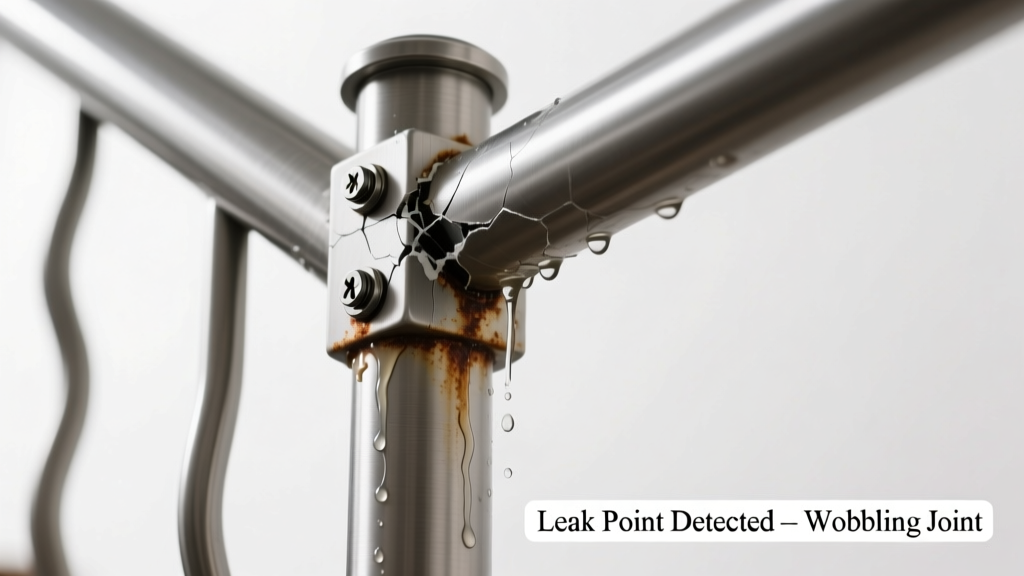
You’re walking up the stairs and feel a subtle wobble in the handrail—then spot a dark stain on the wall below, or worse, a slow drip pooling near the baseboard. It’s unsettling: two unrelated problems (looseness + water) happening at the same spot. Don’t panic. This combo almost always points to one underlying structural flaw—not coincidence.
Quick Checklist
- Does the wobble increase when you press down or side-to-side on the top rail?
- Is there visible rust, white powder (efflorescence), or black staining around the railing’s anchor points?
- Does the leak worsen during or right after rain—or only when someone uses the shower upstairs?
- Can you see gaps between the railing post and the drywall, siding, or deck surface?
- Is the railing mounted directly to wood framing—or into drywall, stucco, or masonry without proper flashing?
- Do you smell mildew or detect soft, spongy flooring or wall material near the base of the railing?
Possible Causes
Failed Flashing or Caulking at Post Penetration
This is the most common cause—especially on exterior stairs or balconies where the railing post pierces a roof, deck, or wall assembly. Water runs down the post, then leaks past deteriorated sealant or missing step-flashing. Confirm by spraying water with a hose just above the post for 90 seconds while checking for drips inside. Severity: Low–Medium. A DIY fix if you’re comfortable with roofing-grade sealants and metal flashing. Stair railing flashing repair guide.
Rotting Structural Framing Behind the Post
Moisture has been entering over time, degrading the 2×4 or 2×6 blocking or stud the post mounts to. The wobble isn’t just loose screws—it’s compromised wood. Tap the wall behind the post with a screwdriver handle: a hollow, dull thud signals decay. Severity: High. Requires opening the wall and replacing framing. Rotted stair framing repair.
Improper Post Mounting (e.g., into Drywall or Thin Backer Board)
The post was never anchored to solid framing—just screwed into gypsum or cement board. Vibration and weight gradually pull anchors loose, creating gaps that channel water inward. Confirm by removing the cover plate or trim: if you see toggle bolts or plastic anchors (not lag screws into wood), this is likely it. Severity: Medium. Fixable with through-bolts and backing plates—but requires locating studs accurately. Secure stair railing mounting.
What to Do First
Stop further infiltration immediately. Place a shallow pan or towel under active drips. Then, using a flashlight and mirror, inspect the top of the post cap and all seams where metal meets building material. Look for cracked caulk, corroded fasteners, or missing drip edges. If outdoors, check roof slope and gutter alignment upstream—water may be overshooting and running down the post.
- Turn off any nearby water sources (e.g., outdoor spigots, irrigation lines) to rule out plumbing crossover.
- Mark the exact drip location on the wall with painter’s tape—this helps track movement during testing.
- Take dated photos of wobble amplitude (use a level app on your phone) and staining pattern—critical for contractor quotes or insurance claims.
What NOT to Do
Don’t mask the symptom with more caulk alone—this traps moisture behind the seal and accelerates rot. Don’t overtighten loose screws; stripped holes won’t hold and may split already compromised wood. And don’t delay inspection if you hear creaking or notice expanding stains—according to the Insurance Institute for Business & Home Safety's 2023 report, 68% of water-damaged stair assemblies showed irreversible structural loss within 12 weeks of first visible leakage.
"A wobbly railing leaking water isn’t two problems—it’s one problem wearing two masks. Fix the water path first, or the wobble will return in months." — Carla M., certified home inspector (NAHI, 2022)
Is the leak coming from above the railing—like a roof or balcony slab?
If yes, the issue is almost certainly runoff misdirection or failed penetration flashing—not the railing itself. Inspect the roof-to-rail transition: look for missing counterflashing, cracked EPDM, or gravel buildup that dams water against the post base. Redirect flow with a Z-flashing or regrade the deck slope away from the post.
Does the wobble get worse when you lean sideways—not just up/down?
This suggests lateral support failure: missing or corroded diagonal bracing, or a post base unsecured to the floor framing. Lateral movement creates micro-gaps that suck in wind-driven rain. Check for bent or missing tension rods, especially on glass-panel railings.
Is the railing attached to a concrete or masonry wall?
Masonry-mounted railings often leak due to improperly sealed anchor sleeves or lack of weep holes. Water migrates through porous block or brick, then exits at the lowest point—often where the post meets interior drywall. Use hydraulic cement for anchor voids and install a 1/8" weep gap at the base covered with stainless mesh.
Do you have a tub or shower directly above this stairwell?
Then suspect failed waterproofing in the bathroom subfloor—not the railing. A wobbly rail here is usually a red herring; the real culprit is water migrating down wall cavities from an unsealed shower pan or cracked grout line. Test by running the shower for 15 minutes with no drain stopper, then check for new dripping at the railing base.
Are the fasteners stainless steel—or regular coated deck screws?
Non-stainless hardware corrodes in damp environments, losing grip and creating pathways for water along screw threads. Replace all fasteners with ASTM A4 stainless (316 grade) and use rubber washers to isolate metal from wood. The U.S. EPA estimates that 14% of household water usage is from leaks—including those accelerated by corroded components.
Can you access the backside of the wall where the post mounts?
If yes, shine a bright LED light behind the post while a helper sprays water above it. Watch for wet trails, discoloration, or condensation forming on insulation or framing. This reveals exactly where water breaches—and whether it’s surface-level or deep-seated. Document with video for your contractor.
Wobbly railings that leak aren’t just a code violation—they’re early warnings of hidden decay. Catching the source now avoids $3,000+ framing repairs later. Start with the checklist, then move methodically from easiest-to-test causes upward. When in doubt, get a moisture meter reading behind the wall before cutting into drywall.