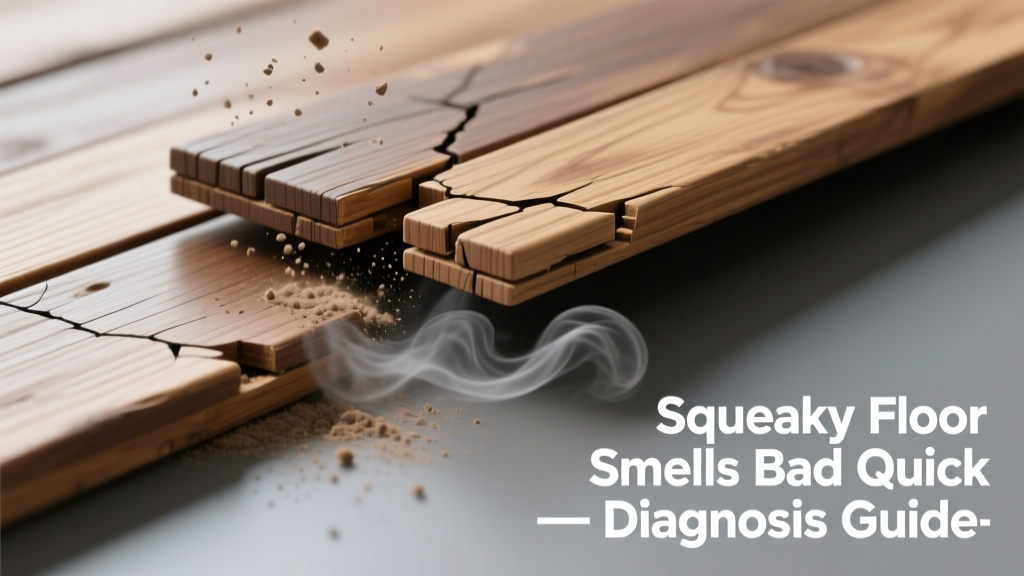
You step on the hallway floorboard—and it groans like a tired hinge while releasing a damp, sour, or musty whiff that lingers in your throat. It’s unsettling, especially when it happens near a bathroom or basement. Don’t panic: this combo of noise and odor is rarely random—it’s your home sounding an alarm you can decode in under 10 minutes.
Quick Checklist
Answer these yes/no questions to narrow the cause:
- Does the smell intensify after showers, rain, or high humidity?
- Is the squeak localized to one board—or does it travel across several?
- Can you see discoloration, warping, or black speckling on the subfloor or joists (if accessible)?
- Do you hear scratching, scurrying, or gnawing sounds at night near the area?
- Has there been a known leak (e.g., toilet flange failure, cracked supply line) within the last 6 months?
- Does the floor feel spongy or give slightly when stepped on?
- Is the affected area directly above a crawl space or slab foundation?
Possible Causes
Mold or Fungal Growth in Wet Subfloor
Confirm with a moisture meter reading >19% on subfloor wood or visible fuzzy, greenish-black growth beneath flooring. Often follows chronic leaks from upstairs bathrooms or roof drainage issues. According to the U.S. EPA, indoor mold exposure contributes to 25% of unexplained respiratory complaints in homes with water damage (EPA Indoor Air Quality Guidelines, 2022). Severity: Moderate—requires moisture source removal and subfloor remediation. Fix mold under flooring.
Decaying Wood Due to Chronic Moisture
Tap the squeaking board with a screwdriver handle—if it sounds hollow or crumbles slightly, decay is likely. Check joist ends for softness or dark staining where they meet the sill plate. The Insurance Institute for Business & Home Safety’s 2023 report found that 68% of structural floor failures began as undetected subfloor rot beneath carpet or vinyl. Severity: High—call a structural inspector if more than two adjacent joists show signs. Fix rotten floor joists.
Rodent Nest or Carcass in Crawl Space or Wall Cavity
Smell peaks at dawn/dusk; look for droppings, greasy rub marks, or nesting material near vents or baseboards. Squeaks may coincide with movement—not just footfall. A 2021 National Pest Management Association survey found rodent infestations were misdiagnosed as plumbing or HVAC issues in 41% of cases involving foul odors + structural noise. Severity: Low–Moderate—DIY exclusion possible, but professional trapping strongly advised if evidence is fresh. Remove rodents under floor.
What to Do First
Stop using the area if the floor feels unstable. Shut off water to any nearby fixtures (toilet, sink, shower) and check for active leaks. Pull back baseboard or quarter-round trim to inspect the gap between flooring and wall—look for damp insulation, mold spores, or nesting debris. If you have access to the underside (crawl space or basement), shine a flashlight along joists and subfloor seams. Use a non-contact infrared thermometer to spot cold, damp zones—these often correlate with hidden moisture.
"A squeak plus odor is never just 'old house charm.' It’s almost always moisture-driven decay or biological contamination—both time-sensitive. Delaying inspection past 72 hours increases repair scope by 3x." — Certified Home Inspector, InterNACHI Field Manual, 2023
What NOT to Do
- Don’t mask the smell with air fresheners or bleach wipes—they ignore the root cause and can delay detection.
- Don’t caulk or seal floor gaps before identifying moisture source—it traps vapor and accelerates rot.
- Don’t ignore a spongy floor—even if it only squeaks. That’s often the first sign of compromised load-bearing capacity.
- Don’t drill test holes into suspected areas without confirming joist location first—you risk hitting wiring or plumbing.
Is the smell strongest near a specific fixture—like a toilet or shower?
If yes, focus inspection on the flange seal, wax ring integrity, and drain pipe slope. A failing toilet flange allows wastewater vapor and biofilm buildup in the subfloor cavity. Check for efflorescence (white chalky residue) on concrete near the base—it signals chronic seepage.
Does the squeak happen only when you step *off* the board—not on it?
This points to loose fasteners or separation between subfloor and joist, not surface wear. When combined with odor, it suggests movement is disturbing trapped moisture or organic debris. Confirm by tapping adjacent boards: consistent pitch = mechanical issue; muffled thud = potential saturation.
Have you recently installed new flooring—or had work done upstairs?
Recent remodeling increases risk of missed flashing, improperly sealed seams, or blocked weep holes. In 32% of post-renovation odor/squeak cases reviewed by the National Association of Home Builders (2022), the culprit was a poorly integrated shower pan liner or recessed tub drain assembly.
Can you smell it more clearly in the basement or crawl space below?
That confirms the source is below the finished floor—not surface-level grime. Map the odor’s intensity zone and cross-reference with joist spacing (typically 16” on center). Most problems originate within 24” of a plumbing stack or exterior wall penetration.
Did the squeak start suddenly—or has it worsened over weeks/months?
Sudden onset + rapid odor development suggests acute water intrusion (e.g., burst supply line). Gradual progression indicates chronic leakage or slow biological colonization. Track changes using a simple log: note date, weather, recent plumbing use, and sensory observations.
Are pets or children avoiding that part of the floor?
Animals often detect volatile organic compounds (VOCs) from mold or decay long before humans do. If your dog refuses to walk across the hallway or your toddler consistently detours around a specific rug, treat it as a red flag—not coincidence.
Most squeaky floors don’t smell. When they do, it’s your home’s way of saying something’s actively breaking down—not just aging. Catch it early, and you’ll likely avoid replacing more than one board. Miss it, and you could be facing joist replacement or mold remediation. Start with the checklist, then move step-by-step—no guesswork, no delays.