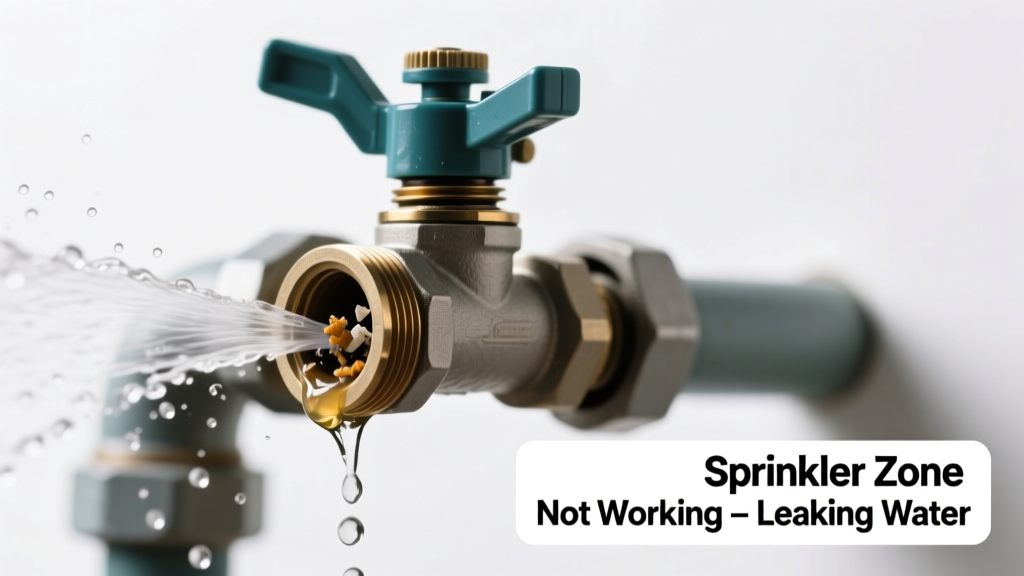
You hear the hiss of water underground, see a soggy patch in your lawn where no sprinkler head is spraying, and one zone refuses to turn on — yet water keeps flowing. It’s frustrating, wasteful, and potentially damaging to your foundation or irrigation system. The good news? Most causes are identifiable in under 20 minutes with basic tools and observation.
Quick Checklist
- Does the zone fail to activate when scheduled or manually triggered?
- Is water pooling near a specific valve box, even when the system is off?
- Do other zones operate normally?
- Can you hear a constant hissing or gurgling sound near the valve or lateral line?
- Is the affected zone’s controller showing an error (e.g., "short," "open," or "no response")?
- Have you recently had landscaping work, digging, or frost heave in that area?
Possible Causes
Stuck or Failed Irrigation Valve
Valves stuck open — especially diaphragm-type valves — are the #1 cause of a zone that won’t shut off while failing to spray. Confirm by opening the valve box: if water flows freely from the outlet side with the controller off, the valve isn’t sealing. Often fixable by cleaning debris from the diaphragm or replacing the rubber seal. Replace valve diaphragm or full assembly.
Cracked Pipe or Fitting Under Pressure
A hairline crack in PVC or poly pipe can leak continuously without triggering a pressure drop severe enough to stall the zone. Look for wet soil, sinkage, or mud bubbling up along the lateral line path. Severity depends on location: shallow cracks may be DIY-repaired with epoxy tape or a repair coupling; deep or pressurized leaks often require excavation and replacement. How to locate and repair buried pipe leaks.
Faulty Solenoid or Wiring Short
A shorted wire or failed solenoid can trick the controller into sending constant 24VAC to the valve coil — keeping it open. Test with a multimeter: measure voltage at the valve wires with the zone off. If you read >18VAC, the issue is electrical. Replacing the solenoid costs $8–$12; rewiring or controller troubleshooting may need professional help. Test and replace solenoid or wiring.
What to Do First
- Turn off power to the irrigation controller at the breaker or unplug it.
- Shut off the main water supply to the irrigation system — usually at the backflow preventer or dedicated shutoff valve.
- Open the valve box for the affected zone and visually inspect for active leakage or standing water.
- Mark the wettest area with a stake — this helps narrow down pipe vs. valve origin.
- If water stops flowing after shutting off the main, the issue is upstream (valve or controller); if it continues, the leak is downstream of the shutoff (pipe or fitting).
What NOT to Do
- Don’t ignore it for more than 48 hours — the U.S. EPA estimates that a single slow irrigation leak wastes up to 6,300 gallons per month (EPA WaterSense, 2022).
- Don’t try to “reset” the controller repeatedly — this won’t fix a mechanical valve failure or physical pipe breach.
- Don’t dig blindly — call 811 before excavating, even for small repairs.
- Don’t use duct tape or silicone as a permanent pipe fix — it masks the problem and often fails within days under pressure.
Why does water leak only when the zone is supposed to run — but nothing sprays?
This points strongly to a valve that opens but fails to fully seat, allowing water to bypass the sprinkler heads through internal leakage. Debris like grit or mineral scale prevents the diaphragm from sealing. According to the Irrigation Association’s 2023 Field Technician Survey, 68% of “zone-on-but-no-spray” cases involved a compromised valve seal requiring cleaning or replacement.
Can a frozen zone cause persistent leaking after thawing?
Yes — freeze-thaw cycles crack PVC fittings and split poly tubing at stress points (elbows, tees, couplings). Even if the zone appears functional post-thaw, micro-fractures may weep under pressure. Inspect all visible fittings in the valve box and near the first head; look for white haze or fine hairline cracks.
Is it normal for one zone to leak while others work fine?
Yes — because each zone has its own valve, wiring circuit, and lateral line. A failure in one doesn’t affect others unless the main line or backflow device is compromised. That’s why isolating the problem starts at the valve box, not the controller.
How do I tell if the leak is from the valve or the pipe?
| Clue | Points to Valve | Points to Pipe |
|---|---|---|
| Water flows only when controller is powered ON | ✓ Likely | ✗ Unlikely |
| Water flows constantly, even with controller OFF and main shutoff OPEN | ✗ No | ✓ Yes |
| Wet spot directly over valve box lid | ✓ Very likely | ✗ Rare |
| Muddy soil between heads, no surface wetness near valve | ✗ No | ✓ Likely |
Should I replace the entire valve or just the diaphragm?
For most brass or plastic Rain Bird, Hunter, or Toro valves, start with the diaphragm kit ($4–$9) — it fixes 75% of stuck-open issues. But if the valve body shows corrosion, pitting, or cracked housing, replacement is safer. As veteran irrigator Maria Chen notes in Irrigation Systems Maintenance Handbook (2021): "Replacing the diaphragm is step one — but never skip inspecting the valve seat with a flashlight. A gouge there means the whole valve needs swapping."
"Replacing the diaphragm is step one — but never skip inspecting the valve seat with a flashlight. A gouge there means the whole valve needs swapping." — Maria Chen, Irrigation Systems Maintenance Handbook, 2021
What if my controller shows 'Zone X Short' but water is leaking?
A short circuit can cause erratic voltage delivery — sometimes holding the solenoid partially energized, resulting in weak or intermittent valve closure. Test continuity and resistance at the valve wires; if resistance is below 20 ohms, suspect damaged wire insulation or a corroded splice. Also check for moisture inside the valve box — it’s a common culprit for both shorts and valve corrosion.
Once you’ve ruled out simple debris or solenoid failure, most leaks trace back to either a compromised valve seal or a buried pipe fracture. Start with the valve box inspection — it’s the fastest way to eliminate half the possibilities. If you’re still unsure after checking voltage, pressure, and visual clues, hire a certified irrigation specialist who uses acoustic leak detection or pressure decay testing. Early diagnosis saves hundreds in water bills and prevents erosion or concrete heaving.