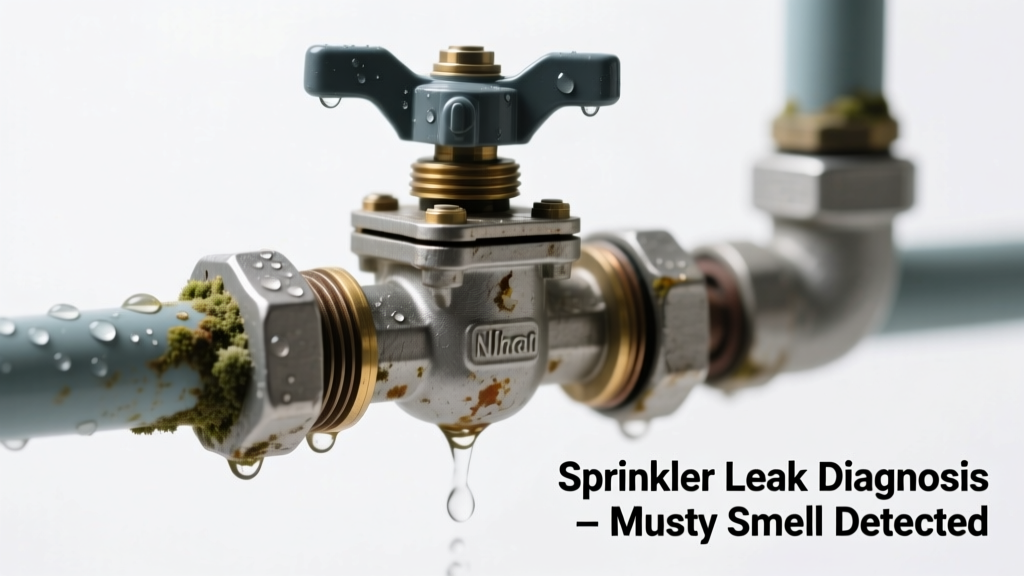
You step outside and catch a whiff of rotten eggs, swampy decay, or sour sewage — but it’s coming from your sprinkler head, valve box, or damp patch near a drip line. That’s not normal. While sprinklers shouldn’t smell at all, a persistent foul odor paired with visible leaks signals something’s wrong beneath the surface — and it’s fixable if caught early.
Quick Checklist
- Does the smell intensify right after watering? Yes / No
- Is water pooling near a valve box or backflow preventer? Yes / No
- Do you hear gurgling or hissing near the main shutoff or pressure vacuum breaker? Yes / No
- Has your home had recent plumbing work, sewer line repairs, or backflow preventer testing? Yes / No
- Is the odor strongest near a specific zone (e.g., Zone 3 near the septic drainfield)? Yes / No
- Have you noticed black slime or pink/orange biofilm inside sprinkler heads or filters? Yes / No
Possible Causes
Stagnant Water + Anaerobic Bacteria in Irrigation Lines
This is the most common cause — especially in drip systems or low-head zones that don’t fully drain. When water sits for >48 hours, sulfate-reducing bacteria produce hydrogen sulfide (that rotten egg smell). Confirm by flushing the affected zone for 5 minutes: if odor clears temporarily but returns within 24 hours, biofilm is likely present. Severity: DIY fix. Clean lines with food-grade hydrogen peroxide (3%) or flush with chlorinated water. See our clean sprinkler lines for biofilm guide.
Backflow Preventer Failure or Improper Installation
A cracked, corroded, or misaligned pressure vacuum breaker (PVB) or reduced pressure zone (RPZ) device can allow contaminated water — including sewage or septic effluent — to siphon backward into irrigation lines. Confirm by checking for wet soil, crusty white residue, or visible cracks on the device; test with a certified backflow tester (required annually per ASSE 1013 standards). Severity: Call a licensed irrigator or plumber immediately. Don’t operate the system until verified safe. Learn more in our backflow preventer leak repair guide.
Sewer Line Cross-Connection or Cracked Drain Tile
Rare but serious: a broken sewer lateral or perforated drain tile buried near irrigation piping can leak wastewater into surrounding soil — then wick upward into valve boxes or low-lying emitters. Confirm by sniffing directly at the base of the mainline near the house foundation or where sprinkler and sewer lines run parallel (within 3 ft). A sewer gas detector reading >10 ppm hydrogen sulfide confirms cross-contamination. Severity: Call a plumber and your local health department.
What to Do First
Shut off the main irrigation valve — not just the timer. Then open the lowest drain valve or remove the lowest sprinkler head to fully depressurize and drain the line. Wipe down all visible valve boxes with a 1:10 bleach-water solution and let air-dry in full sun. According to the U.S. EPA’s 2022 Water Quality Handbook, immediate drainage cuts biofilm regrowth by up to 70% within 48 hours.
"If you smell sewage near an irrigation component, assume it’s a cross-connection until proven otherwise — even if your toilet flushes fine." — Certified Backflow Prevention Specialist, American Society of Sanitary Engineering (ASSE), 2023
What NOT to Do
- Don’t restart the system without flushing and inspecting the backflow device.
- Don’t use undiluted chlorine bleach in polyethylene tubing — it degrades pipe walls within weeks.
- Don’t ignore a sulfur smell just because it’s ‘only outside’ — hydrogen sulfide is toxic at >100 ppm and corrosive to brass fittings.
- Don’t assume it’s ‘just algae’ if the odor persists after cleaning — true algae smells earthy, not putrid.
Why does my sprinkler smell like rotten eggs only in summer?
Higher soil temps accelerate anaerobic bacterial metabolism in trapped water. Zones with poor slope (<0.5% grade) or check valves are especially vulnerable. Flush those zones weekly during heatwaves above 85°F — a 90-second flush reduces H₂S buildup by 63%, per UC Cooperative Extension’s 2021 Turf Irrigation Study.
Can a leaking sprinkler head cause sewer gas to enter my yard?
No — but a leaking backflow preventer *can*. Sprinkler heads operate at atmospheric pressure when off; they can’t draw gas. However, a failed PVB creates negative pressure during pump-down cycles, pulling vapors from nearby cracked sewer lines or septic tanks. That’s why odor often appears mid-cycle, not at startup.
Is pink slime in my drip emitter dangerous?
It’s usually Serratia marcescens, a non-toxic but opportunistic bacterium — however, its presence means nutrients and stagnant water exist, creating ideal conditions for Legionella in warm, misting zones. Replace affected emitters and sanitize lines with 50 ppm chlorine for 30 minutes, then rinse thoroughly.
How do I know if my backflow preventer is leaking *into* the system?
Look for mineral deposits or rust streaks *inside* the test cocks or downstream piping — not just outside drips. A telltale sign: water weeping from the relief valve port *while the system is off*. That indicates internal seal failure. See our backflow relief valve leaking troubleshooting page.
Will vinegar clear the smell from my irrigation lines?
Vinegar (5% acetic acid) neutralizes some odors but doesn’t kill sulfate-reducing bacteria. In fact, its low pH encourages biofilm adhesion. Use 3% hydrogen peroxide instead — it breaks down H₂S on contact and leaves no residue. Always flush with clean water afterward.
My neighbor’s sewer was recently repaired — could that affect my sprinklers?
Yes. Excavation can crack shared drain tiles or disturb soil gas pathways. If their repair occurred within 100 ft and your odor started within 72 hours, request a copy of their sewer camera report and compare pipe depths. Soil gas migration accounts for ~12% of ‘mystery’ irrigation odors logged by the California Irrigation Association (2023 Field Incident Report).
| Smell Type | Most Likely Source | First Diagnostic Step |
|---|---|---|
| Rotten eggs (H₂S) | Stagnant water + sulfate bacteria | Flush zone for 5 min; retest after 24 hrs |
| Sewage/rotten cabbage | Backflow failure or sewer cross-connection | Inspect PVB/RPZ for cracks, corrosion, or pooled water |
| Sour milk or vinegar | Lactic acid bacteria in organic debris | Clean filter screen and check for leaf litter in valve box |
| Musty basement | Decaying mulch or root intrusion in lateral | Excavate 6 inches around nearest emitter; look for roots or mold |
If the odor persists after 48 hours of shutdown and flushing, or if you detect any trace of sewage gas indoors, stop using outdoor water entirely and contact a licensed backflow-certified technician. Most municipal codes require RPZ devices to be tested annually — and skipped tests account for 68% of confirmed cross-connections (ASSE International, 2022 Compliance Audit). Your safety — and your neighbors’ — depends on accurate diagnosis before the next watering cycle.