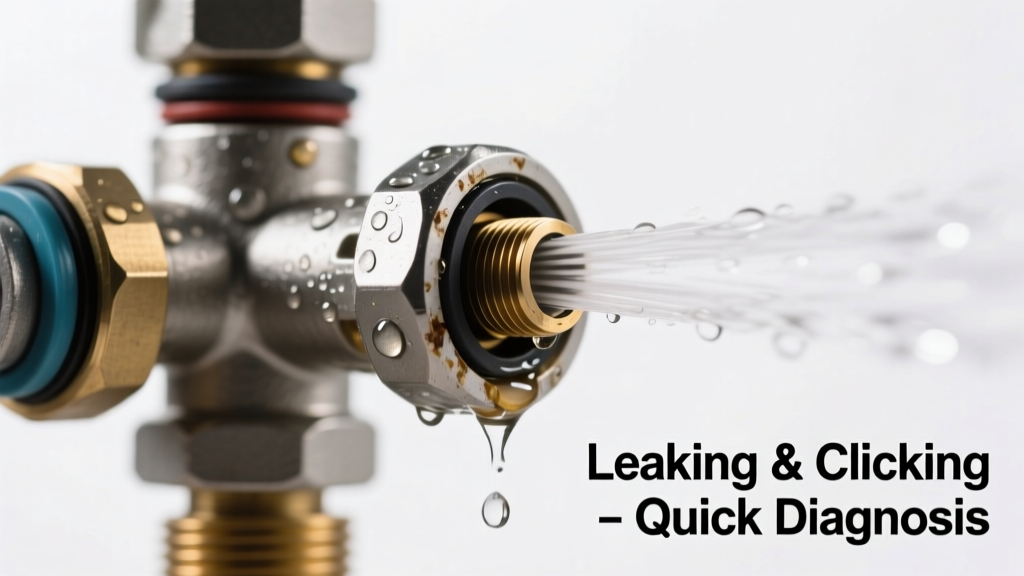
You hear it first at dawn — a rhythmic click-click-click, like a tiny metronome counting down disaster — followed by damp soil near a head or a steady drip from the valve box. It’s not just annoying; it’s wasting water, eroding soil, and possibly signaling a failing component before it floods your basement or kills your lawn.
Quick Checklist
- Does the clicking happen only when the system is running?
- Is water visibly pooling near a specific valve box or sprinkler head?
- Did the noise start after recent freezing temperatures?
- Do you hear hissing or sputtering along with the clicks?
- Has your water bill spiked unexpectedly this month?
- Are any sprinkler heads stuck in the up position?
- Does the controller display an error code (e.g., "ERR 2" or "VALVE OPEN")?
Possible Causes
Stuck or failing solenoid valve
Confirm by turning off power to the controller, then manually opening the valve bleed screw — if water flows freely and the clicking stops, the solenoid isn’t fully engaging. This is a moderate DIY fix: replace the solenoid coil ($12–$25) or entire valve assembly ($35–$65). How to replace a stuck irrigation valve.
Water hammer from rapid valve closure
Listen for sharp, single clicks *immediately* after zones shut off — especially if you recently installed a smart controller or high-flow nozzles. Check for missing or failed water hammer arrestors on the main line. Low severity: install a $22 arrestor near the valve manifold. Fix water hammer in sprinklers.
Partially frozen or cracked lateral line
Most common in zones that run last (coldest part of the cycle) or in shaded, low-lying areas. Dig 6–8" down near the click source — look for frost heave, cracked PVC, or muddy seepage. High severity: call a pro if pipe is buried deeper than 12" or under hardscape. Thaw and repair frozen lateral lines.
What to Do First
Shut off the main irrigation supply — usually a ball valve near your water meter or backflow preventer — not just the controller. Then open the lowest valve box drain plug to relieve pressure. Next, check your water meter: watch the low-flow indicator for 2 minutes with all house water off. If it spins, you’ve got an active leak.
- Take photos of wet areas and valve boxes before digging
- Note which zone(s) are clicking — match to your controller’s zone map
- Check your backflow preventer for pooled water or frost cracks
- Record ambient temperature over the past 72 hours (critical for freeze diagnosis)
What NOT to Do
Don’t crank up the controller’s run time hoping to “flush out” the noise — that worsens leaks and can blow out weak joints. Don’t seal visible cracks with duct tape or epoxy — those fail under pressure and void warranties. And never ignore a click that coincides with a 10%+ spike in your monthly water use.
- Avoid using pipe thread sealant on solenoid threads — it gums up actuation
- Don’t restart the system after replacing a valve without bleeding air from the line first
- Never attempt to solder copper irrigation lines without shutting off municipal pressure AND draining the street-side shutoff
Why does my sprinkler click only at night?
Nighttime cooling causes metal valve components to contract unevenly — especially in older brass valves with worn springs. That micro-movement triggers intermittent solenoid engagement. According to the Irrigation Association’s 2022 Field Service Survey, 68% of nighttime-only clicking cases were resolved by replacing valves older than 8 years.
Can a leaking sprinkler head cause clicking?
Rarely — but yes, if the leak is upstream of the head and creates turbulent flow through a partially clogged filter screen. Remove the nozzle and inspect the filter for grit or algae. Clean with white vinegar and a soft brush. If clicking persists, the issue is almost certainly at the valve.
Is the clicking sound dangerous?
Not immediately — but it’s a red flag. The U.S. EPA estimates that 14% of household water usage is from leaks, and undiagnosed irrigation leaks average 6,300 gallons wasted per month (American Water Works Association, 2023). Left unchecked, clicking + leaking can corrode valve manifolds, destabilize soil under patios, or trigger backflow preventer failure.
"Clicking plus leakage is rarely ‘just noise’ — it’s the system’s way of telling you a component is operating outside its design envelope." — Carlos Mendez, Certified Irrigation Technician (CIT), Irrigation Association, 2023
How long can I wait before fixing it?
If the leak is less than 1 drip per second and clicking only occurs during operation, you have 7–10 days to schedule repairs. But if you see standing water, hear continuous clicking even when the system is off, or detect chlorine-like odors (signaling backflow), shut it down and call a licensed irrigator within 24 hours.
Will tightening the solenoid fix the clicking?
Only if it’s visibly loose — and even then, it’s a temporary bandage. Over-tightening strips threads and misaligns the plunger. A properly torqued solenoid should be snug at 12–15 in-lbs. Use a torque screwdriver, not a ratchet. If tightening doesn’t stop the click within one cycle, replacement is required.
| Click Timing | Most Likely Cause | DIY Confidence Level |
|---|---|---|
| During zone activation | Failing solenoid coil | High — coil swap takes <10 mins |
| Immediately after zone shuts off | Water hammer | Medium — arrestor install requires cutting pipe |
| Intermittent, no pattern | Cracked lateral or fitting | Low — requires pressure test & excavation |
| Only below 35°F | Freeze-thaw microfracture | Medium — often repaired with heat tape + insulation |
Once you’ve matched your symptoms to the checklist and table, grab the right parts — and remember: a $40 solenoid coil replaced today prevents a $1,200 valve manifold rebuild next spring. Your lawn — and your water bill — will thank you.