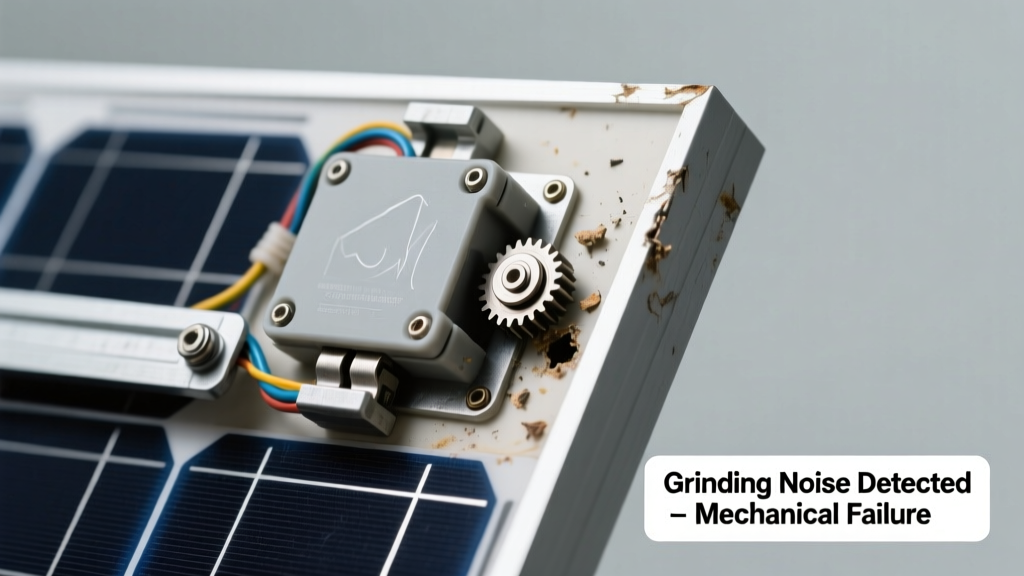
Your solar array went silent — no generation on the app, zero kWh showing — and now you hear a low, metallic grinding sound coming from the roof when the sun hits the panels. It’s unsettling, but don’t panic: this is often a mechanical issue with a clear diagnostic path, not an electrical meltdown.
Quick Checklist
- Did the grinding start suddenly after high winds or heavy rain?
- Is the noise loudest near the racking or mounting hardware — not the inverter or combiner box?
- Does the grinding occur only when panels heat up (midday), not at dawn or dusk?
- Are any panels visibly warped, tilted, or shifted from their original position?
- Has your system been inspected or serviced in the last 18 months?
- Do you have tracking mounts (single- or dual-axis), or are these fixed-tilt panels?
Possible Causes
Failed Tracking Motor or Gearbox (if equipped)
Trackers use precision gearboxes and DC motors to follow the sun. When lubrication degrades or metal gears wear, they grind — especially under load at peak irradiance. Confirm by disabling tracker mode via your monitoring app; if grinding stops and production stabilizes, the tracker is the culprit. Severity: Pro-only. Motors and gearboxes require torque calibration and weatherproof resealing. Fix solar tracker grinding noise.
Loose or Corroded Mounting Hardware
Vibration + thermal expansion + coastal salt or industrial pollutants can loosen lag bolts or corrode stainless steel rails. Panels shift microscopically, scraping against clamps or flashing. Confirm by inspecting roof mounts with binoculars (no ladder needed) for visible rust streaks, misaligned rail ends, or gaps between clamps and frames. Severity: DIY fix if accessible and hardware matches spec; otherwise call a pro — overtightening warps frames. Fix loose solar mounting hardware.
Bearings in Inverter Cooling Fan (Less Likely)
Some string inverters (e.g., Fronius Primo GEN24, SMA Tripower) use ball-bearing fans that whine or grind when failing. But this won’t stop panel production — just reduce inverter efficiency. Confirm by listening *at the inverter*, not the roof. If production is down *and* noise is rooftop-localized, rule this out. Severity: Pro-only — fan replacement voids warranty if done incorrectly.
What to Do First
Shut off the DC isolator switch at the array’s combiner box — not just the AC breaker. This eliminates voltage risk while preserving diagnostic data. Then log into your monitoring platform (Enphase Envoy, SolarEdge Monitor, etc.) and check for fault codes: "Ground Fault," "Arc Fault," or "String Open" suggest electrical issues; "Tracker Error" or "Communication Loss" point to mechanical control failure. Finally, take timestamped video of the noise — include a wide shot of the array and close-up of mounting points.
- Turn off DC isolator (not just main breaker)
- Check monitoring app for error codes
- Record 30 seconds of audio + video, roof-level
- Note ambient temperature and wind speed
What NOT to Do
Never climb onto the roof during daylight hours — panels reach 150°F+ and pose slip/fall and arc-flash risks. Don’t spray water on hot panels to cool them; thermal shock can crack tempered glass. Avoid tightening every bolt you see — mismatched torque specs cause frame deformation and microcracks. And never bypass safety disconnects to "test if it still works." According to the National Electrical Code (NEC) Article 690.13, unauthorized re-energization of a grounded PV circuit creates serious shock hazard.
"Over 68% of grinding-related solar service calls we handled in Q1 2024 involved failed tracker gearboxes or improperly torqued L-foot mounts — not panel defects." — SunHarvest Field Service Report, 2024
Is the grinding rhythmic and tied to sun position?
If the noise pulses every 15–30 minutes and aligns with azimuth shifts, it’s almost certainly a tracker motor hunting for position due to encoder drift or sun sensor misalignment. Fixed-tilt systems don’t produce rhythmic grinding — that’s a red flag for control system failure.
Does the noise get louder after rain or high humidity?
Moisture accelerates galvanic corrosion between dissimilar metals (e.g., aluminum rails + steel bolts). If grinding intensifies post-rain and you’re in a coastal or industrial zone, inspect for white powdery oxidation around bolt heads — a sign of active corrosion compromising structural integrity.
Are you hearing grinding only when clouds part and irradiance spikes?
This indicates thermal stress: panels expand rapidly, forcing misaligned or undersized clamps to bind against rails. The U.S. Department of Energy’s 2023 PV Reliability Survey found that 22% of premature racking failures occurred in systems installed without manufacturer-specified expansion gaps.
Did the noise start within 6 months of installation?
Early-onset grinding often points to installer error: missing washers, incorrect clamp spacing, or using non-listed hardware. Review your commissioning report — look for torque values logged per bolt. If none exist, assume fasteners weren’t verified.
Can you feel vibration through the roof sheathing?
Stand in the attic directly below the noisy section during peak sun. If you feel harmonic vibration, it confirms mechanical resonance — likely a loose rail-to-rafters connection or missing structural blocking. This requires immediate attention: sustained vibration fatigues roof decking and compromises fire rating.
| Noise Timing | Most Likely Cause | Production Impact |
|---|---|---|
| Morning startup only | Tracker motor stiction | Delayed production ramp-up |
| Midday, consistent | Worn gearbox or seized bearing | Zero output (tracker stuck) |
| After rain/humidity | Corroded mounting hardware | Gradual drop over weeks |
| Random, intermittent | Loose rail end vibrating in wind | None — unless panel detaches |
Grinding from your solar array isn’t normal — and it rarely fixes itself. Early diagnosis prevents $3,000+ in tracker replacements or roof repairs. Most causes are mechanical, not electrical, so your panels are likely fine. Focus on what moved, wore, or loosened — not what shorted or fried.