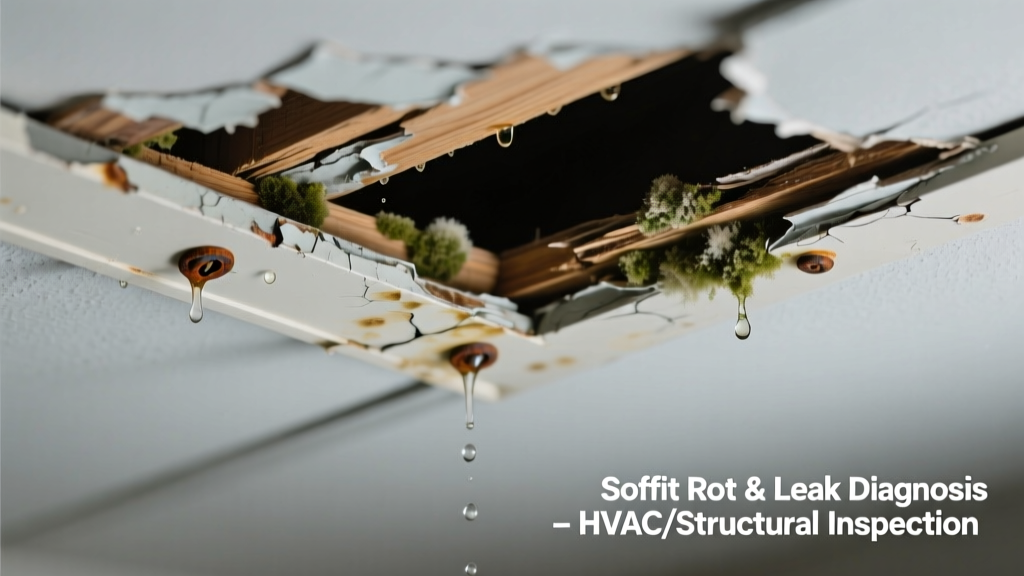
You spot soft, discolored wood under your eaves. A drip pings onto your patio after rain. Then you press a finger into the soffit panel — and it gives like wet cardboard. This isn’t just cosmetic: rotted soffit leaking water signals active moisture intrusion, often from above or behind. The good news? Most causes are identifiable in under 20 minutes — and many fixes start with simple inspection, not demolition.
Quick Checklist
- Is there visible staining or dark streaks on the soffit surface?
- Does water drip from the soffit only during or shortly after rain?
- Can you feel softness, sponginess, or crumbling when pressing gently on the soffit?
- Are gutters clogged, sagging, or overflowing near the affected area?
- Is there missing or cracked caulk where the soffit meets the fascia or roofline?
- Do you see mold, mildew, or white powder (efflorescence) on the underside of the soffit?
- Is the attic insulation above this section damp or discolored?
Possible Causes
Gutter overflow or misalignment
Overflowing gutters dump water directly onto the soffit or behind the fascia board. Check for debris buildup, improper pitch (<0.5″ per 10′), or downspouts terminating too close to the wall. Use a garden hose to simulate rain and watch for runoff paths. Severity: Low — most gutter cleaning and re-sloping is DIY. Gutter cleaning and repitching guide.
Roof-to-fascia flashing gap or corrosion
Missing, lifted, or rusted step flashing at the roof-to-fascia junction lets water wick behind the fascia and soak the soffit from above. Look for rust stains, gaps >1/8″, or exposed nail heads. Tap the fascia — hollow sounds suggest hidden rot. Severity: Medium — requires partial roof access and metal flashing replacement. Roof flashing repair steps.
Vent boot failure or improperly sealed soffit vents
Old rubber vent boots crack; aluminum soffit vents without gaskets allow wind-driven rain to penetrate. Inspect vents for cracks, missing screws, or gaps between vent frame and soffit. Shine a flashlight upward — if light passes through gaps, water likely does too. Severity: Low-Medium — sealant and vent replacement are DIY-friendly. How to seal soffit vents properly.
What to Do First
- Stop active water entry: Place a tarp over the affected roof section (if safe) or redirect downspout flow away using a splash block.
- Remove wet insulation in the attic directly above the leak — mold can begin in as little as 48 hours (EPA Indoor Air Quality Guidelines, 2022).
- Dry the soffit cavity with fans — aim airflow parallel to the surface, not straight in, to avoid forcing moisture deeper.
- Mark the perimeter of all soft or stained areas with chalk — this defines the minimum cut zone if replacement becomes necessary.
What NOT to Do
- Don’t caulk over rotted wood — it traps moisture and accelerates decay.
- Don’t ignore attic inspection — 68% of soffit leaks originate from roof or attic issues, not the soffit itself (IBHS Field Assessment Report, 2023).
- Don’t power-wash the soffit — high pressure drives water behind panels and worsens hidden rot.
- Don’t install new soffit over compromised framing — that’s like putting drywall over termite-damaged studs.
Is the leak happening only on one side of the house?
If yes, focus first on that roof slope’s gutters, flashing, and shingle condition. Wind-driven rain often targets leeward sides — especially homes with prevailing NW winds. Cross-check with local weather history: did the first drip coincide with a recent storm from that direction?
Does the soffit feel damp even on dry days?
That points to condensation or plumbing leaks — not rain infiltration. Check for bathroom exhaust ducts venting into the attic (not outside), or uninsulated HVAC ducts sweating above the soffit cavity. According to the U.S. Department of Energy’s 2021 Home Energy Score Guide, improperly vented exhaust accounts for 22% of chronic soffit moisture in humid climates.
Are you seeing white, chalky residue on the soffit or fascia?
This is efflorescence — a sign that water is moving through masonry (like brick veneer or chimney chase) and depositing dissolved salts as it evaporates. It confirms persistent, slow moisture migration — not a one-time leak. You’ll need to trace the path upward, possibly inspecting mortar joints or weep holes.
Did the rot appear within 6 months of new roof installation?
Yes? The installer may have omitted drip edge or misaligned starter shingles. Roofers skip drip edge on 12% of re-roofs in retrofit scenarios (NRCA Installation Survey, 2022). Pull back the first course of shingles at the eave — you should see metal flashing extending 1/2″ below the roof deck and over the top of the fascia.
Is the soffit made of wood, vinyl, or fiber cement?
Wood soffits rot fastest but show early warning signs (soft spots, discoloration). Vinyl hides damage until it buckles or pulls loose — check for gaps at seams. Fiber cement resists rot but cracks silently; tap it with a screwdriver handle — a dull thud means water saturation inside.
"When I see soffit rot, I always inspect the roof-to-fascia transition first — not the soffit itself. That joint fails more often than any other component in the eave assembly." — Carlos Mendez, RCI-certified roofing consultant, 2023
| Material | First Sign of Trouble | Typical Lifespan Before Failure |
|---|---|---|
| Painted pine | Peeling paint + soft spot under surface | 8–12 years (in humid climates) |
| OSB or plywood | Swelling at panel edges, nail popping | 5–9 years (if unprimed) |
| Vinyl | Gaps >1/16″ at seams, warping in sun | 20–30 years (but fails catastrophically once UV-degraded) |
| Fiber cement | Fine hairline cracks near fasteners | 30+ years (if installed with proper expansion gaps) |
Rotting soffit leaking water isn’t just an eyesore — it’s your home’s early warning system. Catch it early, and you’ll save hundreds on fascia repair, insulation replacement, and potential mold remediation. Start with the checklist, then move methodically upward: gutters → flashing → roof → attic. Most cases resolve with less than $150 in materials and a Saturday morning — no demo required.