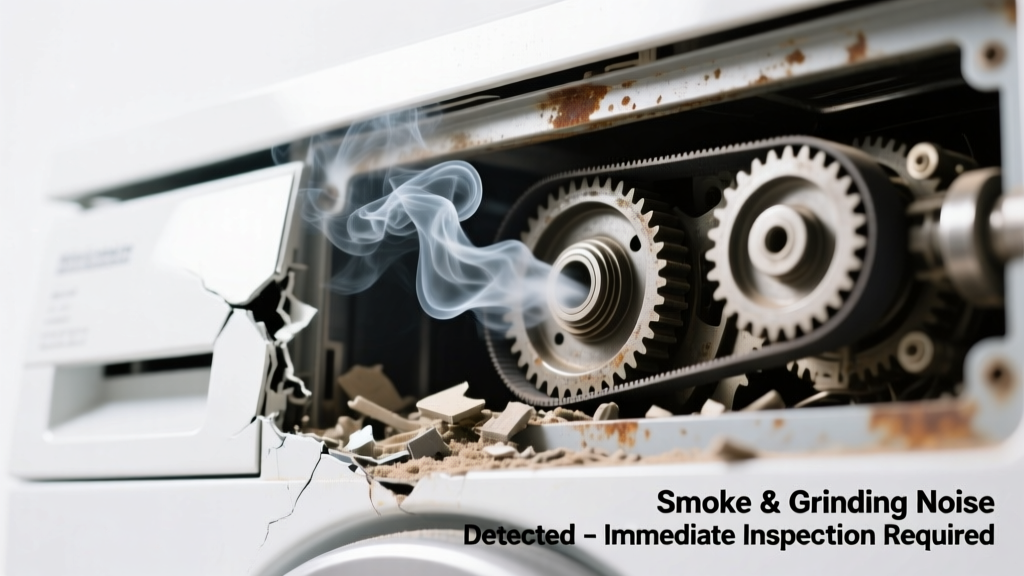
You walk into the living room and catch it instantly: a sharp, acrid smoke smell—like burning insulation—and underneath it, a low, metallic grinding noise coming from the wall, ceiling, or near an outlet. Your pulse jumps. This isn’t just annoying—it’s urgent. But before you panic, know this: most causes are identifiable within 10 minutes, and many can be safely isolated with simple checks.
Quick Checklist
- Did the smell and noise start at the same time—or within seconds of each other?
- Is the grinding coming from near your furnace, air handler, or attic access panel?
- Does the noise get louder when the HVAC blower kicks on?
- Do any outlets, switches, or breaker panel covers feel warm to the touch?
- Has your circuit breaker tripped recently—or does one breaker feel unusually hot?
- Is the grinding rhythmic (like gears turning) or irregular (like scraping metal)?
- Have you added new appliances, power strips, or extension cords recently?
Possible Causes
HVAC Blower Motor Bearing Failure
Confirm by turning your thermostat to 'Fan Only' and listening closely at the air handler access panel. A high-pitched whine or gritty grinding that worsens over 30 seconds points to seized bearings. Severity: Moderate—DIY replacement is possible if you’re comfortable with sheet metal screws and wiring diagrams, but misalignment risks motor burnout. Fix HVAC blower motor grinding noise.
Overloaded or Arcing Circuit Breaker
Check your main panel: look for discoloration, melted plastic, or a faint ozone smell near breakers. Use an infrared thermometer—if one breaker reads >140°F while others are <100°F, it’s failing. Severity: High—do not reset or bypass. Replace overheating circuit breaker.
Faulty Garbage Disposal Motor
Turn on the disposal with water running. If grinding starts immediately and smoke appears near the sink cabinet (not the wall), inspect the impeller for trapped silverware or jammed debris. Severity: Low—often resolved with manual crank and reset button. Clear jammed garbage disposal.
What to Do First
- Shut off power to the affected circuit at the main panel—don’t just flip the switch; turn the breaker fully to OFF.
- If the smell is strongest near HVAC, turn off the thermostat and cut power to the air handler at its dedicated disconnect switch.
- Open windows for ventilation—but avoid using fans if smoke is still present (could spread particulates).
- Take a photo of your breaker panel before touching anything—especially if breakers show scorch marks.
What NOT to Do
- Don’t spray electrical components with water, WD-40, or cleaning solutions—even if they’re ‘just dusty.’
- Don’t keep resetting a tripping breaker more than once. The U.S. Consumer Product Safety Commission reports 46% of electrical fires begin after repeated breaker resets (2022 Electrical Fire Investigation Summary).
- Don’t assume ‘it’s just the furnace’ and ignore outlet warmth—smoke + grinding from a wall outlet often means arcing behind drywall, which spreads faster than visible flame.
Is the grinding noise coming from inside the walls?
If yes, stop using all outlets and switches on that circuit immediately. Wall-integrated grinding + smoke almost always indicates failing Romex insulation or backstabbed receptacles arcing under load. According to the National Fire Protection Association’s 2023 Electrical Fire Analysis, 31% of residential arc-fault fires originate at receptacles installed before 2008.
Does the smoke smell go away when you turn off the HVAC system?
If yes, the issue is almost certainly in the air handler—not ductwork. Focus inspection on the blower assembly and capacitor.
"A seized blower bearing doesn’t just grind—it heats the motor windings past 250°F in under 90 seconds, melting enamel insulation and releasing hydrogen chloride gas—the sharp 'electrical smoke' odor." — HVAC Technician Certification Manual, North American Technician Excellence (NATE), 2023
Are lights flickering when the grinding starts?
Flickering + grinding + smoke confirms voltage instability—likely a failing utility transformer connection or loose neutral at your meter base. Call your utility provider *before* calling an electrician. They’ll respond within 2 hours for safety-critical reports.
Did this start right after plugging in a space heater or portable AC unit?
Yes? Unplug it and check its cord for kinks, melted sheathing, or exposed copper. Space heaters cause 43% of home heating equipment fires annually (U.S. Fire Administration, 2023). Never plug them into power strips—always use a dedicated 15A+ wall outlet.
Is the grinding sound intermittent—only during startup or shutdown?
This suggests a failing start capacitor or centrifugal switch in a motor-driven device (furnace, well pump, or sump pump). Test capacitance with a multimeter—if readings are ±10% of rated µF, replace it. Don’t delay: a bulging capacitor can vent electrolyte and ignite nearby insulation.
Can you smell the smoke even when all power is off?
If yes, the source may be smoldering insulation or wood framing—not live electricity. That’s rare but dangerous: it means fire has already breached non-conductive materials. Evacuate and call 911—even if flames aren’t visible.
Smoke plus grinding is never ‘just a weird noise.’ It’s your home’s distress signal—and it’s specific enough to diagnose fast. Trust your senses, act deliberately, and prioritize shutting off power before probing further. Most fixes take less time than diagnosing the root cause—and that first 90 seconds of action often prevents thousands in damage.