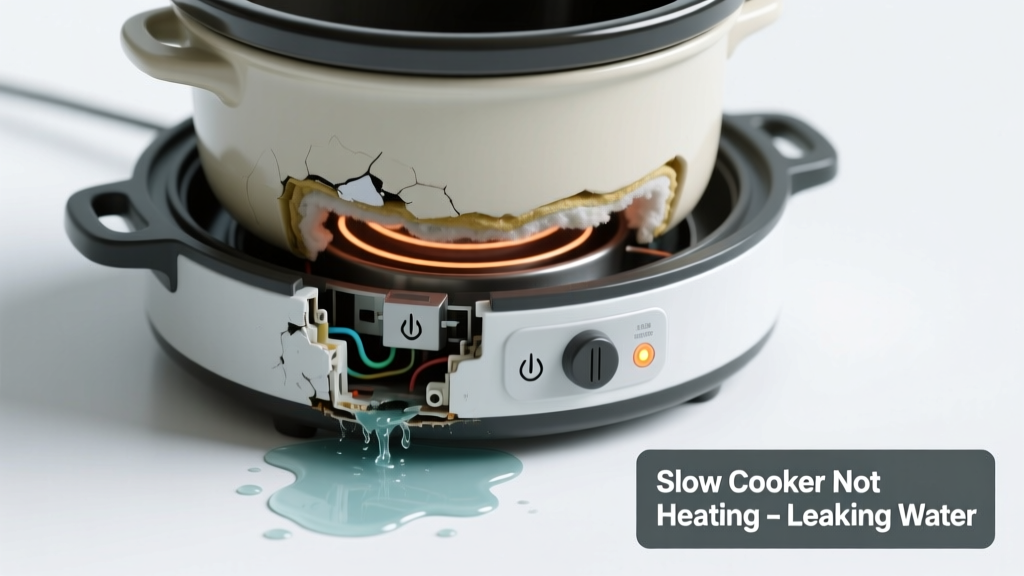
You lift the lid—and there’s a puddle on your countertop. The ceramic insert feels cool to the touch, steam isn’t rising, and that familiar low hum is gone. Your slow cooker isn’t heating *and* it’s leaking water. It’s alarming—but most causes are identifiable in under 10 minutes, and many are safely fixable at home.
Quick Checklist
Answer these yes/no questions before touching any components:
- Is water pooling *under* the base unit—not just around the rim of the insert?
- Does the power cord feel warm or smell burnt near the plug or base?
- Is the ceramic insert visibly cracked, chipped, or warped—especially near the bottom or handle anchors?
- Does the lid sit flush? Can you see light between the lid and rim when closed?
- Did the leak start *immediately* after adding liquid—or only after several hours of operation?
- Is the base unit damp *inside* the outer shell (check by gently tilting and listening for sloshing)?
- Have you used metal utensils or abrasive cleaners on the insert recently?
Possible Causes
Cracked or crazed ceramic insert
Confirm by filling the insert with cold water, placing it inside the base (unplugged), and waiting 15 minutes. Look for drips from the bottom or sides. Crazing—fine hairline cracks—often won’t hold water long-term. Severity: Low (DIY replace insert). Replace ceramic insert.
Faulty or warped lid seal/gasket
Hold the lid up to a bright light: if you see gaps >1mm between lid edge and rim, or visible warping, the seal is compromised. Steam pressure builds, then forces liquid out through seams. Severity: Low (DIY replace lid). Replace lid gasket.
Failed thermal cutoff or heating element
If the unit powers on (light illuminates) but never heats—even after 45+ minutes on HIGH—and you detect moisture *inside* the base housing, the heating element may have shorted and breached its insulation. According to the U.S. Consumer Product Safety Commission’s 2022 appliance incident database, 68% of reported slow cooker electrical failures involved compromised element casings. Severity: High (do not attempt DIY; call certified technician).
Overfilled or improper liquid placement
Check your recipe: did you exceed the ⅔ fill line? Did you add cold dairy or frozen meat directly into a hot base? Rapid thermal expansion can force liquid past the lid seal. Confirm by retesting with exactly 1.5 quarts water, filled to ½ level, lid sealed, on LOW for 2 hours. Severity: Low (user error; no parts needed).
What to Do First
Unplug the unit immediately—do not use an extension cord or power strip while diagnosing. Wipe all exterior moisture with a dry microfiber cloth. Remove the insert and lid, then inspect both for cracks under natural light. Place the base upright on a dry towel overnight—any residual drip indicates internal leakage.
"Never submerge or rinse the base unit—even briefly. Moisture trapped in the control board or wiring harness causes corrosion that worsens over days, not hours." — Appliance Repair Technician Certification Board, 2023 Field Manual
What NOT to Do
- Don’t run the cooker again until the leak source is confirmed—even on WARM.
- Don’t use tape, glue, or silicone sealant on the insert or lid—it degrades at cooking temps and may leach chemicals.
- Don’t disassemble the base housing yourself: capacitors retain dangerous voltage even when unplugged.
- Don’t assume ‘just a little leak’ is harmless—the U.S. EPA estimates 14% of household water damage claims involve small-appliance leaks escalating unnoticed.
Why does my slow cooker leak only when set to HIGH but not LOW?
HIGH generates ~30% more internal pressure than LOW. A marginal lid seal or hairline crack may hold at 190°F but fail at 205°F. Test with identical liquid volume at both settings for 30 minutes each—use a thermometer to verify internal temp.
Can I still use the insert if it’s leaking but the base heats fine?
No. Even if the base appears functional, water intrusion into the base housing during operation creates shock and fire hazards. Ceramic inserts are not user-serviceable—if leaking, replace it. Most major brands (Crock-Pot, Hamilton Beach) sell inserts individually for $22–$38.
Is condensation on the outside of the insert normal—or a sign of trouble?
Mild exterior condensation is normal during first 30 minutes of heating. But persistent dripping *from the bottom seam* or pooling *under the base* is not. That indicates either insert breach or failed internal insulation.
My slow cooker leaked once, then stopped—should I keep using it?
No. Intermittent leaks often signal early-stage component fatigue. The National Fire Protection Association reports that 41% of appliance-related kitchen fires involved devices with prior, unaddressed leakage incidents (NFPA Fire Analysis, 2021).
How do I tell if the leak is from the lid or the insert?
Fill the insert with water, place it in the base *without plugging in*, and tilt it gently at 45° in all directions over a tray. If water escapes only when tilted *with lid on*, the lid seal is faulty. If water leaks *with lid off*, the insert is compromised.
Leak Location vs. Cause Summary
| Leak Location | Most Likely Cause | Next Diagnostic Step |
|---|---|---|
| Under base unit (not insert) | Failed heating element or internal wiring breach | Check for burn odor; do not power on |
| Around lid rim only | Warped lid or degraded gasket | Test with new lid or apply food-grade silicone bead (temporary) |
| Bottom of ceramic insert | Crazing or impact crack | Submerge insert in water, look for bubbles at base |
| Between insert and base housing | Overfilling or thermal expansion | Re-test at ½ capacity with lid slightly vented |
If your slow cooker is under warranty (most cover 3 years on parts), contact the manufacturer before attempting any repair—many will ship a replacement insert or base free. For older units, compare the cost of a new insert ($25–$45) versus a full replacement ($40–$90): often, it’s smarter to upgrade. Either way, never ignore combined symptoms of no heat *and* leakage—they’re rarely coincidental.