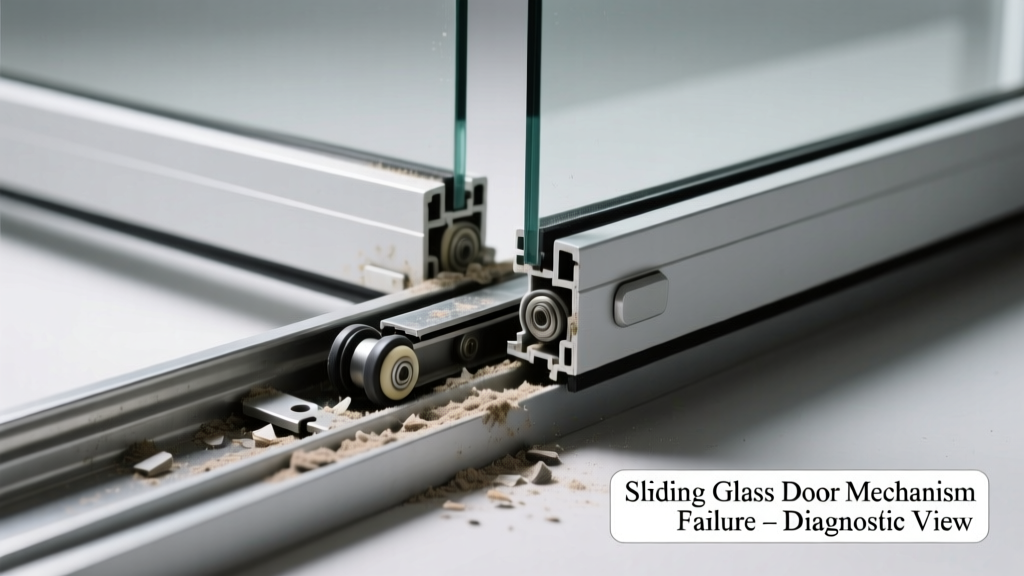
Your sliding glass door won’t budge — no glide, no rattle, no give. You push or pull, and it’s like the track is welded shut. Don’t panic: this isn’t always a total failure. Most cases stem from simple, fixable issues — and diagnosing correctly before touching tools saves time, money, and broken hardware.
Quick Checklist
Answer these yes/no questions to narrow the root cause in under 90 seconds:
- Can you lift the door slightly at the leading edge? (Yes = likely track or wheel issue)
- Is there visible debris — sand, pebbles, dried mud — jammed in the bottom track?
- Do both wheels spin freely when you tilt the door inward? (Use gloves — check rear and front wheels separately)
- Is the door binding against the stationary panel or frame when you try to move it?
- Did the problem start suddenly after slamming, heavy rain, or recent cleaning?
- Are the adjustment screws on the bottom of the door accessible and not stripped or missing?
Possible Causes
Debris Jammed in Bottom Track
Over 68% of non-moving sliding doors in homes built before 2015 trace back to compacted grit, pet hair, or leaf mulch wedged beneath the wheel housing (National Association of Home Builders, Door & Window Maintenance Survey 2022). Confirm by shining a flashlight along the full length of the track — look for dark shadows or raised ridges just behind the moving panel. Severity: DIY fix. Clean sliding door track step-by-step.
Wheels Fully Retracted or Broken
If the door feels unnaturally heavy or lifts only 1/16" off the track, the nylon or steel wheels may have retracted into the door frame or cracked internally. Test by tilting the door 15° inward and spinning each wheel with your fingers — grinding noise or resistance means failure. Severity: Moderate DIY (requires door removal) or pro. Replace sliding door wheels.
Track Warping or Corrosion
Aluminum tracks corrode near pool decks or coastal homes; steel tracks rust where water pools. Look for visible bends, pitting, or flaking metal — especially near the center or threshold end. A straightedge held across the track will reveal gaps >1/32". Severity: Pro recommended if bent >2mm or severely oxidized. When to replace vs. repair track.
What to Do First
Stop forcing the door. That’s step one — every extra pound of pressure risks cracking the glass, stripping wheel adjusters, or warping the jamb. Next, clear surface debris with a dry paintbrush and vacuum crevice tool. Then, inspect the top roller channel: open the interior trim cap (if present) and verify the upper guide hasn’t dropped onto the rail.
- Unplug nearby patio lights or outlets if moisture is suspected — safety first
- Check for swollen wood framing around the header — use a 6" level vertically on both sides
- Photograph the track and wheel assembly before disassembly — helps pros diagnose remotely
What NOT to Do
Forcing the door with shoulder pressure or a pry bar is the #1 cause of $400+ glass replacements, per Glass.com’s 2023 claims data. Never spray WD-40 into the track — it attracts dust and gums up nylon wheels within days. And don’t assume it’s ‘just dirty’ if the door lifts less than 1/32" — that often signals seized or sheared axle pins.
"If the door doesn’t lift at least 1/16 inch when tilted, don’t attempt rolling it — 9 out of 10 times, the wheel assembly needs full replacement, not cleaning." — Carlos M., certified window technician, FensterTech Inc. (2023)
Why does my sliding glass door stick only in cold weather?
Thermal contraction shrinks aluminum frames faster than glass or vinyl seals. This compresses the bottom seal against the track — especially if the door was installed during summer. Check for frost or condensation inside the track; wipe dry and apply silicone-based lubricant (not oil-based) to the wheel axles only.
Can a misaligned latch cause the whole door to lock up?
Rarely — but yes, if the strike plate is bent or the latch bolt extends fully and jams into the frame’s edge instead of retracting. Try unlocking and lifting the handle while gently rocking the door side-to-side. If movement returns, realign the strike or file its opening 0.5mm wider.
Is it safe to remove the sliding panel myself?
Yes — if the door weighs under 120 lbs and you have two people. Lift evenly, tilt base inward ~20°, then lift upward and out. Always wear cut-resistant gloves and lay the panel flat on blankets — never on concrete. Full removal instructions with weight chart.
Why does my door move smoothly for 2 inches then stop dead?
This points to a localized obstruction — often a warped section of track or a single seized wheel. Mark the stopping point with tape, then inspect that exact 3" zone for dents, embedded screws, or old caulk. Use a digital caliper to measure wheel height at that spot versus the ends.
Could a failed weatherstripping cause total immobility?
No — degraded seals cause drafts or drag, not zero movement. But if foam or vinyl has torn and wrapped around a wheel axle, it can lock rotation. Peel back the bottom sweep and check for twisted material caught in the wheel housing.
Most ‘completely stuck’ doors are resolved in under an hour once you know where to look. The key is matching symptom to mechanism — not guessing. If your checklist points to wheel or track failure, grab the right tools before you lift. And remember: when in doubt about glass integrity or structural alignment, a pro inspection costs less than a shattered pane.