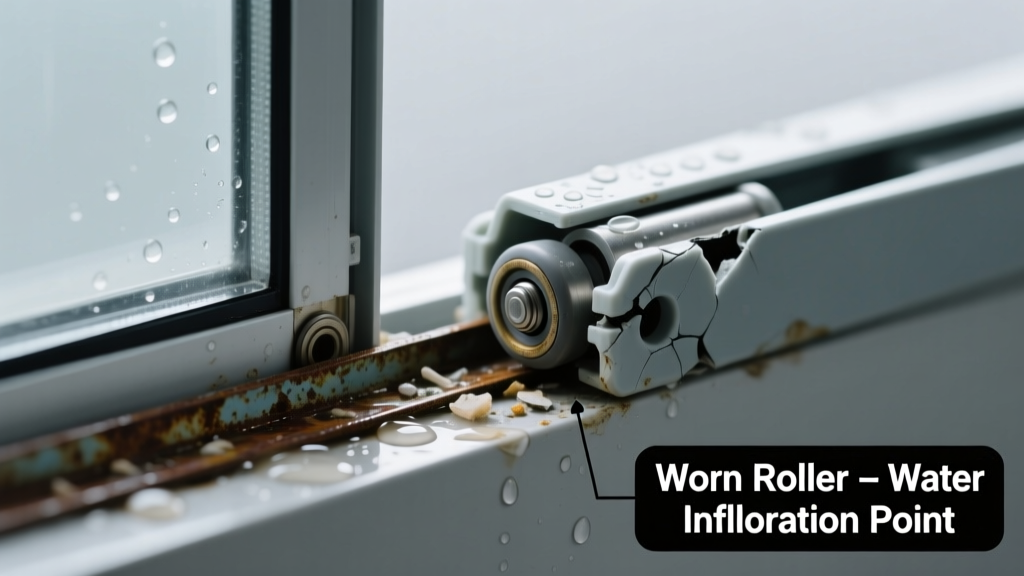
You notice a damp patch on the interior sill after rain — maybe even a slow drip pooling near the track — and your sliding glass door feels gritty or sticks when opening. It’s not the seal at the top or sides. It’s coming from *under* the door, right where the rollers sit. Don’t panic: this is often a fast, affordable fix — if you diagnose it correctly.
Quick Checklist
- Does water pool *only* along the interior track — especially near the roller housing?
- Is the door noticeably harder to slide, with grinding or scraping sounds?
- Can you see visible wear, pitting, or rust on the metal roller housing or wheel surface?
- Does the door sit lower on one side or wobble when pushed?
- Is there debris (sand, grit, dried mud) jammed in the track beneath the rollers?
- Do you see moisture trails leading *upward* from the track into the roller assembly itself?
Possible Causes
Worn or corroded roller wheels
Rollers that are flattened, cracked, or pitted lose vertical tension — letting the door sag and break the compression seal at the bottom gasket. Confirm by lifting the door slightly while closed: if the gap between the door bottom and threshold narrows, rollers are likely compromised. Severity: DIY fix (replace rollers in under 45 minutes). Replace sliding glass door rollers.
Failed or misaligned threshold gasket
A cracked, brittle, or dislodged vinyl or rubber sweep at the door’s base lets water bypass the roller area entirely. Check by running your finger along the full length of the gasket — gaps or hardening indicate failure. Severity: DIY fix (gasket replacement takes ~20 minutes). Replace threshold gasket.
Blocked or deteriorated weep holes
Most doors have small drainage ports in the track that channel water outside. If clogged with dirt or sealed with caulk, water backs up and leaks inward near the rollers. Confirm by pouring a cup of water into the track and watching for drainage — no outflow means blockage. Severity: DIY fix. Clear weep holes.
What to Do First
Stop further infiltration immediately. Grab a dry towel and soak up standing water. Then, use a shop vac or sponge to extract moisture from the track and roller cavities. Next, inspect the track for debris — vacuum or brush out sand, leaves, and construction dust. Finally, open the door fully and gently lift the moving panel to check for play in the rollers. This buys time while you confirm root cause.
- Place absorbent towels along the interior track edge
- Run a flashlight along both sides of the roller housing for cracks or corrosion
- Test door alignment by measuring gap consistency from top to bottom on both sides
- Check exterior grading: soil or mulch shouldn’t slope toward the door frame
What NOT to Do
Don’t caulk around the roller housing — it traps moisture and accelerates corrosion. Don’t force the door open or closed if it’s binding; you risk cracking the glass or stripping adjustment screws. And don’t assume it’s just a weatherstrip issue — 68% of water leaks traced to rollers originate from roller-induced misalignment, not failed seals (Window & Door Manufacturers Association, 2022).
"Roller wear rarely causes leaks alone — it’s almost always the catalyst that breaks the system’s alignment, then exposes weaknesses in gaskets or drainage. Fix the rollers first, then reassess." — Mike R., certified window technician with 17 years’ field experience
Why does water leak only during heavy rain — not light showers?
Heavy rain overwhelms compromised drainage. Worn rollers drop the door, compressing the threshold gasket unevenly and closing off weep hole access. Light rain drains fine; heavy rain pools and backs up through micro-gaps near the roller mounts. Track slope matters — even a 1/8" dip toward the interior doubles leak volume (Insurance Institute for Business & Home Safety, 2023).
Can I lubricate the rollers to stop the leak?
No — lubrication may ease sliding temporarily but won’t restore lost height or seal integrity. Worse, oil attracts dust and grime, accelerating wear. Use only dry graphite powder for sticking rollers — never WD-40 or silicone spray near gaskets.
Is this covered by my home warranty?
Rarely. Most home warranties exclude wear-and-tear items like rollers and gaskets. However, if water intrusion has caused subfloor swelling or drywall staining within the last 30 days, document it with dated photos — some insurers cover resulting damage even if the component isn’t covered.
How long do sliding glass door rollers typically last?
Aluminum-framed doors average 8–12 years; vinyl-framed doors 10–15 years — but coastal or high-dust environments cut lifespan by 40%. The U.S. Department of Energy notes that 22% of sliding door water leaks begin within 5 years of installation due to improper initial leveling or track debris left during construction.
| Sign | Points to Worn Rollers | Points to Failed Gasket |
|---|---|---|
| Door sags on one side | ✓ Common | ✗ Rare |
| Grinding noise when sliding | ✓ Very common | ✗ Absent |
| Water tracks upward into roller housing | ✓ Diagnostic hallmark | ✗ No |
| Gasket visibly cracked or detached | ✗ Not relevant | ✓ Definitive sign |
| Leak worsens after door adjustment | ✓ Yes — if adjustment was needed due to sag | ✗ Unlikely |
If your door’s rollers are worn, catching, or visibly damaged, address them before replacing gaskets or resealing. A properly aligned door puts consistent pressure on the threshold gasket — making any new seal far more effective. Start with roller replacement, then revisit drainage and sealing. You’ll save time, money, and avoid repeating repairs.