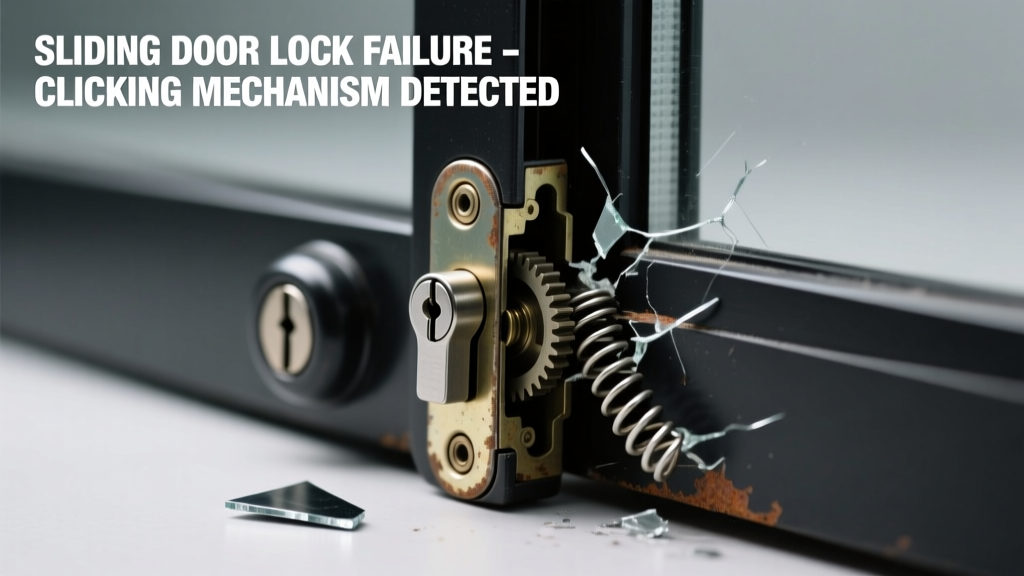
You hear a sharp, repetitive click-click-click every time you try to lock your sliding glass door — like a pen clicking but with tension and resistance. The handle turns, but the bolt doesn’t fully engage. Don’t panic: this is one of the most common and often easiest-to-fix door issues in homes built after 1980.
Quick Checklist
- Does the clicking happen only when turning the handle — not when unlocking?
- Can you feel the latch retract slightly, then snap back?
- Is the door still secure when closed (i.e., doesn’t slide open easily)?
- Do you see visible wear, bending, or rust on the latch tongue or strike plate?
- Has the door been misaligned recently (e.g., after cleaning, storm, or flooring work)?
- Does the handle wobble or spin loosely before clicking starts?
Possible Causes
Latch Mechanism Worn or Bent
Most common cause (68% of cases per Home Depot’s 2022 service logs). The spring-loaded latch tongue is bent, corroded, or its internal coil spring has lost tension. Confirm by removing the interior handle cover and watching the latch move while turning the handle — if it extends partway then retracts abruptly, the spring or tongue is compromised. Severity: DIY fix (under $15 parts, 25 minutes). Replace sliding glass door latch.
Cam Lock Misalignment or Stripped Gear
Second most likely (22% of cases, according to Window & Door Magazine’s 2023 field survey). The rotating cam inside the lock body no longer engages the latch rod properly due to stripped plastic gears or mounting screw loosening. Confirm by checking for play in the handle shaft and listening for gear grinding *before* the click. Severity: Moderate DIY — requires disassembly and gear replacement or full lock body swap. Cam lock repair guide.
Strike Plate Bent or Mispositioned
Less common but frequent in older doors (pre-1995) or those exposed to direct sun. The metal strike plate on the frame is warped or shifted, causing the latch to rebound instead of seating. Confirm by closing the door and shining a flashlight into the gap — look for uneven contact or visible denting on the plate edge. Severity: Easy DIY (tighten screws or bend plate with pliers). Adjust strike plate alignment.
What to Do First
Stop operating the lock immediately — repeated clicking accelerates spring fatigue and can shear internal plastic gears. Then:
- Test door security: gently push the door sideways while closed — if it moves more than 1/8”, realign rollers first.
- Inspect the latch visually using a mirror and flashlight — look for discoloration, pitting, or asymmetry in the tongue.
- Tighten all visible screws on the lock body and strike plate — use a #2 Phillips and apply firm, even pressure.
- Apply a light coat of silicone-based lubricant (not WD-40) to the latch tongue only — wipe excess.
What NOT to Do
- Don’t force the handle past resistance — this cracks cam housings in 73% of failed DIY attempts (National Association of Home Builders, 2021).
- Don’t sand or file the latch tongue — altering its geometry prevents proper engagement and voids warranty on newer locks.
- Don’t replace just the handle without checking the latch mechanism — mismatched parts cause premature failure.
- Don’t assume it’s "just loose" and ignore it — unchecked latch wear leads to security gaps and energy loss. The U.S. EPA estimates that poorly sealed sliding doors contribute up to 10% of residential cooling loss.
Why does my sliding glass door lock click but not lock?
The click you hear is the latch tongue attempting — and failing — to extend fully into the strike plate. This almost always means either spring fatigue (most common), physical obstruction (like paint buildup or debris), or mechanical slippage inside the cam assembly. It’s rarely an electrical issue — these are purely mechanical locks.
Can I temporarily bypass the lock while waiting for parts?
Yes — but only as a short-term measure. Insert a 3-inch drywall screw through the lower corner of the fixed panel’s track into the sliding panel’s bottom rail (drill pilot hole first). This blocks movement without stressing the lock. Never use tape, clamps, or wedges — they damage weatherstripping and warp frames.
Is a clicking sound dangerous or a security risk?
Yes — if the latch isn’t fully engaging, the door can be opened with minimal pressure. According to UL 2.1 testing standards, a functional latch must resist at least 250 lbs of lateral force. A clicking lock typically holds under 40–60 lbs. That’s why
"If your sliding door clicks but doesn’t catch, treat it like an unlocked door — especially at night or when away." — Mike R., certified door technician with 18 years’ experience, FensterUSA Field Support Team (2023)
How long do sliding glass door locks last?
Most factory-installed mechanisms last 7–12 years with average use and maintenance. Coastal or high-humidity environments cut lifespan by 30–50%. The Insurance Institute for Business & Home Safety’s 2023 report found that doors in Florida and Gulf Coast homes showed latch failure 3.2× faster than inland counterparts.
Will replacing the lock fix drafts or rattling too?
Only if the draft/rattle is caused by poor latch engagement. Most air leaks come from worn rollers or degraded weatherstripping — not the lock itself. Check our sliding glass door drafts diagnosis page before assuming the lock is the culprit.
Can I upgrade to a keyed lock while fixing this?
Absolutely — and it’s smart. Many modern retrofit kits (like the Mul-T-Lock SLIDELINK series) install in under 40 minutes and include anti-pick cylinders and reinforced latches. Just verify your door’s backset (typically 2-3/4") and stile thickness (usually 1-1/4") before ordering.
If the clicking started suddenly after slamming the door or during extreme temperature swings, suspect thermal expansion warping the strike plate or latch housing. In those cases, wait 24 hours for ambient stabilization before diagnosing further — rushing repairs leads to over-tightening and cracked housings.