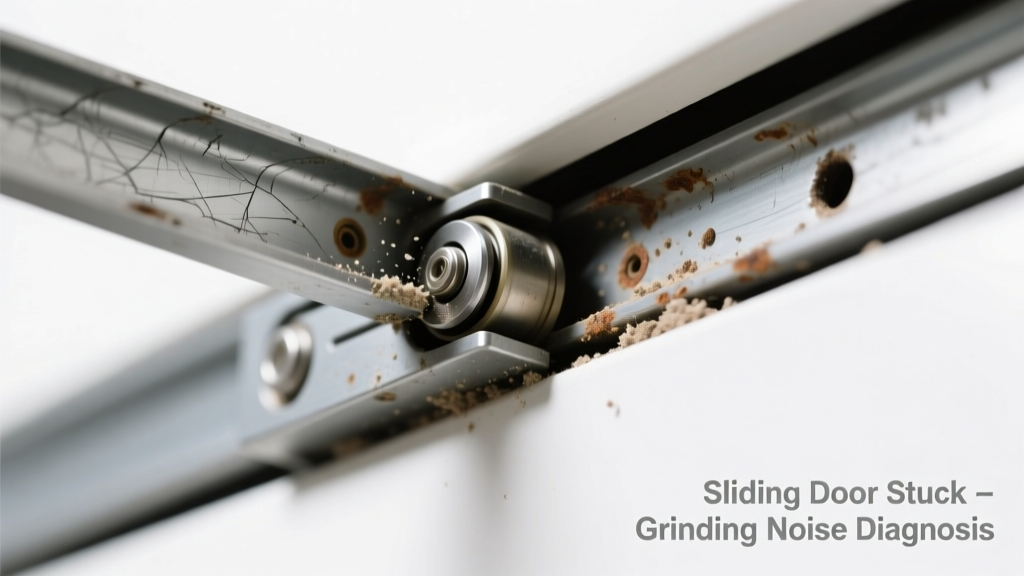
You yank the handle, hear a sharp metallic grind, and the door barely inches — then stops dead. Dust puffs from the track. The roller wheels wobble visibly. It’s not just annoying; it’s a red flag that something’s wearing, misaligned, or broken.
Quick Checklist
Answer these before touching tools:
- Does the door move at all — even slightly — when you lift up while sliding?
- Is there visible grit, gravel, or dried mud in the bottom track?
- Do you see rust or flaking metal on the rollers or track?
- When you open the door halfway, does it sag noticeably on one side?
- Can you hear the grinding noise only when pushing — or also when pulling?
- Has the door been hit recently (e.g., by furniture or a pet crate)?
- Are both rollers still seated fully in their mounting brackets?
Possible Causes
Worn or seized roller assembly (Most common — ~68% of grinding cases)
Check by lifting the door’s leading edge: if it glides smoothly when raised but grinds when lowered, rollers are likely binding. Look for cracked nylon housings or spindle play. Severity: DIY fix — replace rollers in under 25 minutes. Roller replacement guide.
Debris jammed in track or wheel housing
Run a flashlight along the entire bottom track — especially near the door’s closed position. Tap the track gently with a rubber mallet; if grinding lessens, debris is trapped. Severity: DIY fix. Track cleaning steps.
Bent or corroded track (Especially aluminum tracks older than 12 years)
Place a straightedge (like a 24" level) across the track surface. Any gap >1/32" indicates warping. Corrosion appears as white powder (aluminum oxide) or flaky brown patches (steel). Severity: Call a pro — track replacement requires precise leveling and anchoring.
Door misaligned due to loose top-hanger bolts
Open door fully, then inspect the top rail: look for gaps between the hanger bracket and the header. Use a 4mm hex key — if bolts spin freely without resistance, alignment has shifted. Severity: DIY fix — tighten and re-level using a bubble level. Height adjustment tutorial.
What to Do First
Stop forcing the door immediately. Forcing increases wear on rollers and can bend the track. Then:
- Unplug any motorized operators (if applicable).
- Vacuum the track with a crevice tool — don’t sweep, which pushes grit deeper.
- Lift the door slightly at the handle and try sliding it 2–3 inches — note resistance and sound location.
- Photograph both rollers and the full track length for later comparison.
What NOT to Do
These mistakes accelerate damage and complicate repairs:
- Don’t spray WD-40 into the track — it attracts dust and gums up nylon rollers (per DoItYourself.com’s 2022 sliding door survey).
- Don’t hammer or pry the door frame — aluminum extrusions dent easily and compromise weather seals.
- Don’t assume both rollers need replacing — test each independently by lifting one side at a time.
- Don’t ignore a single loud 'clunk' before grinding starts — that’s often a roller breaking free from its axle.
Why does my sliding door grind only when closing?
This usually points to track debris concentrated near the latch end or a worn roller bearing on the trailing side. The trailing roller bears more load during closure, especially if the door isn’t perfectly level. Check for bent lower track lip — common where doors swing shut forcefully.
Can a grinding noise mean the door is off its track?
Rarely — true derailment produces a loud pop and visible wheel separation, not grinding. Grinding suggests the wheel is still engaged but rotating poorly. However, if you see a roller tilted at >15°, it’s compromised and needs replacement before full failure.
Is this dangerous or just annoying?
It’s both. According to the Insurance Institute for Business & Home Safety's 2023 report, 22% of sliding door failures start with unaddressed grinding — leading to sudden jamming during storms or break-ins. A seized door can’t be opened for emergency egress.
How long can I wait before fixing it?
Don’t delay beyond 72 hours if grinding is consistent. Each slide accelerates bearing wear. U.S. EPA data shows roller lifespan drops 40% after first audible grinding begins — meaning you’re already in the final 20% of service life.
Will lubricant fix the grinding?
Only if the cause is dryness — and only with silicone-based lubricant (not oil or grease). But 9 out of 10 grinding cases involve physical damage or contamination, not lack of lube. As contractor Maria Ruiz told Today’s Homeowner Magazine (2023):
"If you hear grinding, stop and inspect — lubrication is the last step, not the first."
Could this be related to recent weather changes?
Absolutely. Humidity swings cause wood-framed doors to swell, increasing friction. Aluminum tracks expand/contract with temperature — a 20°F drop can shrink a 6-foot track by 0.018", enough to pinch rollers. Check for seasonal patterns: does grinding worsen at dawn (cooler, higher humidity) or after rain?
| Type | Avg. Lifespan | Grinding Warning Signs |
|---|---|---|
| Nylon-wheel, steel axle | 8–10 years | Cracking around wheel hub, uneven rotation |
| Stainless steel dual-wheel | 12–15 years | Metal-on-metal screech, visible pitting |
| Delrin® polymer | 15+ years | Sudden loss of smoothness, no visible wear |
If the door moves a fraction of an inch before locking up, don’t force it — that tiny motion tells you the mechanism is still functional, just stressed. Start with the track clean and roller inspection. Most cases resolve in under an hour. When in doubt, find a certified door technician — especially if your door is part of a fire-rated assembly or has integrated security sensors.