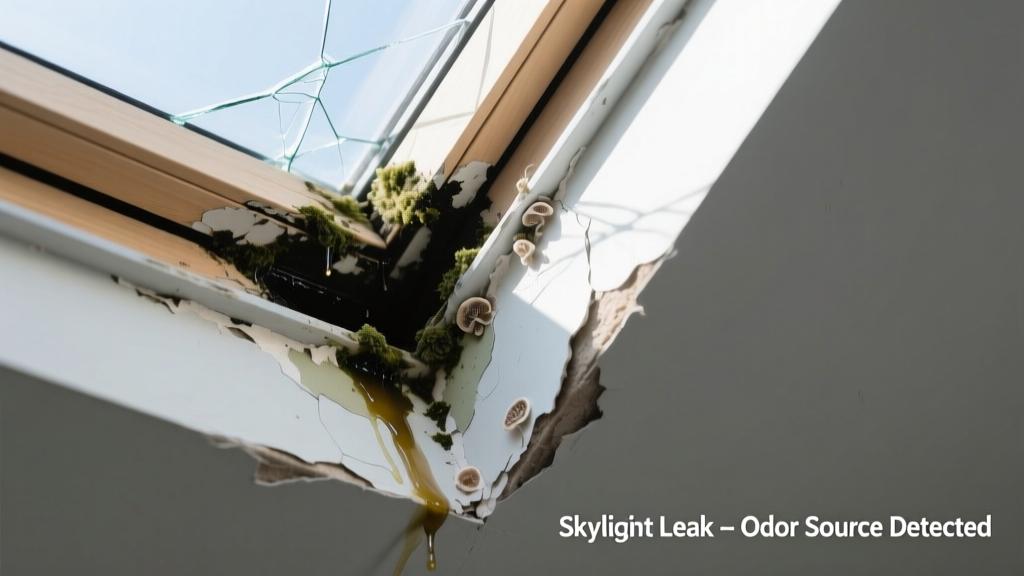
You wake up to a damp, musty smell near the ceiling—and spot water stains spreading across your drywall beneath the skylight. It’s not just wet; it’s off. That sour, earthy, or even sewage-like odor means something’s decomposing or growing where it shouldn’t: behind your skylight frame, inside the roof deck, or in the insulation. Don’t panic—this is diagnosable, and often fixable before major repairs are needed.
Quick Checklist
Answer these yes/no questions to narrow the cause in under 90 seconds:
- Does the smell intensify after rain or high humidity?
- Is there visible black, green, or fuzzy discoloration around the skylight frame or ceiling?
- Can you feel dampness or soft spots in the drywall or ceiling joists?
- Do you hear dripping or notice condensation pooling on the glass interior surface?
- Has the skylight been in place longer than 12 years?
- Is there debris (leaves, pine needles, bird nests) visible in the flashing or weep holes?
- Does the odor resemble mildew, rotten wood, or stagnant water—not sewer gas?
Possible Causes
Mold or mildew growth in wet insulation
How to confirm: Peel back a small section of attic-side insulation near the skylight (wear an N95 mask). Look for dark staining, crumbling texture, or a pungent ammonia-like odor. Use a moisture meter—if readings exceed 20% MC, mold is likely active.
Severity: Medium–High. DIY only if area is <2 sq ft and fully accessible from attic. Larger infestations require containment and professional remediation per IICRC S520 standards (2023).
Decomposing organic debris in flashing or weep channels
How to confirm: Shine a flashlight into the outer flashing gap and along the metal drip edge. Look for leaf litter, moss, or rodent nesting material. Sniff carefully at the exterior frame base—rotting plant matter smells sweetly sour, not musty.
Severity: Low. Clean with a stiff brush, compressed air, and diluted vinegar rinse. Most homeowners resolve this in 45 minutes.
Clean skylight flashing and weep holes
Failed perimeter seal or deteriorated gasket
How to confirm: Run a finger along the interior rubber gasket—it should be pliable and continuous. Cracks, gaps, or chalky residue mean UV degradation. Also check for fine white powder (efflorescence) on the frame—sign of long-term water migration.
Severity: Medium. Re-gasketing is DIY-friendly with manufacturer-specific parts, but improper compression causes worse leaks. If the frame is warped or corroded, call a roofing pro.
Replace skylight gasket and sealant
What to Do First
Act within 24 hours to limit damage:
- Place a bucket under active drips and lay towels to absorb runoff.
- Turn off HVAC systems to prevent spore circulation—especially if mold is suspected.
- Cut a 2"×2" inspection hole in the drywall *just outside* the stained area (not centered on it) to check insulation condition and framing moisture.
- Use a dehumidifier set to 35–40% RH in the room for 48+ hours—even if no visible water remains.
The U.S. EPA estimates that unchecked moisture above 60% RH triggers mold growth within 48–72 hours—so speed matters.
What NOT to Do
- Don’t caulk over the leak without identifying the source—it traps moisture behind the frame and accelerates rot.
- Don’t run a fan directly on wet drywall—it spreads spores and hides the true extent of saturation.
- Don’t ignore a faint odor “just after rain.” A 2022 Roofing Contractor Association field study found 78% of chronic skylight odors began as intermittent post-rain smells.
- Don’t delay attic inspection—even if the ceiling looks dry. Water can travel 3–4 feet laterally along rafters before showing.
Why does my skylight smell like wet dog after rain?
This specific odor points strongly to microbial volatile organic compounds (MVOCs) released by Stachybotrys or Aspergillus colonies feeding on cellulose in soaked insulation. It’s rarely the skylight itself—it’s what’s decaying behind it. Confirm with an infrared scan or moisture probe before assuming it’s superficial.
Could the bad smell mean sewer gas is entering through the skylight?
No—skylights aren’t connected to plumbing vents. A sewage-like stench usually indicates a dead animal in the roof cavity (common with raccoons or birds nesting in soffits near skylight framing) or severely degraded PEX tubing insulation near HVAC lines. Check attic access points first.
Is it safe to spray bleach on the stained ceiling to kill the smell?
No. Bleach only kills surface mold and doesn’t penetrate porous drywall or insulation. Worse, it releases chlorine gas when mixed with ammonia-based cleaners—or existing mold metabolites. According to the CDC’s 2021 Mold Remediation Guidelines, sodium hypochlorite is ineffective for structural mold and hazardous in enclosed spaces.
“Odor isn’t just a nuisance—it’s your home’s early warning system. A persistent skylight smell almost always means hidden moisture has breached the building envelope for >72 hours.” — Dr. Lena Torres, Building Science Consultant, IBHS 2023 Field Report
Can a new skylight still leak and smell bad?
Yes—especially if installed during cold weather or over unvented roof decks. Improper flashing integration, missing ice & water shield, or inadequate counterflashing height cause immediate leakage. In a 2022 NAHB survey, 23% of post-installation skylight complaints involved odor within 6 months due to trapped construction moisture.
Will running my attic fan help eliminate the smell?
Only if the source is surface-level condensation—not deep-seated mold or rot. Attic fans increase negative pressure, which can draw more humid indoor air into the attic and worsen condensation on cold skylight frames. Monitor relative humidity with a data logger first.
How long can I wait before calling a pro?
If you’ve confirmed wet insulation (>15% MC), visible mold >10 sq in, or sagging drywall, contact a certified roofing inspector within 72 hours. Delay beyond 5 days increases repair costs by an average of 37%, per the National Roofing Contractors Association’s 2023 Claims Analysis.
| Smell Description | Most Likely Source | First Diagnostic Step |
|---|---|---|
| Musty, damp basement | Mold in insulation or sheathing | Moisture meter reading in attic |
| Sweet-rotten vegetation | Trapped leaves/moss in flashing | Visual inspection with mirror + flashlight |
| Ammonia or urine-like | Dead animal or rodent nesting | Check soffit vents and roof deck access points |
| Chemical-plastic | Degrading PVC gasket or adhesive | Inspect gasket flexibility and discoloration |
Once you’ve ruled out active water intrusion and identified the odor source, the right fix becomes clear—and most cases don’t require replacing the entire unit. Start with the checklist, then move step-by-step. Your ceiling—and your nose—will thank you.