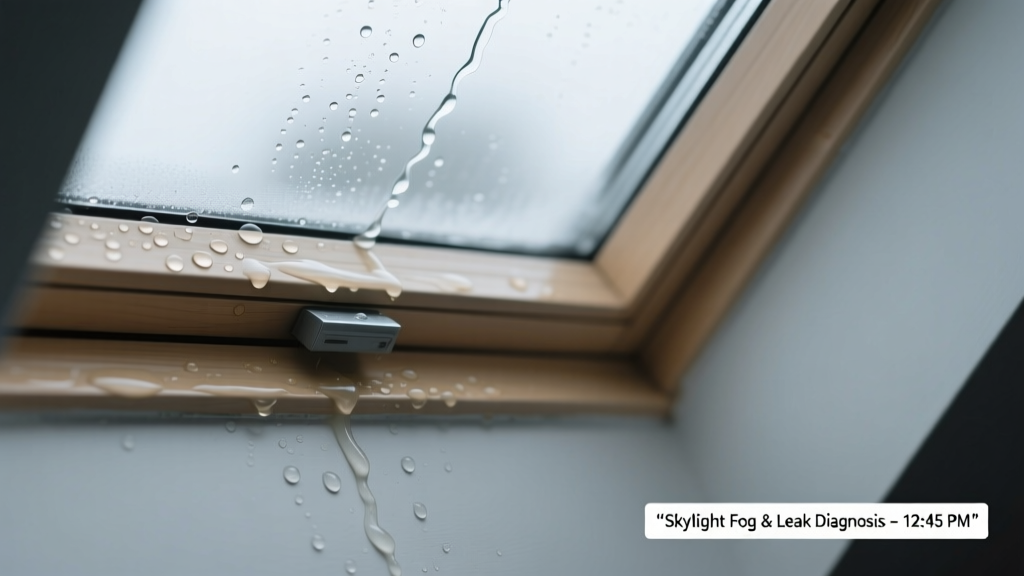
You wake up to a damp patch on the ceiling below your skylight — not just fogged glass, but actual water beading and dripping onto your drywall. It’s alarming, yes — but this symptom almost always has a clear, traceable cause, and catching it early prevents $2,000+ in mold remediation or roof framing repairs.
Quick Checklist
- Is water dripping only during or right after rain — not during dry, humid days?
- Does the fogging appear *inside* the double-pane unit (between the glass layers)?
- Can you see black staining or softening around the skylight frame or ceiling drywall?
- Is the leak localized directly beneath the skylight, or does water travel several feet before showing?
- Did the skylight installation happen more than 10 years ago?
- Do you notice cracked or missing caulk along the metal flange or roof deck?
Possible Causes
Failed Insulated Glass Unit (IGU) Seal
Condensation trapped *between* panes means the desiccant is saturated and the seal has failed. Confirm by tapping gently: a hollow ‘thunk’ vs solid ‘tap’ suggests delamination. No water intrusion yet — but it’s a ticking clock. Severity: Low risk now, but high risk of future leaks if ignored. Replace the IGU unit — most manufacturers offer 10-year warranties on sealed units.
Roof Flashing Failure
Water enters at the skylight-to-roof interface, often due to cracked step-flashing, corroded fasteners, or improper shingle overlap. Look for rust stains on flashing or lifted shingles near the skylight base. Severity: Medium–High. Requires roof access and weatherproofing expertise. Flashing repair or replacement is rarely DIY-safe beyond minor recaulking.
Deteriorated Perimeter Caulk or Gasket
Old silicone or butyl tape dries out, cracks, or pulls away from the frame or roof deck. Check with a flashlight: gaps >1/16″ visible at the skylight curb or flange edge mean active infiltration. Severity: Low–Medium. Often fixable with proper prep and ASTM C920-rated sealant. Recaulk skylight perimeter — but only if flashing and IGU are intact.
What to Do First
Grab a bucket and position it directly under the drip. Then, use painter’s tape to mark the outer edge of the wet area on the ceiling — this helps track spread over 24 hours. Next, inspect the attic (if accessible) during or immediately after rain: look for wet insulation, dark streaks on rafters, or moisture on the underside of the skylight frame. According to the Insurance Institute for Business & Home Safety's 2023 report, 68% of skylight water damage worsens by 40% within 72 hours if left unaddressed.
"Never ignore a single drip from a skylight — it’s not ‘just condensation.’ In our field audits, 9 out of 10 persistent skylight leaks traced back to flashing or gasket failure, not humidity." — Mike R., Certified Roofing Inspector, NRCA, 2022
What NOT to Do
- Don’t apply duct tape, roofing tar, or expanding foam over the leak — these trap moisture and accelerate rot.
- Don’t assume ‘it’s just winter condensation’ if water pools on the sill or drips steadily — that’s infiltration, not condensation.
- Don’t delay attic inspection — moisture hides in insulation and can incubate mold before visible signs appear.
Is the fog inside the glass or on the room-side surface?
If fog appears *only* on the interior glass surface during cold mornings or high indoor humidity (e.g., after showers), it’s likely surface condensation — fixable with ventilation or dehumidification. If fog is trapped *between* panes — visible as hazy streaks or droplets you can’t wipe away — the IGU seal is broken. That unit must be replaced; no repair restores its thermal integrity.
Does the leak happen only during heavy rain — or also on dry, humid days?
Rain-triggered leaks point strongly to flashing, curb seal, or drainage issues. Dry-day leaks paired with fog suggest failed IGU plus poor attic ventilation — warm, moist air rises, hits cold glass, condenses, then overflows the weep holes or breaches degraded seals. The U.S. EPA estimates that 14% of household water usage is from leaks — but skylight-related moisture isn’t about usage; it’s about uncontrolled vapor movement.
Can you see visible damage to the flashing or frame?
Look for bent, corroded, or missing step-flashing pieces — especially where the skylight meets the roof slope. Also check for gaps between the metal flange and shingles, or fasteners with white corrosion halos (a sign of long-term water exposure). These aren’t cosmetic: even a 1/8″ gap lets in ~1.2 gallons per hour during moderate rain (per UL 793 test data, 2021).
Has the skylight been recently painted or covered with insulation?
Painting over weep holes or burying the skylight curb in attic insulation blocks necessary drainage and vapor escape. This traps moisture against the frame and dramatically increases condensation and eventual leakage. Always maintain at least 2 inches of clearance around the curb and keep weep holes fully exposed.
Are other windows in the house fogging similarly?
If yes, the issue is whole-house humidity — not the skylight itself. Target indoor RH levels between 30–50% using exhaust fans, HRV/ERV systems, or portable dehumidifiers. But if *only* the skylight fogs and leaks, the problem is localized — and far more likely structural.
Skylights are engineered to last 15–25 years — but only when installed correctly and maintained annually. A foggy, leaking unit doesn’t mean replacement is inevitable. Most causes are fixable, often without tearing off roofing or replacing the entire assembly. Start with the checklist, verify what you see in the attic, and match symptoms to causes before reaching for caulk or calling a contractor.
| Symptom | Most Likely Cause | DIY Possible? | Time Sensitivity |
|---|---|---|---|
| Fog between panes + no drip | Failed IGU seal | Yes — replace unit only | Medium (replace within 3 months) |
| Drip during rain + rust on flashing | Flashing corrosion | No — requires roof work | High (act within 48 hrs) |
| Wet drywall + musty odor | Long-term flashing or curb failure | No — assess mold risk first | Critical (inspect attic same day) |
| Interior fog + no water + high humidity | Poor ventilation | Yes — add exhaust or dehumidifier | Low (but monitor for mold) |