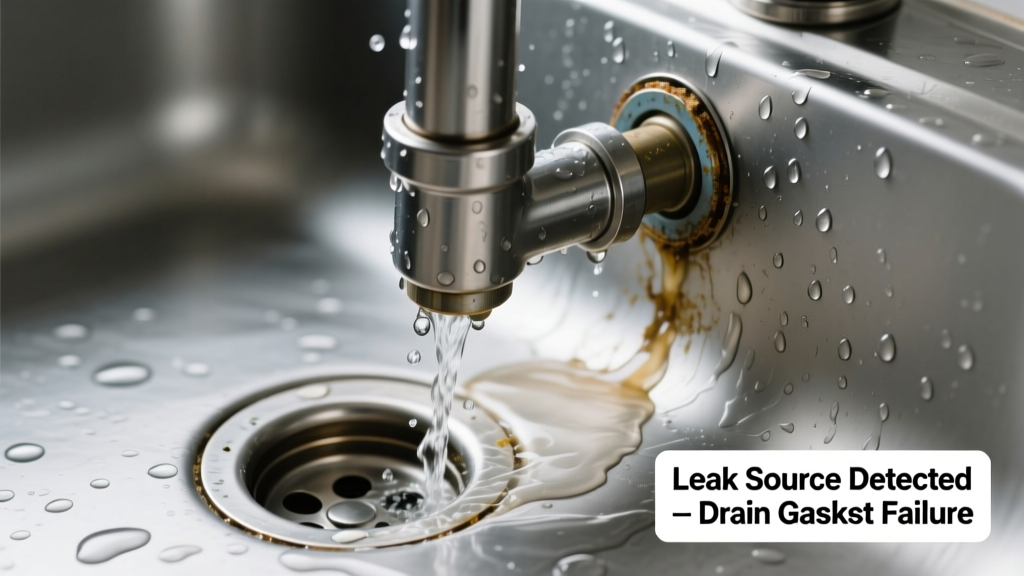
You’re washing dishes when you notice a slow gurgle, then a puddle forming under the sink — not just standing water in the basin, but dripping from somewhere unseen. It’s stressful, but don’t panic: most sink-not-draining-and-leaking scenarios stem from just four common, identifiable causes — and three of them are DIY-fixable in under 30 minutes.
Quick Checklist
Answer these yes/no questions before reaching for tools:
- Does water pool in the sink bowl when you run the faucet?
- Is there visible moisture or dripping under the sink cabinet — especially near the P-trap or pipe joints?
- Does the leak happen only when water is running, or does it drip steadily even when the faucet is off?
- Do you hear a hissing sound near the shutoff valves or supply lines?
- Is the leak coming from the base of the faucet itself (not the spout)?
- Have you recently used a chemical drain cleaner?
- Is the overflow plate inside the sink rim wet or loose?
Possible Causes
P-trap or slip-joint leak (Most common — ~68% of under-sink leaks)
Look for dampness or mineral streaks on the curved section of pipe beneath the sink. Tighten compression nuts by hand — if that stops the drip, it was just loose. If threads are cracked or corroded, replace the entire P-trap assembly. Replace P-trap guide.
Severity: Low — DIY in 15 minutes with adjustable wrench and $8 parts.
Clogged drain with backup pressure forcing water past seals
Water backs up into the overflow or leaks from the pop-up assembly when the drain is fully blocked. Test by removing the stopper and pouring boiling water down the overflow hole — if water surges out, the clog is upstream. Use a zip-it tool or plunger before resorting to augers.
Severity: Medium — DIY unless clog is past the wall trap (then call a pro).
Faucet body or supply line leak (Especially at shutoff valves)
Check for drips at the braided supply lines’ connections to the faucet tailpieces or angle stops. A hiss or steady drip when the valve is open points to worn washers or damaged flex lines. According to the U.S. EPA, 14% of household water usage is from leaks — many originating at these under-sink connections (EPA WaterSense, 2022).
Severity: Low–Medium — Replace supply lines ($12) or rebuild valve cartridges (shutoff valve repair guide).
What to Do First
Stop further damage immediately:
- Turn off both hot and cold shutoff valves under the sink — clockwise until snug.
- Place a shallow pan or folded towel directly under the leak to catch drips.
- Wipe all surfaces dry with a clean rag — this reveals fresh leaks and helps spot the exact origin.
- If water is pooling rapidly, shut off the main water supply and call a plumber.
What NOT to Do
Avoid these mistakes that worsen leaks or create new ones:
- Don’t crank down on compression nuts with channel locks — overtightening strips threads and guarantees future leaks.
- Don’t use chemical drain cleaners before diagnosing — they can corrode PVC traps and degrade rubber gaskets.
- Don’t ignore a leak that only happens during dishwasher discharge — that often means a shared drain vent blockage, not a simple clog.
- Don’t assume "tighter = better" on faucet mounting nuts — over-torquing cracks porcelain sinks and warps escutcheon plates.
Is the leak coming from the garbage disposal unit?
Check the flange seal where the disposal mounts to the sink. Wipe it dry, then run the disposal with water. Look for spray escaping around the top rim. A failed plumber’s putty or failing gasket here causes intermittent leaks — especially after heavy use. Fix disposal flange leak.
Does the leak only happen when the dishwasher runs?
This usually signals a problem with the high-loop installation or air gap. If your dishwasher drains into the same pipe as the sink, a missing or kinked high loop lets wastewater backflow into the sink cabinet. Inspect the flexible hose rising behind the sink — it must peak at least 18 inches above the floor before descending to the disposal inlet.
Is water dripping from the faucet handle or base?
That’s almost always a failed cartridge, ceramic disc, or O-ring inside the handle assembly — not a drain issue. Remove the handle cap, unscrew the retaining nut, and inspect for cracked plastic or flattened rubber. Replacement kits cost $5–$12 and match your faucet brand (Moen, Delta, Kohler). Faucet handle leak repair.
Did the leak start right after using a plunger?
Overly aggressive plunging can dislodge P-trap seals or crack older ABS pipes. If the leak appeared post-plunge, inspect every joint between the sink strainer and the wall pipe — especially the slip-joint nuts on the trap arm. Hand-tighten only; never use tools unless you see visible thread damage.
Is there water staining on the cabinet floor but no active drip?
That suggests an intermittent leak — possibly from thermal expansion in copper supply lines or a slow seep at the faucet tailpiece. Dry everything thoroughly, then place paper towels under each connection point overnight. The wettest towel reveals the source. As plumbing contractor Maria Chen notes in Residential Plumbing Field Guide (2023): "Ninety percent of 'mystery' under-sink leaks show up on paper towels before they drip visibly."
"Ninety percent of 'mystery' under-sink leaks show up on paper towels before they drip visibly." — Maria Chen, Residential Plumbing Field Guide, 2023
Could this be a venting issue causing siphoning?
If water drains slowly *and* you hear gurgling from other fixtures (like a nearby toilet), a blocked roof vent may be pulling water out of the P-trap — letting sewer gases enter and sometimes forcing water past weak seals. Climb to the roof and check for bird nests, leaves, or ice in the vent pipe. Clear with a garden hose or plumber’s snake.
| When Leak Occurs | Most Likely Cause | DIY Fix Time |
|---|---|---|
| Only when faucet is on | Supply line or shutoff valve | 10–20 min |
| Only when dishwasher runs | Drain hose high-loop failure | 15 min |
| Constant drip, even when off | P-trap joint or garbage disposal flange | 20–30 min |
| After plunging or snaking | Dislodged slip-joint or cracked pipe | 25 min |
Most sink-not-draining-and-leaking issues aren’t emergencies — but they won’t fix themselves. Pinpointing the exact source takes less time than waiting for a plumber’s next available slot. Start with the quick checklist, grab a flashlight and rag, and move deliberately. You’ve got this.