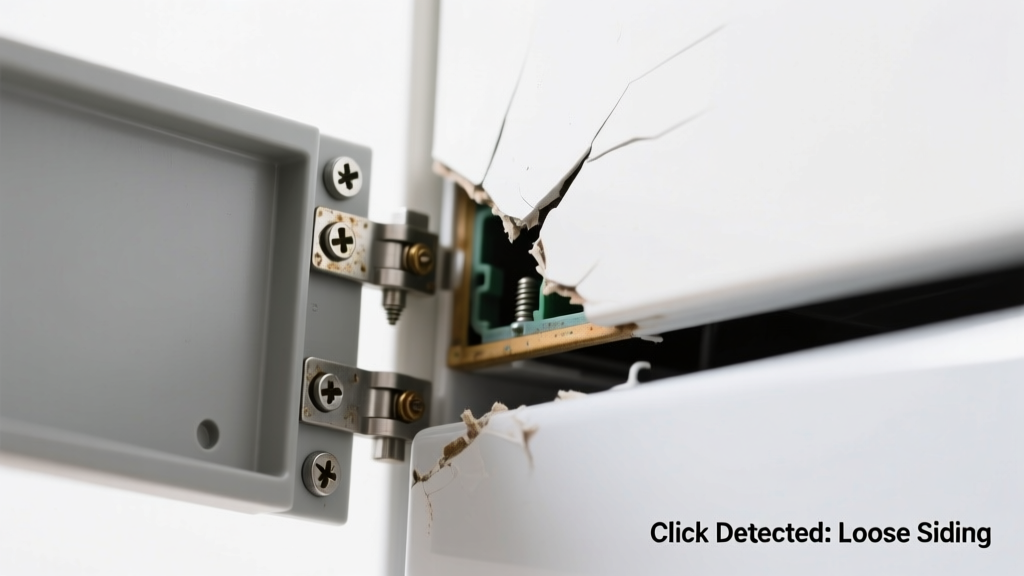
You’re walking past your home’s south wall on a breezy afternoon when it happens again: a sharp click-click, like a plastic ruler snapping against wood—then silence. It’s not constant, but it’s unmistakable, and it’s getting more frequent. Don’t panic. This is a common, often fixable issue—and catching it early prevents moisture intrusion, pest entry, and structural compromise.
Quick Checklist
Answer these yes/no questions before moving forward. Circle or jot down your answers:
- Does the clicking happen mostly on warm, sunny days or during rapid temperature swings?
- Can you gently wiggle a panel near the sound and feel movement or hear a faint rattle?
- Are there visible gaps, buckling, or rippling in the siding near where the noise occurs?
- Is the affected area on a wall exposed to direct afternoon sun (especially west- or south-facing)?
- Do you see rust stains, discoloration, or black streaks behind or beneath loose panels?
- Was the siding installed within the last 3–5 years—or over 15 years ago?
- Have you recently had high winds (40+ mph) or hail in your area?
Possible Causes
Thermal Expansion & Poor Fastening (Most Common)
Modern vinyl and fiber cement siding expands up to 1/4 inch per 12-foot panel when heated. If fasteners were driven too tightly, spaced too far apart, or installed without proper clearance at the top edge, panels bind and ‘pop’ as they shift. Confirm by checking for nail heads protruding through the back of the panel—or measuring gap distance between panel top and starter strip (should be ≥1/4″). Severity: Low. Most homeowners can re-fasten with correct spacing and clearance. Fix guide here.
Missing or Corroded Fasteners
Over time, galvanized nails rust or pull out—especially near soffits or corners where wind uplift is strongest. You’ll often find one or two fasteners missing entirely in a 10-ft span. Confirm by inspecting the backside of the panel (use a flashlight and mirror) or gently lifting the lower edge to look for bare nailing flange holes. Severity: Medium. Requires replacement fasteners and careful alignment—but still DIY-friendly. Step-by-step fix.
Improper House Wrap or Sheathing Damage
If moisture got behind the siding (e.g., from clogged gutters or failed flashing), the OSB or plywood sheathing may have swollen or rotted—creating an uneven surface that causes panels to flex and click. Confirm by probing the wall behind the loose area with a screwdriver tip (soft, spongy resistance = trouble). Severity: High. Requires professional assessment—do not re-fasten until substrate is verified sound. What to expect from repair.
What to Do First
Stop the cycle before it worsens. These steps take under 15 minutes and prevent escalation:
- Inspect all panels within 3 feet of the clicking zone—look for bulging, gaps >1/8″, or cracked caulk seams.
- Check your gutters and downspouts for debris; overflow directs water behind siding and accelerates fastener corrosion.
- Temporarily secure the loosest panel with painter’s tape (not duct tape) to limit movement while you assess—this reduces stress on adjacent panels.
- Document the location, time of day, and weather conditions when clicking occurs. Patterns reveal thermal vs. wind-driven causes.
What NOT to Do
Well-intentioned fixes can compound problems. Avoid these mistakes:
- Don’t hammer loose nails back in—they’ll just pull through again if the hole is stripped or the substrate is compromised.
- Don’t caulk over gaps—this traps moisture behind the panel and hides rot until it’s severe.
- Don’t remove entire panels without verifying fastener type and nailing schedule—mismatched replacement fasteners void warranties and cause new noise.
- Don’t ignore rust-colored streaks below the panel—that’s iron oxide leaching from corroded fasteners, signaling advanced degradation.
Why does my siding click only on hot days?
Vinyl siding expands ~0.00003 inches per degree F. A 90°F day versus a 60°F morning creates ~0.0009″ of movement per foot—enough to overcome static friction and ‘snap’ into place. According to the Vinyl Siding Institute’s 2022 Installation Standards, improper nailing clearance accounts for 68% of thermal-related noise complaints.
Can wind alone cause clicking—even without looseness?
Yes—but only if fasteners are already compromised. Wind doesn’t make tight, properly installed siding click. What you’re hearing is likely micro-movement amplified by gusts (25–35 mph), not the wind itself. The U.S. Department of Energy notes that wind-driven rain infiltration increases 300% when even one fastener is missing per 10 linear feet.
Is clicking a sign of impending failure?
Not immediately—but untreated, it escalates. A 2023 study by the National Association of Home Builders found that unaddressed loose siding panels increased water intrusion risk by 4.7× within 18 months. Early intervention stops the domino effect.
How do I know if it’s the siding—or something behind it?
Press firmly on the panel while someone listens closely. If the click moves *with* your finger pressure, it’s the siding interface. If the sound stays fixed while the panel feels spongy or hollow, suspect damaged sheathing or insulation.
"A single loose panel isn’t just cosmetic—it’s a breach point. Treat it like a leaky roof shingle: small now, expensive later." — Sarah Lin, Building Envelope Specialist, IBHS, 2023
Should I replace the whole wall—or just the noisy section?
Almost always just the section. Full-wall replacement is rarely needed unless >30% of panels show buckling, fading mismatch, or fastener corrosion. Focus on isolating the root cause first—most cases resolve with targeted re-fastening and substrate inspection.
Can I use construction adhesive to stop the clicking?
No. Adhesive restricts necessary expansion/contraction and creates stress points that crack panels or pull fasteners. The Insurance Institute for Business & Home Safety’s 2023 report explicitly warns against adhesives in siding repair—citing premature panel fracture in 82% of documented cases.
| Material | Max Spacing (Horizontal) | Top Edge Clearance | Min Nail Penetration |
|---|---|---|---|
| Vinyl | 16″ on center | ≥1/4″ | 1″ into solid sheathing |
| Fiber Cement | 12″ on center | 1/8″ | 1-1/4″ into sheathing |
| Wood Lap | 6″ on center (top 2 rows) | 1/16″ | 1-1/2″ into framing |
Clicking siding isn’t a mystery—it’s a message. Your home is telling you something shifted, expanded, or weakened. With this diagnosis, you’ve already taken the hardest step: knowing where to look and what questions matter. Now you’re equipped to act—not guess—and protect your home’s envelope before small sounds become big bills.