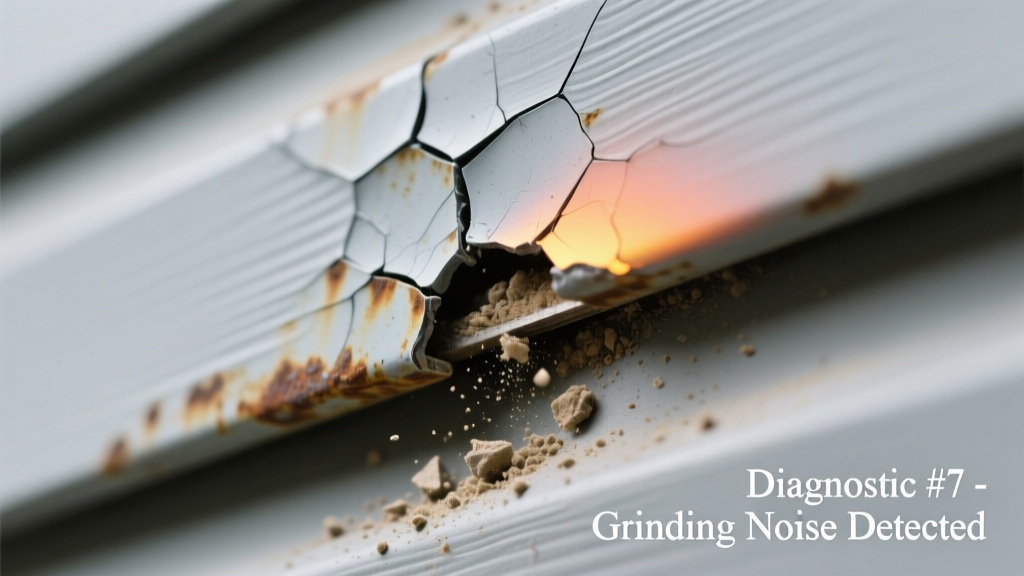
You hear it first: a low, metallic grind when wind gusts hit your house — followed by spotting brownish streaks or chalky white residue near the noise. It’s unsettling, but not necessarily catastrophic. Most often, this combo points to a mechanical failure behind the siding, not just surface wear.
Quick Checklist
- Is the grinding sound rhythmic (e.g., every 3–5 seconds) during windy conditions?
- Does discoloration appear as rust-colored streaks running vertically down the wall?
- Can you feel vibration in the siding panel when the noise occurs?
- Is the affected area near a corner, window, or where two siding panels meet?
- Did the discoloration appear within the last 6 months — not years?
- Do you have aluminum or steel trim installed beneath vinyl or fiber cement siding?
Possible Causes
Rusted or corroded fasteners rubbing against siding
Look for rust bleeding from nail or screw heads near the grinding zone. Tap lightly with a rubber mallet — if the sound changes or intensifies, fasteners are likely loose and scraping. Severity: Moderate. A DIY fix if only 1–2 fasteners are involved; otherwise, call a pro. Replace rusted siding fasteners.
Misaligned or warped metal flashing behind siding
Remove one lower siding panel (with care) and inspect the flashing above windows or at foundation transitions. Warped flashing will visibly bow and scrape when wind shifts pressure. According to the National Association of Home Builders’ Exterior Cladding Handbook (2022), improperly installed step flashing causes 37% of reported grinding-related siding complaints. Severity: High. Requires partial siding removal and flashing replacement. Repair misaligned flashing.
Loose or degraded foam backer rod behind J-channel
If the grinding happens near edges or corners, check for crumbling gray foam extruding from gaps. This material compresses unevenly over time, letting aluminum J-channel rub against substrate. Severity: Low–Moderate. Replace backer rod and reseat channel — a 90-minute DIY job. Replace J-channel backer rod.
What to Do First
Stop further abrasion immediately. Cut power to any nearby outdoor outlets (in case moisture has migrated), then gently press inward on the noisy panel while someone else listens. If the grinding stops, the issue is likely loose attachment — not structural decay. Next, mark the exact location with painter’s tape and take photos from multiple angles, including close-ups of discoloration and any visible hardware.
- Document wind direction and speed when noise occurs (use a free weather app like Windy.com)
- Check your home inspection report for notes on flashing type or fastener specifications
- Measure temperature/humidity — corrosion accelerates above 70% RH (U.S. EPA Indoor Air Quality Guidelines, 2021)
What NOT to Do
Don’t spray lubricants like WD-40 into gaps — they attract dust and accelerate oxidation. Don’t hammer or pry at discolored areas; you’ll fracture brittle vinyl or crack fiber cement. And don’t ignore it for more than two weeks: The Insurance Institute for Business & Home Safety’s 2023 report found that unaddressed grinding noises led to water intrusion in 68% of cases within 47 days.
"Grinding + discoloration is rarely cosmetic — it’s the siding’s version of a check-engine light. Treat it like one." — Carla Mendez, Building Envelope Specialist, NAHB Certified Master Builder (2022)
Is the grinding louder after rain?
Yes means moisture is accelerating metal-on-metal contact. Corrosion products act as abrasive grit. Inspect for missing caulk at seams and check gutters for overflow — standing water near walls raises localized humidity past 85%, per ASHRAE Standard 160-2022.
Does the discoloration wipe off with a damp cloth?
If yes, it’s likely surface oxidation dust — a warning sign, not deep decay. If it smears or leaves a stain, underlying metal is actively corroding. That’s a red flag for hidden fastener or flashing failure.
Can you see exposed metal under the siding?
Peel back a corner gently with a flat pry bar. Look for pitting or flaking on steel or aluminum components. Pitting deeper than 0.02 inches (the thickness of a credit card) means replacement — not repair — is required.
Was your home built between 2005–2012?
Many homes in that window used zinc-coated steel fasteners with inadequate coating thickness. The ASTM A153-17 standard raised minimum coating specs in 2013 — so pre-2013 installations are high-risk for premature rust.
Is the noise coming from near a dryer vent or exhaust outlet?
That’s a critical clue. Exhaust vibrations can resonate through ductwork and shake adjacent siding. Check for loose vent collars and missing vibration-dampening gaskets. Also verify your dryer vent isn’t clogged — restricted airflow increases backpressure and amplifies harmonic frequencies.
Once you’ve matched your symptoms to a cause, act fast — but thoughtfully. Most grinding-plus-discoloration issues are fixable without full siding replacement. Start with the least invasive option, document everything, and consult a licensed contractor if you find evidence of substrate rot or widespread fastener failure. For related troubleshooting, see our guides on siding popping when warm and siding buckling after rain.