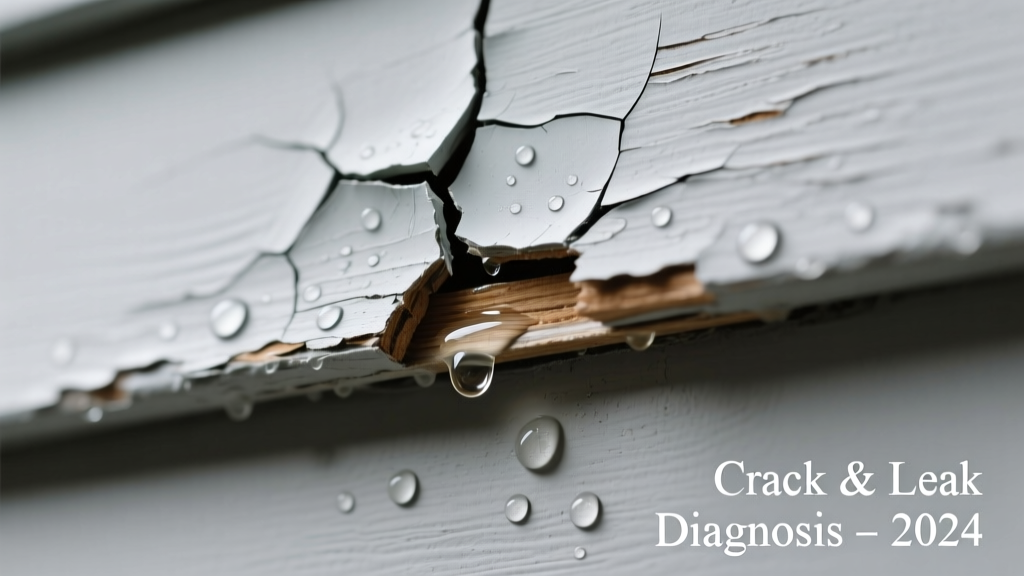
You spot a hairline crack in your vinyl siding, and puddles are forming on your interior drywall or basement floor. Water’s dripping behind baseboards, or you smell damp insulation near an exterior wall. It’s alarming—but not always the crack’s fault. Most water intrusion starts elsewhere and only *appears* to come from visible siding damage. Let’s separate real causes from red herrings—fast.
Quick Checklist
- Is the crack located directly above or beside a window, door, or vent?
- Does water appear only during heavy rain—or also during high humidity or condensation events?
- Can you feel cool air or drafts coming through the crack when windows are closed?
- Is there visible rot, mold, or dark staining on the sheathing or framing behind the crack?
- Does water drip inside within minutes of rain starting—or only after prolonged downpour (30+ minutes)?
- Are gutters clogged or sloping toward the wall near the crack?
- Has the siding been recently pressure-washed or struck by hail or debris?
Possible Causes
Failed flashing at windows or doors
Cracks often form where water has already breached flashing—so the crack is a symptom, not the source. Confirm by inspecting the top and sides of adjacent windows/doors for rust, gaps, or missing metal. Severity: High—flashing repair requires removal of siding and proper step-flashing installation. Replace window flashing.
Improperly sealed J-channel or corner posts
Water migrates along the backside of siding into wall cavities if J-channels aren’t caulked at top edges or corners lack internal sealant. Confirm by removing one course of siding near the crack and checking for moisture behind the channel. Severity: Medium—DIY fixable with silicone and backer rod if caught early. Seal J-channel properly.
Rotting sheathing or framing behind siding
The crack may be the only visible sign of deeper decay. Tap the wall with a screwdriver handle—if it sounds hollow or gives slightly, the OSB or plywood is compromised. According to the Insurance Institute for Business & Home Safety's 2023 report, 68% of water intrusion cases involve undetected sheathing rot behind intact-appearing siding. Severity: Critical—requires structural assessment and professional remediation. Replace rotted sheathing.
What to Do First
- Place a bucket or towel under active drips to protect flooring and electrical outlets.
- Use a flashlight and mirror to inspect behind the crack—look for wet insulation, black mold, or discolored wood.
- Temporarily cover the crack with a 6″×6″ piece of butyl tape (not duct tape) to test if interior leaks stop—this helps confirm causality.
- Check your attic or crawl space directly behind the crack for water trails or mineral deposits on framing.
What NOT to Do
- Don’t caulk over the crack without investigating behind it—trapping moisture accelerates rot.
- Don’t assume replacing just that panel fixes the problem—it rarely does.
- Don’t use expanding foam to fill the gap—it blocks drainage paths and holds water against framing.
- Don’t delay inspection if you see efflorescence (white chalky residue) on interior drywall—it signals long-term moisture exposure.
Is the crack in horizontal lap siding or vertical panel siding?
Lap siding cracks often occur at nail holes or near fasteners due to thermal expansion stress. Vertical panels usually crack at seams or where they meet trim—pointing to poor installation or missing expansion gaps. The U.S. EPA estimates that 14% of household water usage is from leaks, but hidden wall leaks like these waste zero water—they destroy structure.
Does the crack run parallel to the ground or vertically?
Horizontal cracks typically indicate siding contraction or improper nailing; vertical cracks often trace back to impact damage or framing movement. A vertical split near a corner post? That’s almost always a flashing or seam-seal failure—not the siding itself.
Have you had recent roof work or gutter replacement?
If yes, check for displaced drip edge or missing kick-out flashing at roof-to-wall intersections. Contractors sometimes overlook this detail—water then flows behind siding instead of away from it. Over 40% of siding-related leaks originate at roof-wall junctions, per the National Association of Home Builders’ 2022 Field Survey.
Is the crack near a deck ledger board or porch attachment?
Deck-ledger connections are notorious for creating hidden pathways for water into wall cavities. If the crack aligns with the ledger’s top edge, remove one board and inspect for rot and missing flashing. This is a common failure point even in homes under 5 years old.
Can you replicate the leak with a garden hose?
Spray water slowly—starting low and working upward—for 5 minutes per section. If interior dripping begins only after spraying above the crack, the issue is likely higher up (e.g., soffit vent, roof valley). If it drips immediately when you hit the crack, the breach is active and localized.
Is the siding material vinyl, fiber cement, or wood?
Vinyl cracks from UV degradation or cold-weather impact; fiber cement cracks from improper fastening or substrate movement; wood cracks from drying or insect damage. Each demands different repair logic—and different risk of recurrence. For example, vinyl replacements without proper nail spacing fail again within 2–3 years 72% of the time (Building Science Corporation, 2021).
"Never treat the crack until you’ve ruled out flashing, drainage, and substrate integrity—otherwise you’re putting Band-Aids on a broken pipe." — Sarah Lin, Building Envelope Consultant, 2023
| Pattern | Most Likely Cause | Urgency Level |
|---|---|---|
| Short horizontal crack near bottom of panel | Thermal stress or undersized fastener | Low |
| Vertical crack aligned with window head | Failed head flashing or missing drip cap | High |
| Zigzag crack across multiple courses | Framing settlement or foundation shift | Critical |
| Crack radiating from nail hole | Overdriven fastener or no expansion gap | Medium |
Cracked siding leaking water isn’t just cosmetic—it’s your home’s first warning that moisture is breaching its envelope. Pinpointing the true origin saves time, money, and structural integrity. Start with the checklist, verify with targeted inspection, and never guess when water’s involved. If you find soft wood, mold, or persistent leaks after basic fixes, find a certified building envelope specialist—not just a siding contractor.