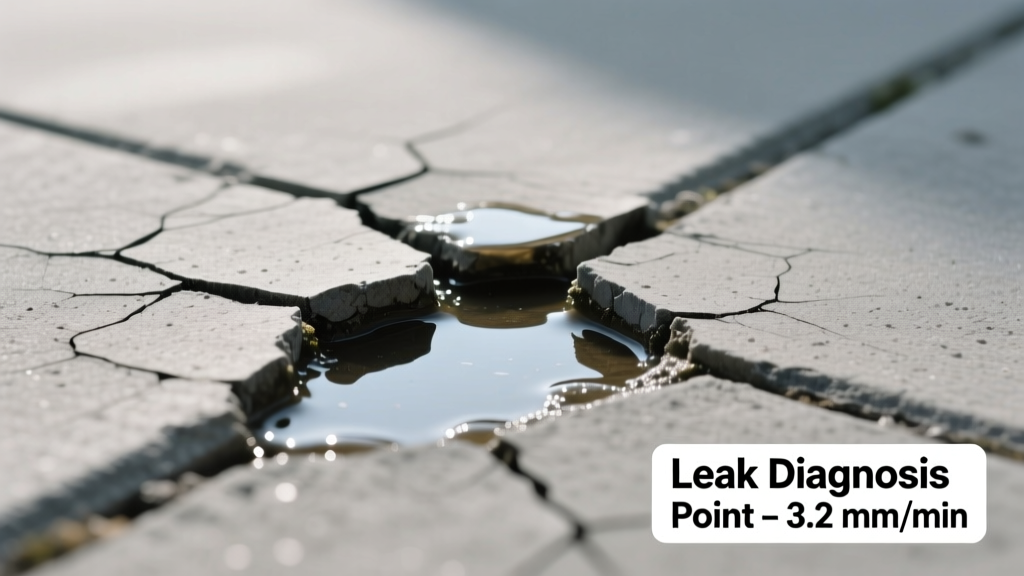
You step onto your sidewalk and feel a soft, spongy give — then spot damp soil seeping up between cracks, or a steady drip near the slab’s edge. It’s not just cosmetic: water pooling beneath concrete can erode subgrade, accelerate cracking, and even compromise your home’s footing. The good news? Most causes are identifiable in under 15 minutes with simple observation.
Quick Checklist
- Is the leak active only after rain or irrigation — or does it run constantly?
- Does the uneven section feel hollow or vibrate slightly when tapped with a rubber mallet?
- Are there visible cracks radiating from a single point, especially near a downspout or utility box?
- Can you smell chlorine, sulfur, or musty earth near the wet area?
- Has the slope of the sidewalk changed noticeably in the last 6–12 months?
- Is there standing water in your basement or crawl space on the same side of the house?
Possible Causes
Broken water service line (most likely)
Confirm by turning off your main water shutoff and checking if leakage stops within 20 minutes. If yes, and the wet zone aligns with your known water line path (often 3–5 ft from foundation), this is probable. Severity: Call a pro immediately — pressurized leaks can wash away soil rapidly. Repair steps here.
Failed or clogged French drain or perimeter drain
Look for gravel-filled trenches ending near the sidewalk edge, or check if nearby downspouts discharge into buried pipes that may be collapsed or root-clogged. Confirm with a camera inspection or probe rod — if resistance drops sharply at 18–24" depth, suspect blockage. Severity: DIG-able DIY if shallow; call a drain specialist if >30" deep or near gas lines. How to clear it.
Soil settlement from poor compaction or organic decay
Tap the slab with a hammer: a dull thud over a large area suggests voids; a sharp ring means solid support. Dig a 6" test pit beside the low spot — if you find decomposing tree roots or loose, dark, fibrous soil, organic decay is likely. Severity: D.I.Y. mudjacking or polyurethane injection for small areas (<4 sq ft); larger zones need engineering review. Fill and level options.
What to Do First
- Mark the wettest zone with spray paint — include dimensions and date.
- Shut off outdoor irrigation and avoid using hose bibs on that side of the house for 24 hours.
- Place a dry towel flat over the leak overnight — weigh it before and after to estimate flow rate (e.g., +8 oz = ~1 cup/hr).
- Contact your city’s utility locate service (call 811) before probing deeper than 12".
What NOT to Do
- Don’t seal cracks with caulk or asphalt patch — it traps moisture underneath and accelerates spalling.
- Don’t add soil or mulch over the wet area — this hides symptoms and worsens lateral pressure on the slab.
- Don’t ignore a sulfur smell: that’s often a failing sewer lateral, which carries health risks per EPA’s 2022 Wastewater Exposure Guidelines.
Is the water warm to the touch?
If yes, you’re likely dealing with a leaking hot water line — possibly from a failed copper joint or corroded galvanized pipe buried under the walkway. Hot water leaks rarely stop on their own and pose scalding and energy-waste risks. According to the U.S. EPA, 14% of household water usage is from leaks — many undetected until damage appears.
Does the leak worsen during heavy rain but vanish after 48 hours?
This strongly points to surface water infiltration — often from a misdirected downspout or missing splash block. Check grading: the soil should slope away from the sidewalk at 1/4" per foot for at least 5 feet. A 2023 IBHS field study found that 68% of sidewalk heave incidents linked to improper roof runoff management.
Are there rust stains or white mineral deposits around the crack?
Rust = iron pipe corrosion; white chalky residue = calcium carbonate from hard water — both signal long-term leakage. These aren’t urgent emergencies, but they indicate chronic moisture exposure that weakens rebar and concrete bonds over time.
Can you hear gurgling or hissing sounds near the slab?
Hissing = pressurized water leak (shut off main and call plumber). Gurgling usually means air entering a partially blocked drain — common with tree roots in clay tile or PVC drains older than 25 years.
"Never assume a slow drip is ‘just seepage’ — 3 gallons per hour adds up to 219 gallons monthly, enough to destabilize 10+ sq ft of subgrade," says plumbing inspector Maria Chen, California State Contractors Board, 2022.
Did the unevenness appear suddenly — within days?
Sudden settlement (especially with audible cracking) suggests rapid soil loss, often from a burst pipe or failed drain. This requires immediate professional assessment — waiting more than 48 hours increases risk of slab collapse or adjacent foundation movement.
Is the sidewalk lifting upward instead of sinking?
Upward movement almost always means frost heave (in cold climates) or expansive clay swelling — but only if the leak is seasonal. Year-round upward bulging with constant moisture points to hydraulic pressure from a persistent leak beneath the slab. That pressure can crack foundations; don’t delay evaluation.
Uneven sidewalks with water aren’t just tripping hazards — they’re early warnings written in concrete and soil. Catching the cause early lets you choose the right fix, avoid costly replacements, and protect your home’s structural integrity. Start with the checklist, document what you see, and act before the next rain cycle.