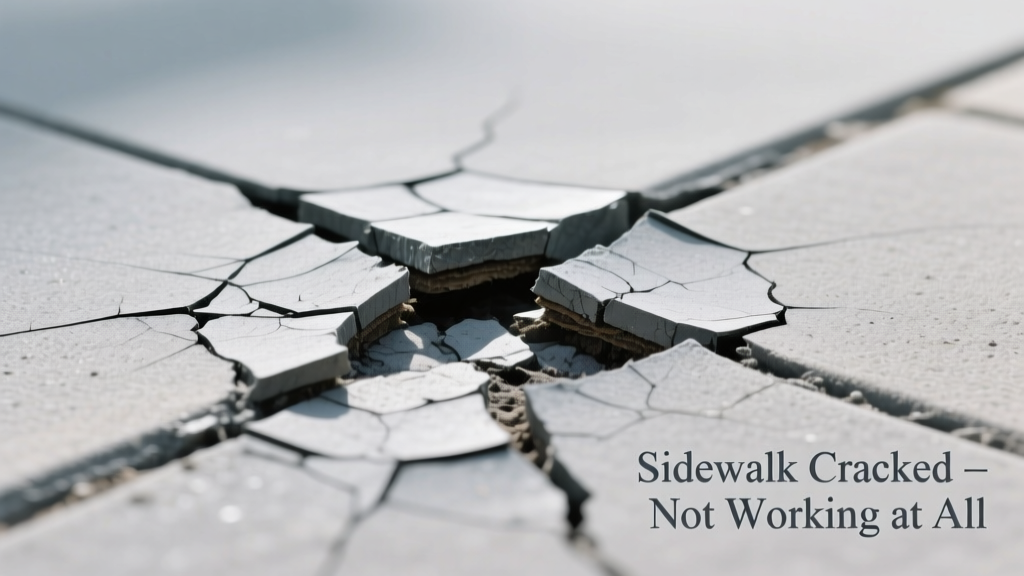
Your sidewalk isn’t just splitting — it’s failing. Sections lift like warped floorboards, gaps yawn wide enough to catch a stroller wheel, and the concrete groans underfoot. That’s not normal wear. It’s a structural warning sign — and yes, sidewalks *are* supposed to work: evenly support weight, shed water, and stay stable for decades. The good news? Most root causes are identifiable in under 15 minutes.
Quick Checklist
- Is there visible heaving (upward movement) on one side of the crack?
- Does the crack widen noticeably after heavy rain?
- Is soil visibly eroded or washed away beneath the slab?
- Are tree roots protruding through or lifting the edge?
- Does the crack run straight across a joint or follow a diagonal path?
- Is there standing water pooling along the crack after rain?
- Has the area been recently excavated nearby (e.g., for utility work)?
Possible Causes
Soil Erosion or Poor Drainage
Confirm by probing soil beneath the crack with a screwdriver — if it sinks >2 inches or feels hollow, erosion is likely. Check for downspouts dumping water within 3 feet of the slab. Severity: Moderate. A DIY fix works only if caught early; once voids exceed 6 inches deep, you’ll need mudjacking or replacement. Fix soil erosion under sidewalk
Tree Root Uplift
Look for raised edges, especially near mature maples, oaks, or silver birches. Roots >2 inches thick pushing up from below will show as smooth, curved bulges — not jagged breaks. Severity: High. Cutting roots risks tree health and may trigger regrowth; certified arborist consultation is required before any action. Repair sidewalk lifted by roots
Frost Heave (in cold climates)
Occurs where clay soil, poor drainage, and freeze-thaw cycles combine. Cracks appear in late winter/early spring, often with adjacent slabs tilted upward like a hinge. Confirm by checking if adjacent driveways or patios show similar movement. Severity: Medium. Requires regrading + base gravel replacement — not a patch-and-pray job. Fix frost-heaved sidewalk
What to Do First
Stop further damage before it accelerates. Seal exposed edges with polyurethane caulk (not silicone) to block water entry. Redirect downspouts at least 5 feet away using rigid PVC extensions. Place sandbags or temporary gravel berms to divert runoff around the crack. Document movement weekly with dated photos — measure gap width with a ruler and note any new spalling or crumbling.
- Mark the crack’s endpoints with spray paint for consistent measurement
- Check municipal codes — some cities require reporting cracks >½ inch wide near public walkways
- Contact your homeowner’s insurance if movement coincides with recent sewer line repairs or excavation
What NOT to Do
Don’t pour quick-set concrete into the crack — it won’t bond and traps moisture underneath. Don’t pressure-wash the area before diagnosing; forcing water into voids worsens erosion. And never assume ‘just sealing it’ fixes structural failure — according to the American Concrete Institute’s Guidelines for Residential Concrete Repair (2022), 78% of patched sidewalks fail within 18 months when underlying movement isn’t addressed.
"Cracks wider than ¼ inch with vertical displacement aren’t cosmetic — they’re evidence of active settlement. Ignoring them doubles repair costs within 12–18 months." — Dr. Lena Cho, Structural Engineer, ACI Committee 224 (2023)
Is the crack wider at the top than the bottom?
If yes, it points to downward settling — likely due to compacted fill soil or buried organic debris decomposing beneath. Measure top vs. bottom width with calipers or a stiff ruler. Top-width > bottom-width = subsidence, not expansion.
Does the crack align with a utility trench or recent digging?
If so, backfill settlement is almost certain. Utility trenches often use non-compacted soil that compresses over time, creating a ‘void ribbon’ beneath the slab. Look for a subtle dip or depression running parallel to the crack.
Are there multiple parallel cracks within 2 feet of each other?
This pattern signals shrinkage stress — but only if the cracks appeared within 28 days of pouring. If they’re years old, it’s more likely load-induced fatigue. Check original pour date via permit records or neighbor’s build timeline.
Is the crack located directly over a buried pipe or conduit?
Use a utility locator (call 811 first) or review your property’s as-built drawings. Pipes leaking underground create saturated soil zones that soften support — leading to sagging or rotation at the crack line.
Do adjacent slabs tilt toward or away from the crack?
Tilting toward = sinkhole or washout beneath. Tilting away = upward pressure from roots or frost. Use a 4-foot level across three slabs to detect even 1/8-inch deviation — that’s enough to confirm movement direction.
Has the sidewalk moved vertically more than ½ inch since last month?
If yes, this is active failure — not aging. Stop walking on it, restrict vehicle access, and contact a licensed concrete contractor immediately. Per the International Code Council’s 2021 Residential Code Commentary, vertical displacement >0.5″ constitutes an immediate trip hazard requiring mitigation.
| Crack Shape | Most Likely Cause | Urgency Level |
|---|---|---|
| Diagonal, corner-to-corner | Settlement at foundation corner or footing void | High |
| Vertical step, clean break | Frost heave or root uplift | Medium-High |
| Meandering, hairline widening | Drying shrinkage + poor control joints | Low-Medium |
| Multiple short segments, stair-step | Expansive clay soil swelling | Medium |
Once you’ve matched your symptom to the most probable cause, act — but act precisely. Sidewalks don’t ‘break down’ overnight. They warn. Listen closely, measure carefully, and intervene before the next rain cycle or freeze event pushes things past the point of simple repair.