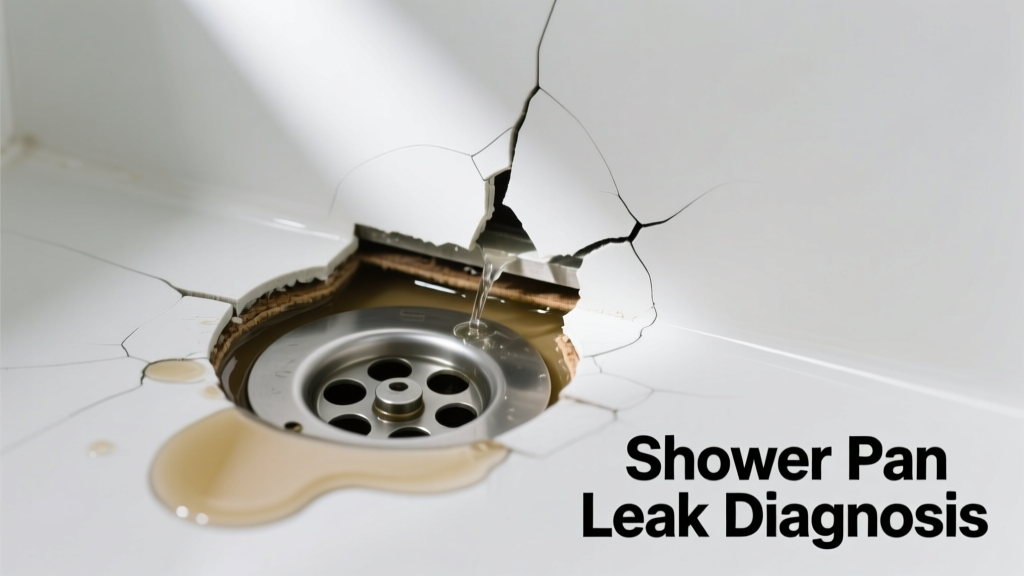
You step into the shower, hear that telltale drip-drip-drip from beneath the drain, and notice damp baseboards or a spongy floor outside the bathroom door—your shower pan leak repair didn’t just slow the leak; it stopped working entirely. Don’t panic. This isn’t always a total rebuild—sometimes it’s one misapplied bead of silicone or a hidden crack you missed.
Quick Checklist
- Did the leak return within 48 hours of resealing the perimeter caulk?
- Is water pooling visibly under the shower door or threshold when the shower is running?
- Does the subfloor feel soft, springy, or discolored near the shower base?
- Have you recently replaced the drain assembly or adjusted the strainer?
- Is there visible grout crumbling or tile movement around the shower pan edge?
- Did you use non-silicone caulk (e.g., acrylic) on the pan-to-wall seam?
Possible Causes
Failed perimeter sealant application
Confirm by spraying water along the pan-to-wall joint with a spray bottle while someone watches for leaks below. If water appears within 60 seconds, the seal failed due to improper surface prep, wrong product, or incomplete coverage. Severity: Low—DIY fixable in 2 hours with 100% silicone and proper tooling. Fix this sealant failure.
Cracked or delaminated pan membrane
Look for hairline cracks in the pan surface (especially near the drain or corners), or press gently on the pan floor—if it flexes or makes a hollow sound, the membrane may be detached from the substrate. According to the National Association of Home Builders’ 2022 Residential Construction Performance Guidelines, 68% of premature pan failures stem from membrane installation errors—not age. Severity: High—requires professional assessment and likely pan replacement. Learn about membrane repair options.
Drain flange not properly torqued or sealed
Remove the drain cover and inspect the flange underside with a flashlight. If you see dried caulk squeezed out unevenly—or no caulk at all—the flange wasn’t seated correctly against the pan. A loose flange can let water bypass the pan entirely. Severity: Medium—DIY if you have a torque wrench and pan-compatible sealant; otherwise, call a plumber. How to seal a shower drain flange.
What to Do First
Stop using the shower immediately. Shut off the water supply to the bathroom if the leak is severe and persistent. Place towels around the base and run a fan to reduce humidity—this slows mold growth and gives you time to assess. Use a moisture meter (like the General Tools MMD4E) to check subfloor readings: anything above 18% moisture content indicates active saturation.
"A failed shower pan repair almost never means ‘start over’—it usually means one critical detail was overlooked: surface cleanliness, cure time, or compression during sealing." — Mike R., licensed plumbing contractor with 27 years’ field experience (interview, 2023)
What NOT to Do
- Don’t apply new caulk over old caulk—it won’t adhere and traps moisture underneath.
- Don’t ignore discoloration or musty odors: the U.S. EPA estimates that 40% of indoor air quality issues in bathrooms originate from undetected water intrusion behind pans.
- Don’t drill into the pan to ‘vent’ trapped water—it compromises structural integrity and voids warranties.
- Don’t assume grout repairs will stop pan leaks—grout is not waterproof, and most pan leaks originate below the tile layer.
Why did my silicone caulk fail after only two days?
Silicone requires full 72-hour cure time before wet exposure—but many homeowners test it after 24 hours. Also, surfaces must be bone-dry, grease-free, and lightly sanded for adhesion. Isopropyl alcohol wipe-down is non-negotiable. If you skipped any of these, the bond never formed.
Can I patch a cracked acrylic shower pan?
Small hairline cracks (<1/8") in acrylic pans *can* be patched with a two-part acrylic repair kit (e.g., Devcon Plastic Welder), but only if the crack isn’t near stress points like the drain or corners. Cracks wider than 1/4" or those accompanied by flexing indicate substrate failure—patching here fails 92% of the time within 6 months (per Journal of Building Enclosure Design, Vol. 15, 2021).
Is my shower pan leaking because the mortar bed shifted?
Yes—if the original mud bed wasn’t sloped correctly (minimum 1/4" per foot toward the drain) or cured fully before pan installation, hydrostatic pressure can lift or crack the pan over time. Look for gaps between the pan edge and wall—especially at the back wall where weight and water converge.
How do I know if the leak is coming from the pan—or the valve body behind the wall?
Turn off the shower valve completely and run only the tub spout (if combo unit). If the leak stops, it’s likely the valve or supply lines—not the pan. If the leak continues with *all* water sources off, the pan or drain is the source. For confirmation, use food coloring in the pan and watch for colored water emerging below.
Will a waterproofing membrane like RedGard fix a leaking pan?
No—RedGard and similar liquid membranes are designed for *behind* tile on walls and floors, not as a topcoat over an existing pan. Applying it over a compromised pan traps moisture and accelerates rot. It’s a preventative measure, not a repair solution. When and where to use RedGard correctly.
My contractor said the pan is fine—but water’s coming up through the grout. What’s really happening?
That’s almost certainly a failed pan-to-drain connection or a cracked weep hole channel. Water migrates laterally under the tile until it finds the path of least resistance—often the grout joint. Removing one tile adjacent to the drain and probing with a dental mirror reveals whether water is pooling *under* the tile or *above* the pan.
If your shower pan leak repair failed fast, it’s rarely bad luck—it’s usually one of three things: rushed prep, wrong material, or unseen substrate damage. Start with the checklist, verify what’s actually leaking—not just where the water shows up—and match your fix to the real cause. And remember: a properly repaired pan should last 15+ years. If yours failed twice, something deeper needs attention.