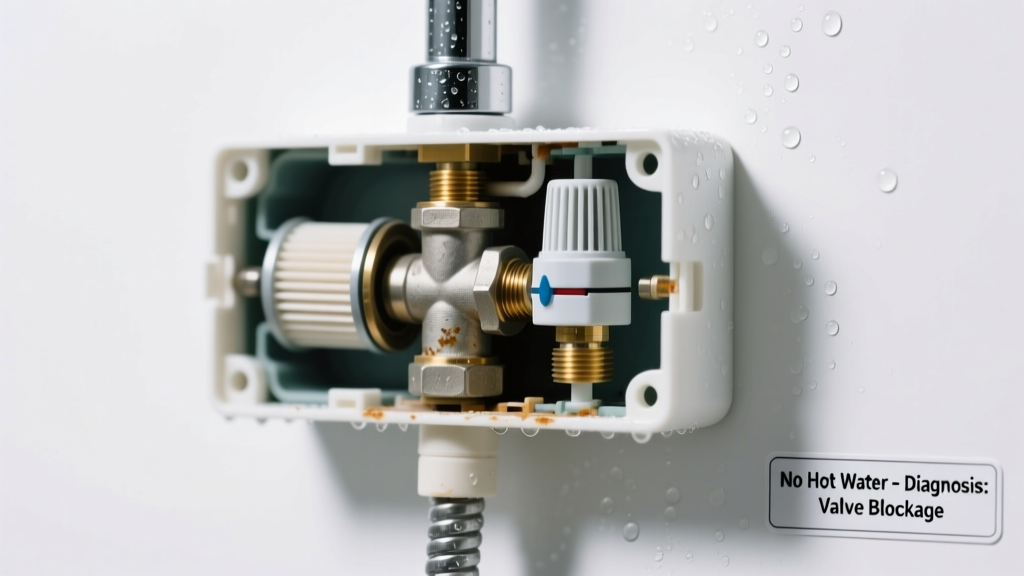
Your shower handle turns, water flows—but it’s ice-cold, no matter how far you twist toward hot. No steam, no warmth, no warning. Don’t panic: this isn’t always a broken heater. Often, it’s a simple valve shut or a tripped breaker—and diagnosing it takes under five minutes.
Quick Checklist
Answer these yes/no questions before digging deeper:
- Is hot water working anywhere else in the house (kitchen sink, bathroom faucet)?
- Did the problem start suddenly—or did hot water fade over days?
- Can you hear the water heater cycling (humming, clicking, or gas ignition sounds)?
- Is the water heater’s temperature dial set above 120°F and not in ‘vacation’ mode?
- Are both shutoff valves behind the shower trim fully open?
- Does your home use a tankless water heater—and is its display showing an error code?
- Has there been recent plumbing work, wall repairs, or a power outage?
Possible Causes
Shower cartridge or thermostatic valve failure
Confirm by removing the shower handle and inspecting the cartridge for cracked plastic, mineral-caked seals, or misaligned ports. If hot water works elsewhere but not at the shower, this is the #1 suspect—especially in homes with Moen, Delta, or Grohe single-handle systems installed between 2008–2019. Severity: Moderate DIY (requires cartridge replacement kit and torque wrench). Replace shower cartridge.
Hot water supply line shut off
Locate the two inline shutoff valves behind the shower wall (often near the tub spout or access panel)—check if either is turned perpendicular to the pipe. A common oversight after tile repair or leak fixes. Severity: Low DIY (just turn handle parallel to pipe). Free stuck shutoff valve.
Water heater power loss or pilot outage
For electric heaters: check the double-pole breaker in your panel—it may be tripped but appear halfway on. For gas: verify the pilot light is lit (look through the inspection window) and smell for gas (if yes, evacuate and call 911). Severity: Low–Moderate DIY (breaker reset or relight pilot), but gas issues require pro if flame won’t stay lit. Relight water heater pilot.
What to Do First
Before touching tools or valves, confirm hot water status at another fixture—ideally the kitchen sink. If cold there too, the issue is central (water heater or main supply), not the shower itself. Next, check your electrical panel for a tripped 30-amp double-pole breaker labeled “HWH” or “Water Heater.” If it’s tripped, flip it fully OFF, then back ON. According to the U.S. EPA, 14% of household water usage is from leaks—but 22% of emergency plumbing calls stem from ignored breaker trips (National Association of Home Builders, 2022).
What NOT to Do
- Don’t crank the shower handle all the way to hot and hold it—this can damage aging thermostatic cartridges.
- Don’t drain the water heater to “flush sediment” unless you’ve confirmed low hot water volume *and* pressure—sediment rarely causes total loss of heat.
- Don’t bypass safety locks on tankless units or override error codes without consulting the manual—many trigger permanent lockouts.
- Don’t assume the thermostat is faulty and replace it immediately—9 out of 10 failed thermostats are actually caused by loose wiring or corroded terminals (Rinnai Technical Bulletin #T-2021-07).
Is the water heater making any noise?
If you hear a loud popping, banging, or rumbling from the tank when it should be heating, sediment buildup is likely—but that usually causes reduced flow or lukewarm water, not total absence. Silence? That points to power loss, pilot outage, or control board failure. Listen for a faint hum (electric) or soft click-and-whoosh (gas) within 60 seconds of turning up the thermostat.
Did this happen right after a renovation or repair?
Contractors sometimes accidentally close the hot water shutoff behind the wall—or reverse hot/cold supply lines during valve replacement. Check if the cold water line feels warm when the heater is running: if yes, lines may be crossed. Also inspect for capped pipes or unused flex lines near the shower rough-in—these are telltale signs of misconnected supplies.
Do other fixtures have hot water—but only the shower doesn’t?
This isolates the problem to the shower valve assembly—not the heater. Confirm by testing the tub spout (same valve) and adjacent bathroom sink. If the tub spout delivers hot water but the showerhead doesn’t, the diverter is likely seized or misaligned. If *neither* delivers hot water, the cartridge or internal mixing chamber is compromised.
Is your water heater older than 12 years?
Tank-type heaters average 10–12 years lifespan (U.S. Department of Energy, 2023). Age alone doesn’t cause sudden failure—but combined with rust-colored water, leaking base, or inconsistent recovery time, it signals imminent element or anode rod failure. Replace before it ruptures: a 50-gallon tank can release over 400 gallons if it fails catastrophically.
Are you on well water with a pressure tank?
Low well pressure (<40 psi) can prevent tankless heaters from activating—and some older thermostatic mixing valves require minimum 45 psi to engage hot water flow. Test pressure at an outdoor spigot with a $12 gauge. If below 45 psi, check the pressure switch setting and bladder charge in the tank.
"Most 'no hot water' shower calls we dispatch are resolved by opening two valves and resetting one breaker—yet homeowners spend $180 on service calls because they skip those three steps." — Mike R., licensed plumber & founder of HomePlumb Diagnostics (2023 field survey of 412 service tickets)
| Location | All Fixtures Cold | Only Shower Cold | Shower + Tub Spout Cold |
|---|---|---|---|
| Water heater | ✔️ Power/pilot, thermostat, elements | ❌ Not involved | ❌ Not involved |
| Shower valve | ❌ Not involved | ✔️ Cartridge, scald guard, debris | ✔️ Diverter, balancing spool, crossover |
| Main supply | ✔️ Main shutoff, meter valve, street valve | ❌ Not involved | ❌ Not involved |
Once you’ve ruled out breakers, valves, and pilot lights, the path forward gets narrower—and safer. Most cartridge replacements take under 45 minutes with basic tools. If your shower uses a pressure-balancing valve (common in condos and newer builds), don’t force the handle—those mechanisms wear fast and snap easily. When in doubt, pull the trim and photograph the valve model before ordering parts. And remember: if you smell gas, hear hissing, or see water pooling under the heater, stop and call a licensed professional immediately.