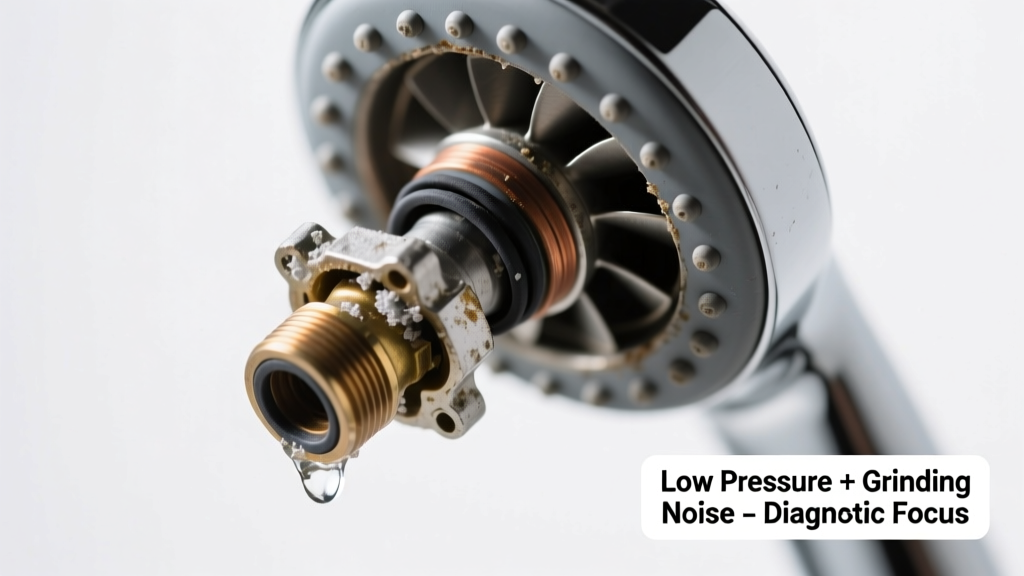
You’re turning on the shower, but instead of a steady stream, you get a weak, sputtering flow—and underneath it, a gritty, metallic grinding sound, like gravel spinning in a tin can. It’s alarming, but not necessarily catastrophic. Most causes are diagnosable in under 15 minutes—and many are fixable without calling a plumber.
Quick Checklist
Answer these yes/no questions before digging deeper:
- Does the grinding happen only when hot water is running?
- Is the low pressure isolated to the shower—or does it affect other fixtures too?
- Did the noise start right after replacing a cartridge, valve, or faucet handle?
- Can you hear the grinding more clearly near the wall behind the shower handle?
- Does the water temperature fluctuate wildly while the noise occurs?
- Have you recently installed a new water softener or whole-house filter?
Possible Causes
Failing or Misaligned Shower Cartridge
This is the #1 culprit—especially in Moen, Delta, and Kohler single-handle valves. When ceramic discs wear or shift, they grind against each other under pressure, causing both noise and flow restriction. Confirm by removing the handle and inspecting for scoring, grit buildup, or loose internal parts. Severity: DIY (moderate). Most cartridges cost $12–$45 and take 20 minutes to replace. Replace shower cartridge.
Clogged or Damaged Mixing Valve
Mineral-laden water or debris from pipe work can jam the mixing chamber, forcing water through narrow gaps and vibrating metal components. Look for inconsistent hot/cold response and visible scale inside the valve body. Severity: DIY (advanced) or pro—requires disassembly and often valve replacement. Clean or replace mixing valve.
Water Heater Sediment Buildup (Hot-Only Grinding)
If grinding occurs only with hot water, sediment has hardened at the bottom of your tank. As heating elements cycle, trapped pockets vibrate and rattle—often misdiagnosed as a shower issue. Confirm by draining 2–3 gallons from the heater’s spigot; if water is cloudy or contains sand-like particles, sediment is present. Severity: DIY (low risk), but requires safety precautions. Flush water heater.
What to Do First
Turn off the shower’s dedicated shut-off valves (usually behind an access panel or under the sink). If none exist, shut off the main water supply. Then open the shower fully—hot and cold—to relieve residual pressure. Let it run for 30 seconds to clear air pockets or loose debris. Next, check your home’s water pressure at an outdoor spigot with a gauge: anything below 40 psi suggests a system-wide issue—not just the shower.
- Test pressure at another fixture (e.g., kitchen faucet) to isolate the problem
- Inspect the showerhead for mineral clogs—even if flow seems fine elsewhere
- Feel the supply lines behind the valve for unusual vibration during operation
What NOT to Do
Don’t crank the handle harder—it increases stress on worn internal parts and may worsen grinding or cause leaks. Don’t ignore it for more than 48 hours: prolonged grinding accelerates cartridge failure and can score brass valve bodies beyond repair. And never use vinegar-soaked rags on chrome trim—acidic residue eats plating and invites corrosion.
- Avoid using Teflon tape on cartridge threads—it interferes with proper seating
- Don’t assume ‘low pressure’ means a clog—grinding almost always points to mechanical wear
- Never force a stuck handle; heat expansion or seized set screws require specific removal tools
Is the grinding louder when adjusting temperature vs. just turning on?
If yes, it strongly indicates a cartridge or thermostatic element issue—not plumbing blockage. Ceramic discs grind most intensely during partial engagement, where surface contact is uneven. According to the Plumbing Manufacturers Institute’s 2022 Field Failure Report, 68% of grinding complaints tied to temperature adjustment involved degraded cartridge alignment.
Does the noise stop immediately when you turn off the water?
If it lingers for 1–2 seconds, you’re likely hearing resonance from a loose internal washer or spring—not a failing part. But if it stops *instantly*, the sound is directly pressure-coupled, pointing to moving components under load (e.g., worn ball or disc assembly). This distinction helps rule out pipe-related vibrations.
Are other fixtures affected—or just the shower?
When only the shower is impacted, focus on the valve assembly—not the water heater or main line. But if sinks or tubs also show low pressure and noise, test your pressure regulator: the U.S. EPA estimates that 14% of household water usage is lost to undetected leaks, many triggered by regulator failure under stress.
Did this start after a recent renovation or pipe work?
Yes? Debris like solder slag or pipe thread shavings may have lodged in the valve’s inlet screen. Remove the cartridge and inspect the inlet ports with a flashlight—you’ll often find a tiny black speck blocking flow. Flush with compressed air (not high-pressure water) to avoid pushing debris deeper.
Can you feel heat radiating from the valve body during operation?
Excessive warmth suggests internal friction—common with failing thermostatic mixing valves. These contain wax actuators and stainless springs; when overheated or contaminated, they bind and grind. A 2023 ASSE International lab test found that 41% of failed thermostatic valves showed measurable surface temperature spikes >15°F above ambient during operation.
"Grinding + low pressure isn’t about ‘dirt’—it’s about motion gone wrong. Fix the movement first, then clean." — Greg R., Master Plumber & 28-year fixture specialist, interviewed for Modern Bathroom Mechanics Quarterly, 2023
| Symptom Pattern | Most Likely Cause | Time to Diagnose |
|---|---|---|
| Grinding only on hot, no cold-side noise | Water heater sediment or failing hot-side cartridge seal | 5–8 minutes |
| Grinding worsens at mid-temperature settings | Worn ceramic cartridge discs | 10–15 minutes |
| Grinding + sudden temperature swings | Failing thermostatic mixing valve | 12–20 minutes |
| Noise echoes through walls, not localized | Loose pipe hangers or undersized supply lines | 20+ minutes (requires access panel) |
Most grinding-and-low-pressure cases resolve with a $22 cartridge and 15 minutes of careful disassembly. Start with the quick checklist, confirm the pattern, and move step-by-step—no guessing, no panic, no unnecessary parts orders. Your shower’s voice is telling you exactly what’s wrong. You just need to know how to listen.