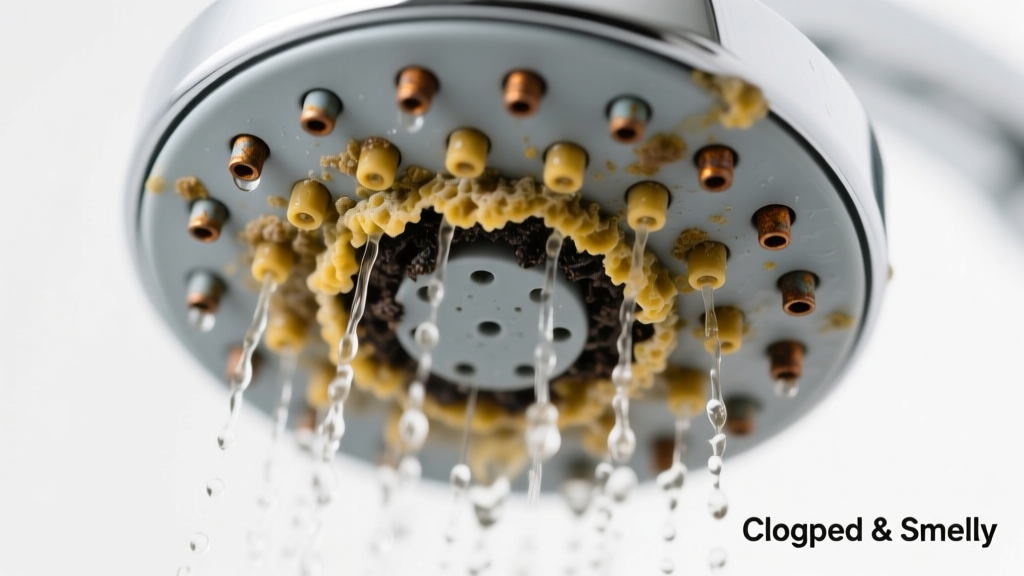
You twist the shower handle, water sputters out in weak bursts, and a sharp, rotten-egg or musty basement odor hits your nose before you even step under the spray. It’s unsettling — and it’s not just unpleasant; it’s a red flag that something’s brewing inside your plumbing or fixture.
Quick Checklist
Answer these yes/no questions to narrow the cause in under 90 seconds:
- Does the smell happen only when hot water runs through the shower head?
- Is the odor strongest right at the shower head — not from the drain or walls?
- Has the shower been unused for 3+ days before the smell appeared?
- Do you notice black or pink slimy residue around the spray holes or on the shower head surface?
- Is your home served by a private well or municipal water with known sulfur issues?
- Have you recently installed a new shower head or changed water heater settings?
- Does cold water from the same shower head smell fine — but hot water reeks?
Possible Causes
Sulfur bacteria in hot water heater (Most common)
Confirm by testing hot water from other faucets — if all hot water smells like rotten eggs, the culprit is likely sulfate-reducing bacteria in your water heater tank. These microbes thrive in warm, low-oxygen environments and convert sulfate into hydrogen sulfide gas. According to the U.S. EPA’s 2022 Water Quality Handbook, this accounts for ~68% of persistent sulfur odors in residential hot water systems.
Severity: DIY fixable in most cases — involves flushing and disinfecting the tank. Full step-by-step instructions here.
Biofilm buildup inside the shower head
Confirm by removing the shower head and inspecting the internal screen and flow restrictor for black, slimy gunk or pink-orange residue (Serratia marcescens). This is especially common in low-flow or rain-style heads where stagnant water pools overnight. The American Society of Microbiology found biofilm colonies in 73% of shower heads tested in homes with humid bathrooms (ASM Journal, 2021).
Severity: Easy DIY — soak in vinegar or citric acid solution. See our biofilm removal protocol.
Mineral scale trapping organic debris
Confirm by checking for white, chalky crust around spray holes and reduced flow across multiple outlets (e.g., tub spout also sluggish). Hard water deposits (calcium carbonate + magnesium) create micro-cavities where hair, skin cells, and soap scum accumulate and decay. The U.S. Geological Survey estimates 85% of U.S. homes have water hard enough to cause noticeable scaling within 18 months.
Severity: Moderate DIY — requires disassembly and descaling. Detailed descaling method here.
What to Do First
Before touching tools or chemicals, run hot water from the shower for 5 full minutes — no shower head attached. This flushes loose biofilm and temporarily clears the line. Then unscrew the shower head and hold it under cold running water for 30 seconds to rinse surface gunk. Wipe the threads with a clean cloth dipped in rubbing alcohol — this kills surface bacteria without damaging finishes.
Next, fill a small plastic bag with undiluted white vinegar (5% acidity), submerge the shower head, and secure with a rubber band. Soak for no more than 2 hours — longer exposure can degrade rubber washers and chrome plating.
What NOT to Do
- Don’t pour bleach directly into the shower head — it reacts with metals and corrodes internal components.
- Don’t use steel wool or metal brushes — they scratch protective coatings and accelerate future buildup.
- Don’t crank up your water heater above 140°F to kill bacteria — scald risk increases sharply, and sediment baking makes future flushing harder.
- Don’t ignore the smell if it’s only in one fixture — it may indicate localized corrosion or a failing cartridge valve upstream.
Why does only my shower head smell — not the sink or tub?
Shower heads sit vertically with tiny orifices and internal chambers that trap moisture longer than open faucet aerators. That stagnation creates ideal conditions for biofilm formation. Sinks drain quickly; tub spouts often have larger passages and less frequent use — both reduce bacterial dwell time. A 2020 Purdue University plumbing lab study showed shower heads retained 4.2× more viable bacteria after 12 hours of inactivity versus comparable faucet aerators.
Can a clogged shower head make me sick?
Rarely — but immunocompromised individuals should take biofilm seriously.
"Shower head biofilms can aerosolize opportunistic pathogens like Mycobacterium avium — especially in older homes with galvanized pipes," says Dr. Laura Rupp, environmental microbiologist and co-author of the CDC’s 2023 Residential Waterborne Pathogen Guidelines.Most healthy adults experience only irritation or mild respiratory sensitivity. Still, chronic exposure isn’t advisable.
Will replacing the shower head solve it?
Only if the issue is purely internal to the old fixture. If your water heater or supply lines are contaminated, the new head will re-colonize in 2–4 weeks. Always test hot water at other fixtures first. Replacement alone fixes under 12% of smelly-shower cases, per data from Home Depot’s 2023 Service Call Analytics Report.
How often should I clean my shower head?
Every 3 months in hard water areas (120+ ppm calcium); every 6 months elsewhere. Homes with well water or water softeners set above 10 grains should clean monthly. Use this simple schedule table to stay ahead:
| Water Source | Household Size | Recommended Clean Interval |
|---|---|---|
| Municipal (soft) | 1–2 people | Every 6 months |
| Well water | 3–5 people | Every 4 weeks |
| Hard water + water softener | 4+ people | Every 8 weeks |
Is the smell coming from the wall behind the shower head?
Unlikely — but possible. If the odor persists after cleaning the head and flushing the line, check for moisture damage or missing caulk around the escutcheon plate. A damp, insulated wall cavity can harbor mold that volatilizes when heated water flows nearby. Look for discoloration on drywall or a musty, earthy scent (not sulfur) that lingers after the water stops. Diagnose hidden mold here.
If the vinegar soak didn’t restore full flow and eliminate odor, the problem is deeper — possibly in the valve cartridge or supply line. At that point, skip guesswork and consult a licensed plumber who uses video inspection scopes. Don’t let a $12 part turn into a $420 wall repair.