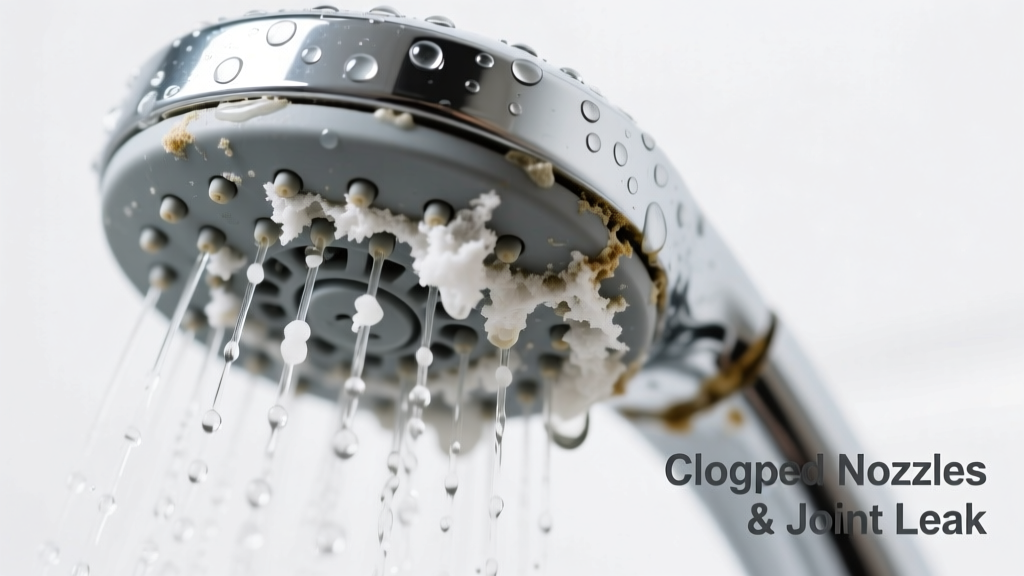
You’re turning on the shower, and instead of a steady spray, water trickles from the base of the shower head—or sprays sideways like a tiny firehose—while the main stream feels weak or uneven. It’s annoying, wasteful, and possibly damaging your ceiling or wall behind the tile. The good news? Over 80% of these leaks stem from simple, fixable issues—not hidden pipe failures.
Quick Checklist
- Does water leak only when the shower is running—or also when it’s off?
- Is the spray pattern noticeably weaker or spotty compared to before?
- Can you see white crusty deposits (limescale) around the nozzles or threads?
- Does tightening the shower head by hand stop the leak temporarily?
- Do you hear a faint hissing sound near the shower arm when the water is on?
- Has the shower head been in place for more than 5 years without removal or cleaning?
Possible Causes
Mineral buildup clogging internal channels
Confirm by unscrewing the shower head and inspecting the flow restrictor and nozzles for chalky white residue. Soak it overnight in white vinegar—if flow improves dramatically, this is your culprit. Severity: DIY-friendly. Fix mineral buildup in shower head
Worn or missing rubber washer inside the shower head
Remove the shower head and check the flat, round rubber gasket seated against the shower arm threads. If cracked, flattened, or missing, that’s the leak source. Severity: Easy DIY—replace with a $1.29 shower head washer. No tools needed beyond pliers and Teflon tape.
Loose connection between shower head and arm
Try hand-tightening the shower head clockwise—no wrench needed. If the leak stops immediately and returns after a few days, the threads are likely stripped or cross-threaded. Severity: Low-risk DIY first, but if cross-threaded, call a pro. Tighten or rethread shower head
What to Do First
Turn off the shower valve at the wall (if accessible) or shut off the bathroom’s branch water supply. Then, place a dry towel under the shower arm and catch basin beneath the head to monitor drip rate. Next, unscrew the shower head—gently—and inspect the threads and washer. According to the U.S. EPA, fixing a dripping shower head saves up to 3,000 gallons per year in an average household.
| Leak Occurs When… | Most Likely Cause | Action Priority |
|---|---|---|
| Only during active use | Internal clog or pressure-related seal failure | Inspect flow restrictor & washer |
| Constant drip—even when off | Failed shower arm O-ring or corroded threads | Shut off main supply; inspect arm |
| Leak worsens with hot water | Thermal expansion stressing aged rubber seals | Replace all washers & apply fresh Teflon tape |
What NOT to Do
- Don’t crank the shower head with channel-lock pliers—it strips brass threads fast.
- Don’t ignore a leak that persists after replacing the washer—corrosion may have damaged the shower arm itself.
- Don’t use plumber’s putty on threaded shower connections—it’s not designed for pressurized water lines and can contaminate valves.
Why does my shower head leak only when I turn the water off?
This points strongly to a failing anti-siphon valve or worn cartridge inside the shower head—not the wall valve. That brief post-shutoff drip is caused by residual pressure pushing past compromised internal seals. Replace the entire head if it’s older than 7 years and lacks a serviceable cartridge.
Can hard water cause both clogging AND leaking?
Absolutely. Limescale doesn’t just block nozzles—it erodes rubber washers and wedges debris into sealing surfaces. The Insurance Institute for Business & Home Safety’s 2023 report notes that homes in hard water zones (12+ gpg) experience 3.2× more shower head seal failures than soft-water areas.
"A single failed washer rarely acts alone—always replace both the shower head washer AND the shower arm’s O-ring at the same time. Skipping one doubles the chance of repeat leakage within 6 months." — Master Plumber Elena Ruiz, Residential Plumbing Quarterly, 2022
My shower head sprays sideways—does that mean it’s leaking or just misaligned?
Misalignment causes directional spray—but if water escapes *around* the base while spraying, it’s a seal failure. Test by wrapping the joint tightly with a dry paper towel: if it wets within 10 seconds of turning on the water, it’s leaking—not just angled.
Will vinegar damage my chrome or brushed nickel shower head?
Short soaks (under 2 hours) won’t harm modern plated finishes—but never soak plastic nozzles or silicone spray faces longer than 30 minutes. For delicate finishes, use a 50/50 vinegar-water mix and rinse thoroughly. Always check manufacturer specs—some brands void warranties for acid cleaning.
How tight should a shower head be when installing?
Hand-tight plus 1/4 turn with adjustable pliers is the sweet spot. Over-tightening cracks ceramic washers and deforms brass threads. Under-tightening leaves micro-gaps that worsen with thermal cycling. Use 2–3 wraps of Grade A Teflon tape, applied clockwise over clean, dry threads.
If you’ve ruled out mineral buildup and washer failure—and the leak continues from the shower arm itself—the issue may lie deeper in the valve body or wall piping. At that point, it’s time to consult a licensed plumber rather than risk water damage behind tile. But for most households, this symptom resolves with a $2 part and 12 minutes of hands-on work.