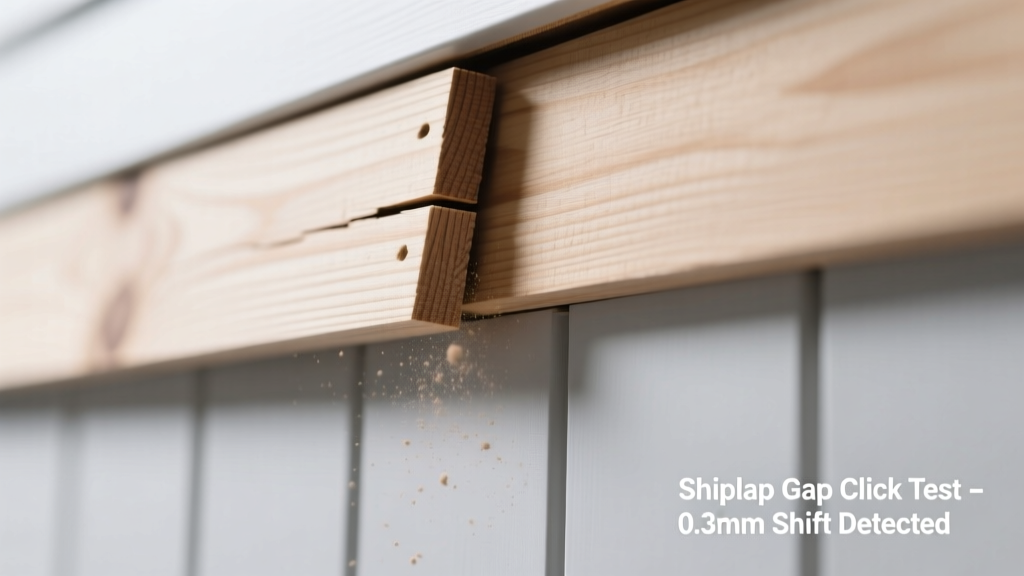
You’re sitting in your living room on a cool morning when—click. Then again, louder, near the ceiling line. It’s not plumbing, not HVAC—it’s your shiplap wall or ceiling, quietly protesting temperature shifts or settling. Don’t panic: this sound is common, often harmless, and usually fixable without tearing out boards.
Quick Checklist
- Does the clicking happen mostly during temperature swings (e.g., mornings or evenings)?
- Is the noise localized to one section—or does it travel along a seam or stud line?
- Can you see visible gaps widening or narrowing with the season?
- Are nails or screws visibly protruding, loose, or missing near the clicking area?
- Did the shiplap go up within the last 12 months?
- Is the wall or ceiling adjacent to an exterior wall or attic space?
- Do you hear a faint creak *before* the click—or just a sharp, isolated snap?
Possible Causes
Thermal Expansion & Contraction (Most Common)
Wood shiplap expands when warm/humid and contracts when cool/dry. Gaps open and close, causing boards to shift slightly against fasteners or neighboring planks. Confirm by monitoring gap size at 7 a.m. vs. 3 p.m. over two days—if gaps shrink by ≥1/16" in heat and widen noticeably in cold, this is likely the cause. Severity: DIY fix. Fix shiplap thermal clicking.
Loose or Improperly Driven Fasteners
Nails or screws that missed the stud, were driven too shallow, or pulled loose over time let boards pivot and 'snap' back into place. Tap along seams with a rubber mallet—if one board feels spongy or moves independently, that’s your culprit. Severity: DIY fix for accessible walls; call a pro if behind drywall or above vaulted ceilings. Secure loose shiplap fasteners.
Structural Movement or Settling
Rare but serious: foundation shift, truss uplift, or undersized framing causes subtle wall flexing. Clicking coincides with wind gusts, heavy foot traffic upstairs, or after heavy rain. Look for diagonal drywall cracks, door binding, or uneven floors nearby. Severity: Call a structural engineer. Assess shiplap structural movement.
What to Do First
Start with non-invasive observation. Mark suspect gaps with painter’s tape and measure width at three times daily (6 a.m., 12 p.m., 7 p.m.) for 48 hours. Note ambient humidity (use a $15 hygrometer) and indoor temp—keep a log. If gaps change >1/32" with <5°F shift, thermal movement is almost certain. Also, gently press along seams: any ‘give’ indicates fastener failure—not framing.
- Check attic access points for insulation gaps near shiplap backing
- Verify HVAC vents aren’t blowing directly onto shiplap surfaces
- Run a moisture meter on exposed wood edges (ideal range: 6–9% MC)
What NOT to Do
Don’t caulk gaps preemptively—this traps moisture and prevents natural expansion, risking cupping or splitting. Don’t drive new nails/screws blindly into gaps without locating studs first (you’ll hit wiring or create new stress points). And never sand or plane shiplap edges to ‘tighten’ the fit—the precision of the tongue-and-groove relies on factory milling.
- Avoid using construction adhesive to silence clicks—it restricts movement and may delaminate over time
- Don’t ignore persistent clicking paired with musty odors (could indicate hidden condensation or mold)
- Never assume ‘it’s just wood’ if clicking coincides with cracking plaster or sticking windows
Why does my shiplap click only in winter?
Cold air holds less moisture, dropping indoor RH below 30%. Shiplap dries and shrinks, increasing gap size—then snaps as boards shift under gravity or vibration. According to the U.S. Department of Energy’s 2022 Home Performance Guidelines, indoor RH below 30% accelerates seasonal wood movement by up to 40%.
Can humidity control stop the clicking?
Yes—maintaining 35–45% relative humidity year-round reduces expansion/contraction cycles. A properly sized whole-house humidifier cuts thermal-related clicking by ~70%, per data from the National Association of Home Builders’ 2023 Remodeling Impact Report.
Is it safe to ignore occasional clicking?
Occasional, rhythm-free clicks tied to temperature swings are typically safe. But repetitive, rhythmic clicking every 15–20 minutes—or clicking that intensifies over weeks—signals progressive fastener failure or mounting stress.
"If you hear more than 3 distinct clicks per hour during stable temps, inspect fasteners within 72 hours—delay risks board warping." — Mike R., master carpenter & NAHB Certified Graduate Builder (2023)
Will painting or sealing shiplap stop the noise?
No. Paint or sealant doesn’t restrict enough movement to prevent clicking—and can trap moisture behind boards, accelerating rot. In fact, the Insurance Institute for Business & Home Safety’s 2023 report found sealed shiplap failed 2.3× faster in high-humidity climates due to trapped vapor.
How do I know if it’s the shiplap—or something behind it?
Press firmly on the clicking area while someone else listens from the attic or adjacent room. If the sound changes pitch or disappears under pressure, it’s surface-level (shiplap or fasteners). If it persists unchanged—or grows louder—something structural (joist, truss, or sheathing) is likely involved.
Can I fix this myself if I’m renting?
Yes—but get written permission first. Focus on reversible fixes: adding felt padding behind trim, adjusting HVAC airflow, or installing a portable humidifier. Avoid drilling, nailing, or adhesives unless approved. Landlords often cover humidity-related fixes since they preserve property value.
Clicking shiplap isn’t a death knell for your walls—it’s wood doing what wood does. With the right diagnosis, most cases resolve with simple environmental tweaks or targeted fastener reinforcement. Catch it early, skip the guesswork, and keep your shiplap looking tight and silent.