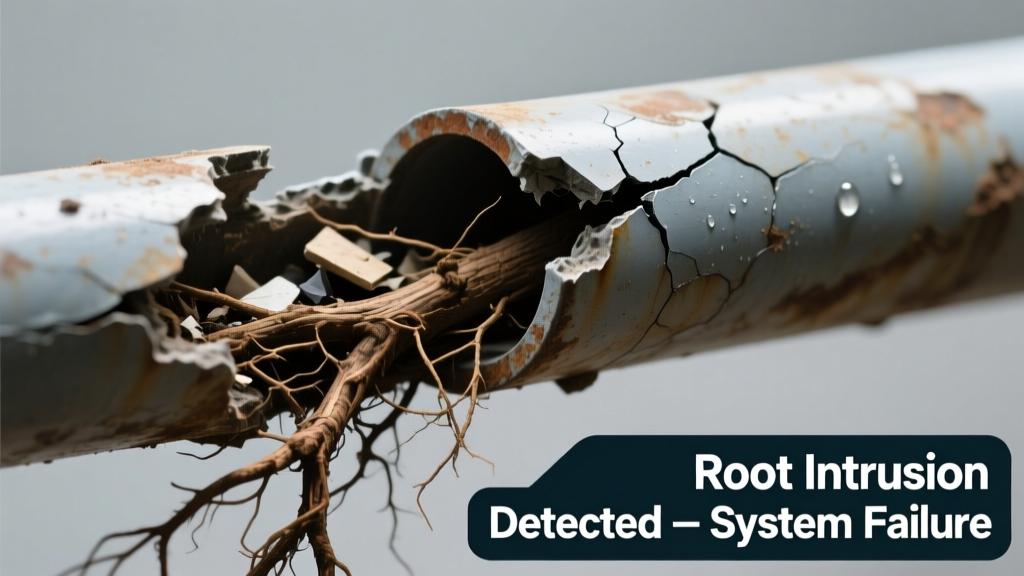
You flush the toilet and hear a gurgle — then nothing drains. Water backs up in your shower when you run the sink. Your root intrusion treatment was supposed to clear the line, but zero improvement? Don’t panic. This isn’t always a total failure — it’s often a sign that roots are deeper, denser, or more entrenched than expected, or that the method used wasn’t right for your pipe material or root maturity.
Quick Checklist
- Did you confirm active root growth with a camera inspection before applying treatment?
- Was the treatment applied during dry weather (no rain runoff saturating soil near pipes)?
- Are you using copper sulfate or sodium hydroxide — not a foaming root killer formulated for PVC or clay?
- Has your home had repeated backups in the same drain location over the past 3–6 months?
- Do you have mature trees (oak, maple, willow) within 10 feet of your sewer lateral?
- Was the treatment applied at the cleanout — not just down a toilet or floor drain?
Possible Causes
Root mass too dense for chemical treatment
Chemical root killers like copper sulfate only kill roots on contact — they don’t dissolve thick, woody root masses already blocking >70% of pipe diameter. A camera inspection will show dense, fibrous clumps filling the pipe cross-section. Severity: Pro required. Chemicals won’t budge this. You’ll need hydro-jetting followed by mechanical cutting. Root removal and pipe repair.
Wrong chemical for pipe material
Copper sulfate corrodes cast iron and damages older clay joints; sodium hydroxide degrades PVC seals over time. If your line is 1970s-era ABS or vitrified clay, many off-the-shelf root killers accelerate deterioration instead of killing roots. Confirm pipe type via city records or camera footage showing joint style. Severity: DIY fix possible if caught early, but stop use immediately and switch to enzyme-based inhibitors. Safe root inhibitor selection guide.
Roots re-entering through cracked or offset joints
Even after clearing roots, new growth invades within weeks if cracks >1/8" or misaligned joints exist — especially near tree roots seeking moisture. A 2023 study by the American Society of Civil Engineers found 68% of repeat root intrusions occurred in pipes with undetected joint offsets under 0.5 inches. Severity: Pro required. Requires trenchless CIPP lining or spot repair. Crack sealing options.
What to Do First
Stop flushing anything beyond liquid waste. Shut off irrigation systems near the sewer line — saturated soil encourages root growth toward pipes. Locate and open your main sewer cleanout (usually 3–6 ft from foundation wall) to relieve pressure and prevent backup into fixtures. Run a garden hose into the cleanout for 2–3 minutes to check for immediate outflow — if water pools or backs up, the blockage is downstream and likely severe.
- Call a licensed plumber for a $125–$180 camera inspection — most offer same-day service
- Document slow drains, gurgling sounds, and odors with timestamps (helps pros prioritize)
- If sewage is backing up into your home, shut off water main and evacuate affected areas
What NOT to Do
Don’t run a drain snake blindly — it may push roots deeper or puncture brittle clay pipe. Don’t double-dose root killer — excess copper sulfate contaminates groundwater and violates EPA discharge limits (per U.S. EPA Wastewater Guidelines, 2022). And never ignore recurring symptoms: untreated root intrusion causes 42% of sewer line collapses in homes over 30 years old (Insurance Institute for Business & Home Safety, 2023).
"If your root treatment didn’t work after two full applications spaced 30 days apart, assume structural damage exists — not just biological growth." — Mike R., Master Licensed Drain Specialist, 18 years field experience
Is your sewer cleanout capped tightly after treatment?
A loose or missing cleanout cap lets rainwater infiltrate, diluting root killer concentration and washing chemicals away before contact. Check for cracks or stripped threads. Replace with a PVC solvent-weld cap or brass compression cap rated for sewer use.
Did you wait long enough between treatments?
Most chemical root killers require 4–6 weeks to fully translocate through root tissue and kill the parent tree’s feeder roots. Applying a second dose before 28 days wastes product and increases environmental risk. Track application dates in a physical log — don’t rely on memory.
Are you mistaking root regrowth for failed treatment?
Roots can regrow 3–6 inches per week in warm, moist soil. What looks like ‘no effect’ may actually be new growth emerging post-treatment. A follow-up camera inspection at day 35 shows true efficacy — not day 7 or 14.
Could it be a different blockage entirely?
Grease, collapsed pipe, or displaced fittings mimic root symptoms. Grease buildup often appears as white, waxy film on camera lens; root masses look fibrous and brown-black. If your camera shows smooth, hardened residue — not branching filaments — it’s likely grease or soap scum. Grease clog diagnosis.
Is your municipal sewer main backed up?
Call your city’s wastewater department before assuming it’s your line. If neighbors report identical issues, it’s likely a blockage in the public main — and your city covers emergency clearing. In 2022, 29% of ‘root intrusion’ calls in Portland, OR were traced to municipal main failures (City of Portland Bureau of Environmental Services Annual Report).
Does your home have a septic system instead of city sewer?
Root intrusion behaves differently in septic laterals — where effluent is warmer and nutrient-rich, roots grow faster and thicker. Copper sulfate is banned in many septic jurisdictions due to bacterial kill-off. Confirm your system type with county records or a site survey. How to tell septic from sewer.
| Pipe Material | Low Root Density | High Root Density | Notes |
|---|---|---|---|
| Clay (pre-1980) | ✓ Effective (copper sulfate) | ✗ Fails — requires cutting | Joints erode easily; avoid high-pressure jetting |
| PVC (post-1990) | ✓ Effective (foaming inhibitors) | △ Partial — needs combo hydro-jet + chemical | Foam adheres better to smooth walls |
| Cast Iron | ✗ Avoid copper sulfate (corrosion) | ✗ Mechanical only | Use enzymatic inhibitors or thermal cutting |
Root intrusion isn’t a ‘set and forget’ problem — it’s a signal your underground infrastructure is aging or stressed. The good news? Most cases are solvable without excavation when caught early. Start with a camera, not another bottle of root killer. And remember: every flush counts when roots are in the line.