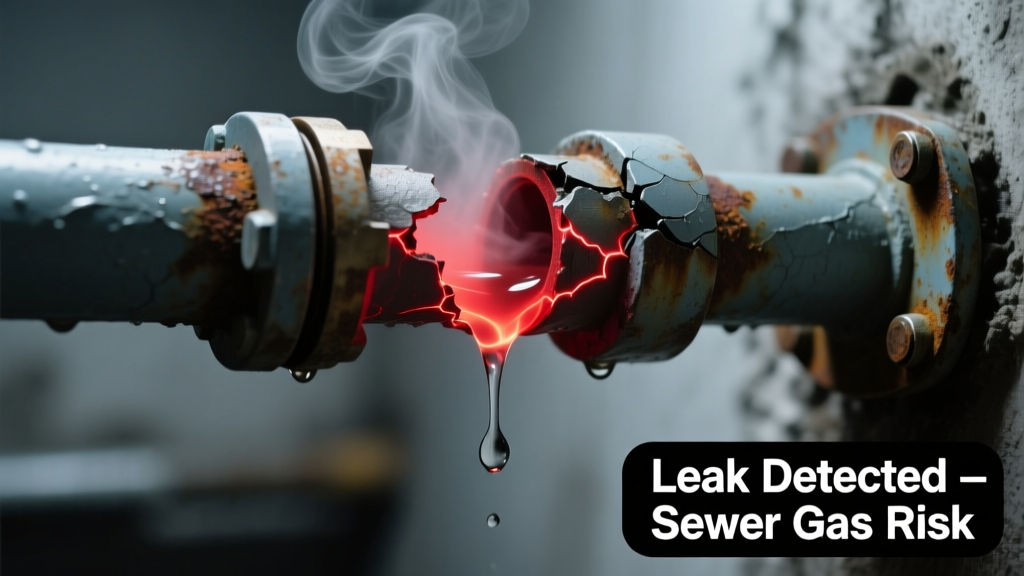
You walk into your basement and catch that unmistakable rotten-egg stench—sharp, sour, and clinging—just as you spot a dark, slow drip pooling near the floor drain. Your sink gurgles when the washing machine drains. It’s alarming, but not necessarily catastrophic—yet. Most causes are fixable, and many can be diagnosed in under 10 minutes with basic tools and observation.
Quick Checklist
- Does the smell intensify after flushing a toilet or running water in a specific fixture?
- Is water visibly leaking from a cleanout cap, floor drain, or pipe joint?
- Do you hear gurgling or bubbling sounds from drains when other fixtures run?
- Has the affected area been unused for more than 3 weeks (e.g., guest bathroom, basement sink)?
- Is the leak coming from near a wall-mounted fixture like a toilet or shower valve?
- Did the smell start right after heavy rain or a sewer main backup in your neighborhood?
Possible Causes
Dry P-Trap (Most Common)
Evaporation in infrequently used drains leaves the water seal gone—letting sewer gas rise through the pipe and leak water if condensation or minor backpressure forces moisture up. Confirm by pouring ½ cup of water down the suspect drain and waiting 2 minutes: if the smell fades and no new leak appears, it’s likely the trap. Low severity—DIY fix. How to refill and maintain P-traps.
Cracked or Corroded Drain Pipe (High Risk)
Old cast iron or PVC pipes develop hairline cracks near joints or beneath slabs; gas escapes *and* water weeps out under pressure. Look for white mineral deposits, damp drywall behind fixtures, or rust streaks on basement pipes. Moderate-to-high severity—requires camera inspection. Signs and repair options for cracked drain lines.
Faulty Wax Ring or Toilet Flange Seal
A compromised wax ring lets gas seep from the base of the toilet—and water may leak during flushes or when the bowl overflows slightly. Check for rocking toilet, black mold at base, or wet flooring around the pedestal. Medium severity—DIY possible with proper prep, but misalignment risks repeat failure. Step-by-step wax ring replacement guide.
What to Do First
- Turn off water supply to the affected fixture if the leak is active and localized.
- Open windows and run exhaust fans—sewer gas contains methane and hydrogen sulfide; prolonged exposure above 10 ppm causes headaches and nausea (U.S. EPA, 2022).
- Pour 1 quart of water into every floor drain, utility sink, and unused tub/shower drain.
- Check your home’s roof vent stack for bird nests, ice blockage, or debris using binoculars—not a ladder.
- If water is pooling rapidly or smells strongly of sewage (not just sulfur), evacuate and call a licensed plumber immediately.
What NOT to Do
- Don’t pour bleach or chemical drain cleaners down the drain—they won’t stop gas leaks and may corrode older pipes.
- Don’t ignore gurgling sounds: they indicate negative air pressure pulling traps dry, per the International Plumbing Code Section 709.1 (2021 edition).
- Don’t tape or caulk around a toilet base to stop the leak—it masks a structural failure and violates building code.
- Don’t assume it’s “just the weather”—persistent sewer gas + water means a breach in containment, not humidity.
Why does the sewer smell come and go with water use?
Intermittent odors tied to water use point to air pressure imbalances. When a large volume of water rushes down a drain—like from a washing machine—it creates suction that pulls air (and gas) backward through a weak or dry trap. This is why you’ll often smell it right after a shower ends or the dishwasher discharges.
Can a blocked vent pipe cause both gas smell and water leakage?
Yes. A clogged vent prevents proper airflow, causing siphoning of trap seals and backpressure that forces water up overflow holes or past loose seals. According to the National Association of Home Builders’ 2023 Plumbing Systems Report, 22% of sewer gas complaints in homes under 15 years old traced to obstructed roof vents.
Is the leak coming from the wall or floor—and what does that tell me?
| Leak Location | Most Likely Cause | Diagnostic Tip |
|---|---|---|
| Base of toilet | Failed wax ring or flange damage | Rock the toilet gently—if it moves, flange bolts are loose or rotted. |
| Under kitchen sink cabinet | Loose slip-nut or cracked tailpiece | Shine a flashlight while running water—look for spray, not just drip. |
| Basement floor near floor drain | Dry trap or cracked cast iron hub | Pour water in drain—smell stops? Trap was dry. Still leaks? Suspect crack. |
| Behind shower tile or wall | Corroded drain pipe or failed silicone seal | Check grout lines for discoloration or softness—early sign of behind-wall moisture. |
Could this be a septic system failure instead of a plumbing issue?
Unlikely—but possible if you’re on septic. Key clues: multiple drains backing up, lush green grass over the leach field in dry weather, or standing water near the tank. The U.S. EPA estimates that 14% of household water usage is from leaks—but only ~2% of sewer gas incidents originate at the septic tank itself (EPA Onsite Wastewater Treatment Systems Manual, 2021). Start with plumbing first.
How long can I wait before fixing it?
"A sewer gas leak paired with visible water isn’t just an odor problem—it’s evidence of a breach in your home’s sanitary barrier. Delaying beyond 48 hours increases mold risk in adjacent framing and raises hydrogen sulfide exposure above safe thresholds." — Licensed Master Plumber & IAQ Specialist, R. Delgado, 2023
If the leak is slow and the smell mild after refilling traps, you’ve got a 3–5 day window to schedule diagnostics. But if water is actively dripping onto wood subfloor or insulation—or if anyone in the home experiences dizziness, nausea, or eye irritation—act today. Your nose is detecting a real hazard, not just a nuisance.