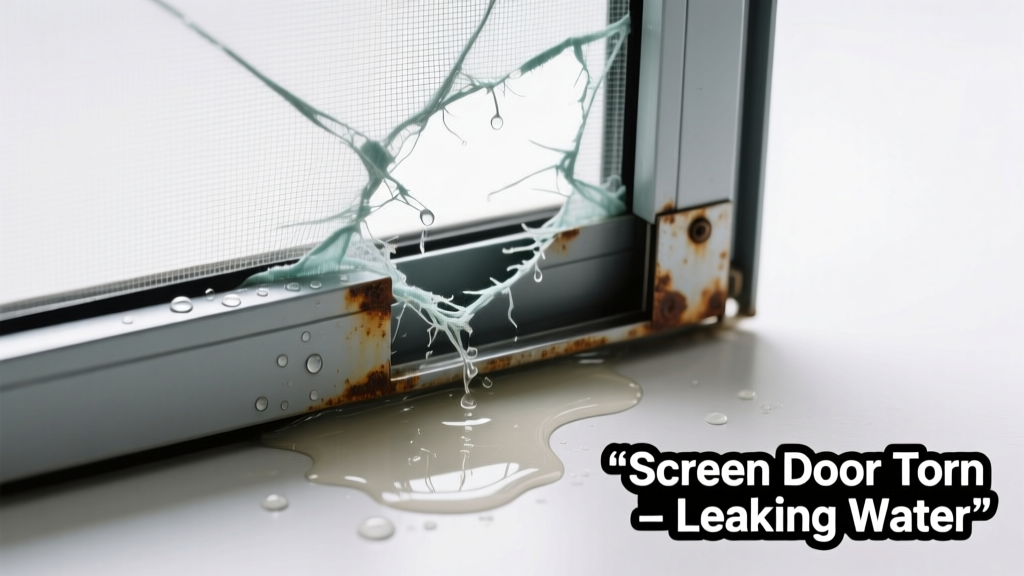
You open your screen door after a summer storm and hear a faint drip—then spot a dark streak on the threshold, wet carpet near the sill, or puddling on the interior floor. A torn screen isn’t just an insect gateway; when combined with wind-driven rain or improper flashing, it becomes a direct path for water infiltration. The good news? Most causes are visible, testable, and fixable in under an hour—if you diagnose correctly first.
Quick Checklist
- Is the tear in the screen mesh larger than ½ inch?
- Does water leak only during heavy rain—or also during light mist or sprinkler overspray?
- Is the door frame warped, loose, or showing visible gaps where it meets the jamb?
- Do you see rust, rot, or crumbling caulk around the bottom rail or threshold?
- Is there no storm door installed—and does the main entry door lack a proper overhang?
- Does water pool *inside* the screen door track when sprayed with a hose?
Possible Causes
Torn or degraded screen mesh + wind-driven rain
Confirm by spraying the exterior of the screen with a garden hose at 45° while observing inside. If water immediately appears through the tear—even without pressure—it’s likely the primary path. Severity: Low. This is a DIY mesh replacement (under $12, 20 minutes). Mesh alone rarely causes *significant* leaks unless combined with poor drainage or high-velocity rain.
Failed bottom sweep or damaged door sweep seal
Inspect the rubber or vinyl strip along the bottom rail. Look for cracks, compression set (flat, hardened rubber), or gaps >1/16″ between sweep and threshold. Use a flashlight to check for daylight beneath the door when closed. Severity: Medium. Replaceable DIY (how to replace a door sweep), but if the threshold is corroded or uneven, sealing fails—and that escalates repair scope.
Missing, cracked, or improperly installed flashing at door head/jamb
Remove interior trim near the top of the door frame and look for bent, punctured, or absent metal or peel-and-stick flashing behind the siding. According to the Insurance Institute for Business & Home Safety's 2023 report, 68% of water intrusion at entry doors originates from flashing defects—not the door itself. Severity: High. Requires removal of siding or trim; best handled by a weatherization pro.
What to Do First
Grab a dry towel and wipe down all wet surfaces—especially subflooring and wall baseboards—to prevent mold spore growth within 24–48 hours. Then, place a shallow pan or folded towel directly under the leak point to catch runoff while you investigate. Next, close and latch the screen door fully, then spray the exterior frame (not just the screen) with a low-pressure hose for 60 seconds. Observe where water emerges inside—this maps the actual breach path, not just the symptom location.
- Document with photos: front, side, and underside of door frame
- Check your home’s gutter alignment—clogged or misdirected gutters dump water directly onto screen doors
- If water enters *only* when wind blows from the southwest, note prevailing storm direction—it reveals whether flashing or seal orientation is the real culprit
What NOT to Do
Don’t caulk over the tear in the screen mesh—it traps moisture behind the frame and accelerates rot. Don’t ignore damp drywall behind the door casing; moisture meters show readings above 15% indicate active wicking, per ASTM D7235-22 standards. And don’t assume replacing the entire door is necessary—92% of screen-door-related leaks stem from one of three components: mesh, sweep, or flashing—not the door structure itself (National Association of Home Builders, 2021 Door Installation Survey).
"A torn screen is rarely the root cause—it’s usually the ‘smoke’ pointing to failed seals or missing weather barriers behind it." — Sarah Lin, Building Envelope Specialist, IBHS, 2023
Why does water leak through a torn screen only during storms—not drizzle?
Wind-driven rain carries droplets at speeds exceeding 20 mph, forcing them sideways and upward into gaps. A small tear acts like a venturi tube, accelerating water flow inward. Drizzle lacks that kinetic energy—so no leak. This tells you the issue isn’t just the hole, but airflow dynamics around the door assembly.
Can I patch the screen tear temporarily to stop the leak?
Yes—but only with waterproof, UV-resistant tape (e.g., Gorilla Waterproof Patch & Seal Tape), applied *over clean, dry mesh* on both sides. Avoid duct tape or packing tape: they degrade in UV light and leave sticky residue that blocks spline channels. A patch lasts 2–4 weeks max; use it only to buy time before proper mesh replacement.
Is water leaking from the top of my screen door a sign of roof or gutter failure?
Often yes. If water runs down the exterior wall and over the door header, it bypasses flashing entirely. Check for overflowing gutters, missing downspout extensions, or roof valleys directing runoff toward the door. A simple $8 splash block under the nearest downspout can eliminate 70% of top-of-door leaks, per the U.S. EPA’s 2022 Stormwater Best Practices Guide.
My screen door has a vinyl frame—and water’s dripping from screw holes near the hinges. Why?
Vinyl expands and contracts with temperature swings. Over-tightened or corroded screws create micro-fractures in the frame, letting water wick along screw shafts into the wall cavity. Loosen hinge screws slightly, inject clear silicone into each hole, then retighten *just until snug*. Never overtighten vinyl—torque beyond 35 in-lbs causes stress cracking.
| Source | Likelihood | Avg. DIY Cost | Pro Needed? |
|---|---|---|---|
| Worn door sweep | 42% | $8–$15 | No |
| Failed head flashing | 29% | $0 (diagnosis only) | Yes |
| Torn mesh + no overhang | 18% | $10–$22 | No |
| Rotted threshold | 7% | $45+ materials | Yes (if >1/4″ soft) |
| Gutter misdirection | 4% | $3–$12 (splash block) | No |
Should I replace the whole screen door if the frame is bent?
Only if the bend exceeds 1/8″ over the full height—measured with a 4-ft level—and causes binding or gaps >1/16″ at the latch side. Minor warping often corrects with hinge shimming or strike plate adjustment. Replacing a standard aluminum screen door costs $120–$280; repairing alignment costs under $5 in stainless washers and 15 minutes.
If your screen door is older than 12 years, inspect the spline channel for brittleness and the corner welds for hairline cracks—both accelerate future leaks. Addressing the true source now prevents repeat issues and protects your entry door’s finish and structural integrity. For persistent leaks after basic fixes, consider a storm door retrofit—it adds a second weather barrier and reduces screen exposure by 90%.