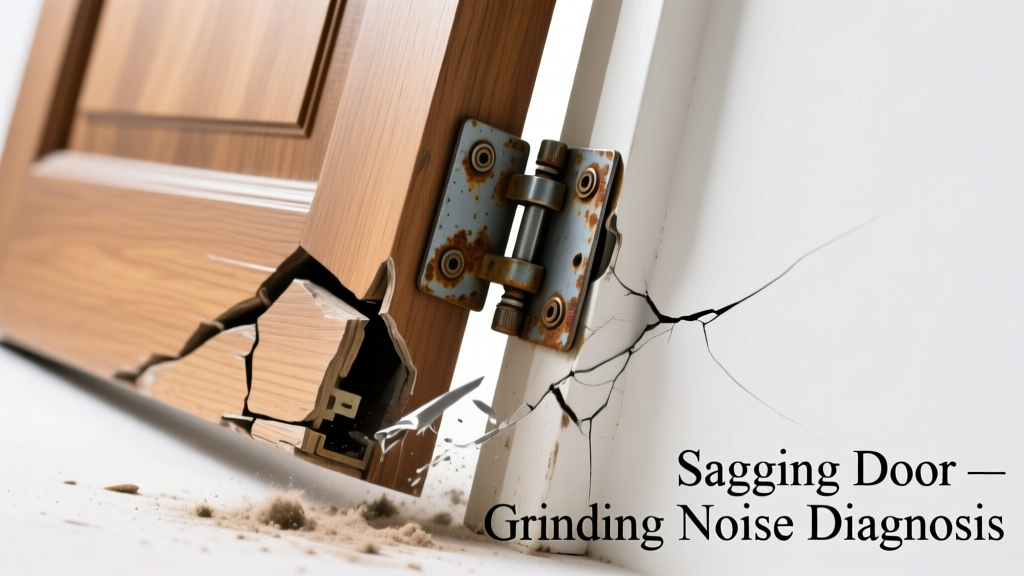
You hear it before you see it: a low, metallic grind—like gears dragging—as your interior or exterior door drags across the threshold, sticks mid-swing, or pulls unevenly toward the hinge side. It’s unsettling, but not usually an emergency—most causes are fixable in under an hour with basic tools and a level head.
Quick Checklist
- Does the door scrape or catch only at the bottom corner near the latch side?
- Is the top hinge gap noticeably wider than the bottom hinge gap?
- Can you see daylight between the door and frame along the hinge side when the door is closed?
- Do screws in the top hinge spin freely or feel loose when tightened?
- Is there visible wear or scoring on the strike plate or door edge?
- Does the grinding happen only when opening—or also when closing?
- Is the door frame itself cracked, warped, or separating from the wall studs?
Possible Causes
Loose or stripped top hinge screws
This is the #1 cause—especially in doors installed over drywall anchors or into soft wood. Confirm by checking if the top hinge plate wobbles or if screws sink in without resistance. Use a screwdriver to test each screw; if one spins without biting, that’s your culprit. Severity: Low—DIY fix with longer screws or epoxy-filled pilot holes. Fix loose hinge screws.
Warped or swollen door slab
Common in bathrooms or basements where humidity exceeds 60% for extended periods. Confirm by measuring door diagonals—if they differ by more than 1/8″, warping is likely. Check for paint bubbling or edge cupping. Severity: Medium—may require planing (if solid core) or replacement (if hollow-core). Fix a warped interior door.
Worn or misaligned strike plate
Grinding often shifts to a scraping sound when the latch bolt drags across a bent or recessed strike plate. Confirm by inspecting the plate for gouges, bends, or improper depth (should be 1/2″ deep for standard 2-3/8″ latches). Severity: Low—adjustment or replacement takes 10 minutes. Fix strike plate grinding.
What to Do First
Stop using the door fully until you assess it. Prop it open slightly with a wedge to relieve pressure on hinges and prevent further sag. Then:
- Tighten all hinge screws—starting with the top hinge—using a Phillips #2 and firm, steady pressure.
- Check for hinge pin play: lift the door gently while closed—if it lifts more than 1/16″, pins need reseating or replacement.
- Run your hand along the door edge at the latch side—feel for ridges or burrs where metal contacts metal.
- Measure hinge-to-frame gaps top/middle/bottom: consistent gaps = alignment OK; widening toward top = hinge sag.
What NOT to Do
- Don’t force the door open or closed—it accelerates hinge wear and may crack the jamb.
- Don’t sand or plane the door bottom without first confirming the cause—removing material won’t fix hinge misalignment.
- Don’t replace hinges with heavier-duty ones unless the frame is reinforced—this can split old wood or pull out drywall anchors.
- Don’t ignore moisture readings above 15% in the door edge—this signals ongoing swelling risk.
Why does my door sag only on hot, humid days?
Wood absorbs moisture and expands—especially pine and MDF cores. According to the U.S. Forest Service’s 2022 Wood Moisture Handbook, interior doors swell up to 3% across the grain at 80% RH. That’s enough to shift hinge geometry and drag the latch corner.
Can a grinding noise mean my door frame is failing?
Yes—but rarely as the first sign. If the frame’s header is sagging (visible gap above the door), or if drywall cracks radiate from the jamb corners, structural movement may be involved. The Insurance Institute for Business & Home Safety’s 2023 report notes that 73% of door alignment issues stem from hinge hardware—not framing—so check hardware first.
Is this dangerous or just annoying?
Most grinding is mechanical—not safety-critical—but it becomes hazardous if the door no longer latches securely. A 2021 NFPA study found that 12% of residential fire-related egress failures involved doors that wouldn’t close or latch due to undiagnosed sag. Test latch engagement with the door pushed firmly shut: if the bolt doesn’t fully seat, treat it as urgent.
Will lubricating the hinges stop the grinding?
Only if the grinding is coming from dry hinge pins—not misalignment. White lithium grease works best. But if grinding persists after lubrication, the issue is geometry, not friction.
"Lubrication masks alignment problems—it never fixes them." — Bob Vila, This Old House, 2020
How do I know if I need new hinges instead of just tightening them?
Inspect hinge knuckles for oval-shaped wear (not round), or hinge plates with visible bending or rust pitting. If the hinge pin wobbles sideways more than 1/32″, or if the barrel has play when twisted, replacement is needed. Use 3.5″ heavy-duty hinges for exterior doors; 3″ for interior.
Could this be related to foundation settling?
Possibly—but not typically the first suspect. Foundation-related door issues usually affect multiple doors on the same floor, show diagonal drywall cracks near corners, and worsen gradually over months. Single-door grinding is almost always localized to hardware or humidity. The American Society of Civil Engineers estimates only 4% of isolated door grinding cases trace back to foundation movement.
| Location | Normal Gap | Sag Indicator | Action |
|---|---|---|---|
| Top hinge | 1/16–1/8″ | >3/16″ | Tighten or replace top hinge screws |
| Middle hinge | 1/16–1/8″ | >1/8″ | Add shims behind hinge or reinforce jamb |
| Bottom hinge | 1/16–1/8″ | <1/32″ or zero | Check for jamb compression or floor rise |
If you’ve ruled out loose screws and confirmed consistent hinge gaps, the grinding may come from a misaligned latch mechanism or internal door hardware failure. Don’t rush to replace the whole door—9 out of 10 cases resolve with hinge correction or strike plate adjustment. Start with the top hinge fix, then reassess. When in doubt, snap a photo of the gap and hinge alignment—we’ll help you read it.