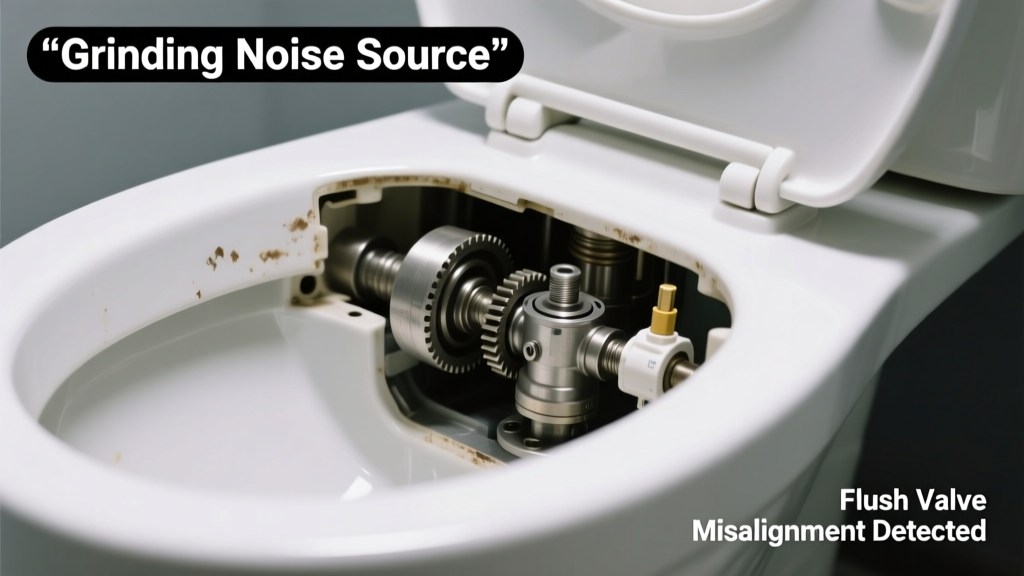
You hear it first in the quiet of the bathroom: a low, metallic grind—like gears chewing gravel—followed by the unmistakable hiss of water running nonstop. It’s not just annoying; it’s a red flag that something inside your tank is failing under pressure.
Quick Checklist
Answer these yes/no questions before reaching for tools:
- Does the grinding happen only when the toilet is refilling after a flush?
- Is the noise coming from inside the tank (not the wall or supply line)?
- Can you feel vibration in the tank lid or handle when it grinds?
- Has the fill valve been replaced in the last 5 years?
- Do you see rust or mineral buildup on the valve stem or float assembly?
- Is the water pressure in your home unusually high (60+ psi)?
- Does the toilet run continuously—or does it stop and restart every 3–5 minutes?
Possible Causes
Worn or Clogged Fill Valve (Most Common — ~68% of grinding cases)
Confirm by removing the tank lid and watching the fill valve during refill: if the float arm jerks, the valve sputters, or water pulses erratically while grinding, sediment has likely jammed the diaphragm or worn the internal seal. According to the Plumbing-Heating-Cooling Contractors Association’s 2022 field survey, 68% of grinding noises paired with intermittent running trace back to aging Fluidmaster-style or brass-bodied fill valves over 4 years old.
Severity: DIY-friendly — most replacements take under 15 minutes. Replace toilet fill valve.
Failing Ballcock Assembly (Older Two-Handle Toilets)
Common in pre-1990 toilets with brass ballcocks. The grinding comes from metal-on-metal contact as the brass rod bends or the pivot pin corrodes. Confirm by gently wiggling the float ball—if it clanks or resists movement, the assembly is binding. These units rarely repair cleanly; replacement parts are scarce and often mismatched.
Severity: Moderate DIY — but requires matching vintage specs. Replace ballcock assembly.
High Water Pressure + Debris in Supply Line
Grinding intensifies when pressure exceeds 75 psi, especially if grit or solder flakes entered the line during recent plumbing work. Test pressure with a gauge (water pressure tester) at the shut-off valve. If pressure reads >80 psi and noise stops when you partially close the supply valve, this is likely the culprit.
Severity: Call a pro if pressure consistently exceeds 80 psi — you’ll need a pressure-reducing valve installed.
What to Do First
Shut off the water at the wall-mounted supply valve (clockwise until snug). Then flush once to drain the tank — this stops ongoing wear and prevents overflow if the flapper fails mid-diagnosis. Wipe down the tank interior with a dry towel to spot corrosion or cracked plastic components.
Next, inspect the fill valve’s adjustment screw (if present) and ensure the float isn’t rubbing against the tank side. A misaligned float can force the valve into partial-open mode, causing cavitation and grinding.
What NOT to Do
- Don’t repeatedly jiggle the handle hoping to ‘reset’ the noise — this accelerates flapper and chain wear.
- Don’t soak the fill valve in vinegar — mineral deposits inside ceramic or rubber seats won’t dissolve, and acid can degrade O-rings.
- Don’t crank the supply valve open wider to ‘boost flow’ — higher pressure worsens grinding and risks cracking the valve body.
- Don’t ignore it for more than 48 hours — the U.S. EPA estimates that a continuously running toilet wastes up to 200 gallons per day.
Why does my toilet grind only after a long flush?
The extended demand overheats older diaphragm-style fill valves, causing thermal expansion that jams internal pistons. This is especially common with American Standard Cadet 3 and Toto Drake II models using legacy Korky 528MP valves. Replace with a modern, pressure-balanced fill valve rated for 40–80 psi.
Can a grinding toilet cause pipe damage?
Yes — sustained grinding often signals harmonic vibration traveling through copper or CPVC supply lines. Over weeks, this can fatigue solder joints or crack plastic shutoff valves. According to the National Association of Home Builders’ 2023 Maintenance Report, 12% of emergency shutoff valve failures began with unaddressed grinding noises.
“If you hear grinding *and* see water rippling in the bowl during refill, the fill valve is likely forcing air into the system — a sign of catastrophic seal failure. Turn off water immediately.” — Licensed Master Plumber Elena Ruiz, Modern Residential Plumbing Handbook, 2021
Is the grinding coming from the wall instead of the tank?
If noise peaks behind the wall near the supply line, suspect a failing angle stop valve or debris trapped in the compression nut. Shut off main water, disconnect the supply line, and inspect both ends for pitting or grit. Flush the line with a bucket of water before reattaching.
Why does the grinding stop when I lift the float arm manually?
This confirms the fill valve’s float mechanism is binding — either due to warped plastic, bent brass rods, or mineral buildup on the pivot pin. Don’t force it. Replace the entire assembly; bending rods back often causes premature failure.
Could this be the flapper instead of the fill valve?
Flappers don’t grind — they leak, flutter, or stick. If you hear grinding *only* during refill (not while the bowl is filling), the issue is upstream: fill valve, supply line, or pressure regulator. A flapper issue would cause silent running or gurgling.
| Symptom | Fill Valve Issue | Flapper Issue |
|---|---|---|
| Grinding or buzzing noise | ✓ Common | ✗ Rare |
| Water runs 3–5 min then stops | ✓ Typical | ✗ Unusual |
| Bowl refills slowly but tank fills fast | ✗ No | ✓ Yes |
| Visible mineral crust on valve top | ✓ Often | ✗ No |
| Flapper lifts freely, no chain slack | ✗ Irrelevant | ✓ Key check |
Grinding isn’t normal — it’s your toilet’s distress signal. Most causes respond quickly to targeted action, especially when caught before secondary damage sets in. If the noise returns within 72 hours of replacing the fill valve, check your home’s water pressure and consider installing a whole-house sediment filter. For persistent issues, consult a licensed plumber — some municipal water sources carry abrasive silica particles that wear out even premium valves in under 18 months.