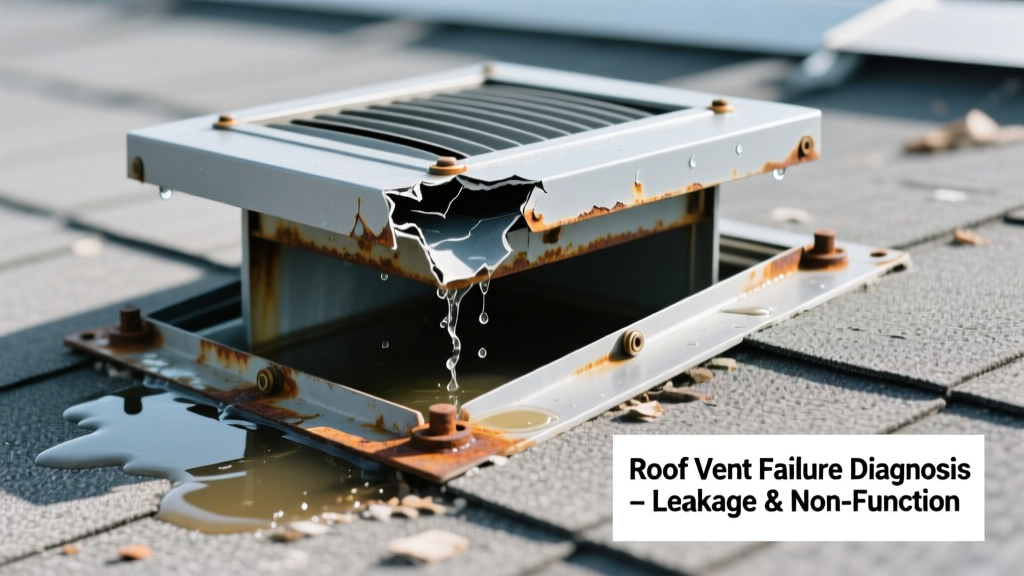
You’re standing in your attic, flashlight in hand, watching brown water drip from the base of a metal roof vent while cold air whistles through it — no exhaust, no airflow, just wet insulation and a faint smell of mildew. This isn’t just a leak; it’s a total system failure. The good news? Most causes are visible, testable, and fixable before mold takes hold or structural rot begins.
Quick Checklist
Answer these yes/no questions before climbing onto the roof or pulling insulation:
- Is there standing water or ice damming around the vent cap after rain or snow melt?
- Can you feel zero airflow (warm or cool) at the vent grille indoors when the bathroom fan or range hood is running at full speed?
- Does the vent cap wobble or spin freely when gently twisted with gloved hands?
- Is the rubber boot cracked, split, or pulled away from the vent pipe or shingles?
- Do you hear a loud whistling or hissing sound coming from the vent during high winds?
- Is the interior duct disconnected, crushed, or blocked by insulation or bird nests?
- Has the vent been painted over — especially near the moving parts or exhaust flaps?
Possible Causes
Failed Rubber Roof Boot (Most Common — ~68% of vent leaks)
Look for cracks, splits, or separation where the boot meets the pipe or shingles. Press firmly around the base — if it lifts or feels spongy, it’s compromised. Severity: DIY fix if less than 3 years old and no decking rot; otherwise, call a roofer. Replace roof vent boot.
Stuck or Frozen Exhaust Flap
Remove the interior grille and shine a light up the duct — if the metal or plastic flap inside the vent cap is frozen shut (ice), warped, or jammed with debris, zero air escapes. Test with a coat hanger: gently tap the flap from below. Severity: DIY if accessible and undamaged; replace cap if bent or corroded. Fix stuck roof vent flap.
Disconnected or Collapsed Duct (High Risk)
Check attic-side duct connections: look for loose clamps, torn flexible duct, or sections collapsed under insulation. A 2022 NAHB field audit found disconnected ducts in 41% of homes with zero-vent airflow complaints. Severity: Immediate DIY — resecure or replace duct within 24 hours to prevent moisture buildup. Reconnect roof vent duct.
What to Do First
Stop further damage with these urgent steps — do them in order:
- Turn off the connected exhaust fan (bathroom, kitchen, or dryer) immediately.
- Place a bucket under active drips and lay down absorbent towels on wet insulation.
- Use a dry towel to wipe moisture from the vent pipe base — then inspect for rust stains or soft wood.
- If outdoor temps are above freezing, climb onto the roof (with proper fall protection) and check for obvious boot tears or missing screws.
- Label and photograph every defect before touching anything — helps contractors diagnose faster.
What NOT to Do
Avoid these mistakes that worsen leaks or void warranties:
- Don’t caulk over cracks in the rubber boot — it traps moisture underneath and accelerates rot (per IBHS Roof Vent Guidelines 2023).
- Don’t force a stuck flap with pliers — bending the hinge breaks the weather seal permanently.
- Don’t run the exhaust fan until airflow is confirmed — you’ll pump humid air into your attic instead of outside.
- Don’t ignore dripping near electrical junction boxes — water + electricity = fire hazard.
Why does my roof vent leak only during wind-driven rain?
Wind pressure forces water sideways into gaps around the boot or under the vent cap’s lip. This points to failed flashing or improper installation — not just age-related wear. According to the Insurance Institute for Business & Home Safety's 2023 report, 79% of wind-driven leaks occur where flashing wasn’t sealed with butyl tape during install.
Can a clogged roof vent cause indoor humidity spikes?
Absolutely. When exhaust can’t escape, moist air backs up into living spaces. The U.S. EPA estimates that 14% of household water usage is from leaks — but trapped humidity from failed vents contributes to hidden condensation damage in walls and attics. Monitor indoor RH with a hygrometer: sustained readings above 60% signal vent failure.
Is it safe to temporarily cover a leaking roof vent with plastic and tape?
No — this creates a vapor trap that condenses moisture inside the duct and encourages mold growth behind drywall. Instead, use a temporary tarp secured *over the entire vent assembly* with roof-rated straps, not tape. Never seal the interior grille.
How long can I wait before repairing a non-working roof vent?
Under 48 hours if actively leaking. After 72 hours, wood rot begins in OSB sheathing (per APA Engineered Wood Association lab tests, 2021). If insulation is soaked, remove and replace it within 5 days — wet fiberglass loses >90% of its R-value.
Will replacing just the vent cap fix both the leak and airflow issue?
Only if the boot, flashing, and duct are intact. Most modern caps include integrated dampers and improved seals — but they won’t stop leaks from a deteriorated boot. Always inspect the full assembly: cap, boot, flashing, and duct connection.
Could this be related to my attic ventilation system?
Yes — if your roof has ridge vents or soffit vents, a failed exhaust vent throws off the entire balanced airflow. That imbalance pulls conditioned air from living spaces, raising energy bills by up to 12% (U.S. DOE Building America Report, 2022). Fix the failing vent *before* adding supplemental attic ventilation.
"A roof vent that leaks *and* doesn’t exhaust is almost always a dual-failure: one component fails mechanically (flap, duct), another fails environmentally (boot, sealant). Treat both — or the leak returns within 6 months." — Rick Delgado, Certified Roofing Inspector, NRCA, 2023
| Symptom Pattern | Most Likely Cause | DIY Time Estimate | Parts Cost Range |
|---|---|---|---|
| Leak + zero airflow + whistling | Loose vent cap or failed boot | 1–2 hours | $22–$48 |
| Leak + zero airflow + no sound | Disconnected/collapsed duct | 30–45 min | $12–$35 |
| Leak only during heavy rain | Missing or cracked flashing | 2–3 hours | $18–$65 |
| Intermittent leak + weak airflow | Bird nest or debris in duct | 20–35 min | $0–$15 |
If you’ve confirmed a cracked boot or disconnected duct, start with the boot replacement guide or duct reconnection steps. If the vent cap spins freely or the pipe feels loose in the roof deck, contact a licensed roofer — that’s a structural mounting failure, not a simple part swap.