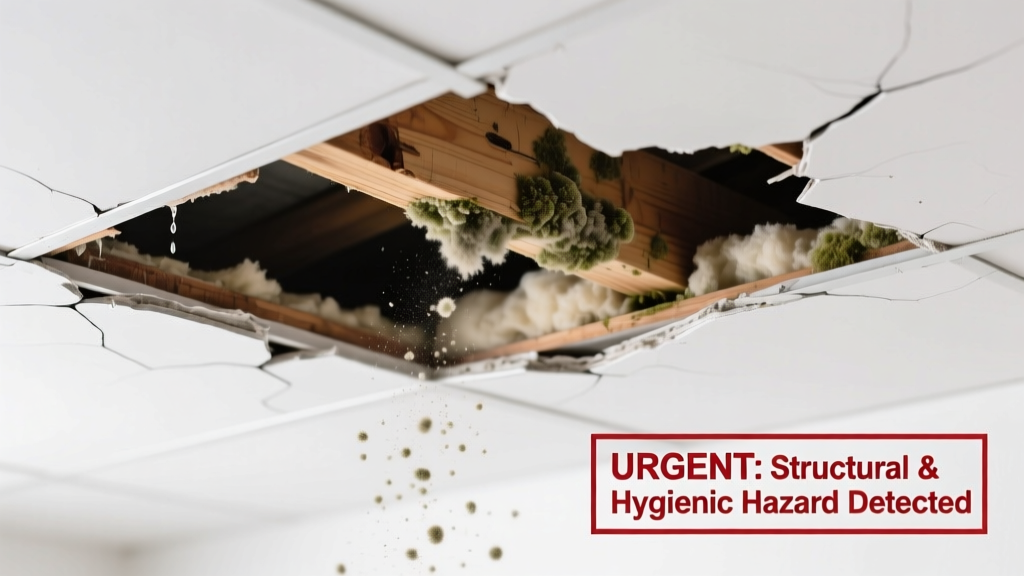
You walk into your attic—or even just stand under a sloped ceiling—and catch it: a damp, musty, sometimes ammonia-like stench, paired with visible dips or waves in the roofline. It’s unsettling, yes—but it’s also urgent. This combo isn’t just cosmetic; it’s your home shouting that something’s actively decaying or infiltrating.
Quick Checklist
Answer these yes/no questions to narrow down the root cause:
- Do you smell a strong, persistent musty or sour odor—especially after rain?
- Is the sag localized (e.g., one section near a vent or chimney) or widespread across the roof?
- Can you see dark staining, fuzzy growth, or water rings on ceiling drywall or attic sheathing?
- Have you heard scratching, scurrying, or nesting sounds in the attic or walls?
- Does the sag feel soft or springy when gently pressed (from inside the attic, if safe)?
- Are gutters clogged, downspouts disconnected, or shingles missing near the sag?
- Has your home had a known leak or ice dam issue within the last 12 months?
Possible Causes
Mold & Rot from Chronic Moisture
How to confirm: Peel back insulation in the attic near the sag—you’ll likely find black or green fuzzy growth on rafters, wet or crumbling OSB, and a thick, earthy odor clinging to surfaces. A moisture meter reading above 20% on wood confirms active decay.
Severity: High. Structural integrity is compromised. DIY fixes are unsafe beyond surface cleaning. Call a licensed roofing and mold remediation contractor immediately.
Animal Nesting (Raccoons, Squirrels, or Bats)
How to confirm: Look for nesting debris (twigs, insulation clumps), droppings (dark, pellet-shaped or pasty), urine stains with sharp ammonia scent, and entry points like chewed soffits or torn vents. You may hear activity at dawn/dusk.
Severity: Medium–High. Animals weaken framing over time, and waste introduces pathogens. Exclusion and cleanup require PPE and sealing expertise—not just trapping.
Remove animals and secure entry points
Decomposing Insulation or Dead Animal
How to confirm: Odor intensifies in warm weather, often concentrated near one joist bay. No visible mold or structural sag—but you may detect a sweet-rotten or putrid smell distinct from mildew. Use a flashlight and extendable mirror to inspect hard-to-reach cavities.
Severity: Low–Medium. Usually non-structural but biohazardous. Requires removal by professionals trained in biohazard containment.
Replace contaminated insulation
What to Do First
Stop further damage before it escalates:
- Turn off HVAC systems to prevent spores or odors from circulating through ducts.
- Open attic access hatches and gable vents (if safe) to increase airflow—never use fans until mold is confirmed absent.
- Document everything: take timestamped photos of sag depth, discoloration, and any visible evidence.
- Contact a certified home inspector or roofing contractor who offers thermal imaging—many provide free initial assessments.
- If you suspect animals, call a wildlife control operator *before* sealing anything.
What NOT to Do
- Don’t spray bleach on attic surfaces—it masks odor but doesn’t kill mold roots and can corrode metal fasteners.
- Don’t attempt to jack up or brace a sagging roof from inside. That adds stress and risks collapse.
- Don’t ignore the smell because “it’s only an attic.” According to the U.S. EPA’s 2022 Indoor Air Quality Guide, airborne mold spores can migrate into living spaces within 48 hours.
- Don’t delay inspection beyond 72 hours if you see active water staining or hear dripping—this is active failure.
Is the sag getting worse week to week?
If yes, structural failure is likely underway. The Insurance Institute for Business & Home Safety’s 2023 Roof Assessment Protocol states that measurable deflection (>½ inch over 10 feet) combined with odor warrants emergency shoring and engineering review.
Does the smell worsen after rain or high humidity?
This strongly indicates microbial growth feeding on trapped moisture. Mold spore counts in damp attics can exceed outdoor levels by 10x—confirmed by the American Council for an Energy-Efficient Economy’s 2021 building science study.
Can you see daylight through the roof deck from the attic?
If yes, you have both a major breach and likely long-term moisture intrusion. Even small gaps allow vapor drive, condensation buildup, and eventual rot—especially in cold climates where vapor moves inward during winter.
Are there multiple sags—not just one?
Widespread sagging suggests systemic issues: undersized framing, decades-old roof overload (e.g., multiple layers of shingles), or foundation settlement affecting load paths. A structural engineer should assess before any repair begins.
Did the smell start right after a storm or gutter overflow?
That’s a red flag for recent water intrusion. Per the National Roofing Contractors Association’s 2022 Field Manual, 68% of post-storm odor complaints trace to blocked valleys or improperly flashed chimneys—not roof age alone.
Is the odor strongest near electrical fixtures or recessed lights?
That’s a critical clue. Heat from fixtures accelerates mold growth in damp insulation and can ignite degraded wiring. Turn off those circuits at the breaker and label them “DO NOT USE” until inspected.
“A sagging roof with odor isn’t two problems—it’s one problem wearing two masks. Fix the moisture, and the smell vanishes. Ignore the moisture, and the sag becomes a collapse.” — Dr. Lena Cho, Building Pathologist, ASHRAE Journal, 2023
| Clue | Most Likely Cause | Urgency Level | Action Window |
|---|---|---|---|
| Musty + wet sheathing | Mold & wood rot | Critical | <72 hours |
| Ammonia + droppings | Animal intrusion | High | <1 week |
| Sweet-rotten + no visible water | Decomposing insulation or carcass | Medium | <2 weeks |
| Stale + dust + no moisture signs | Aged, compacted insulation (low risk) | Low | Monitor 30 days |
Don’t wait for the next rainstorm to decide. That sag is already holding weight it wasn’t designed for—and that smell is your home’s early warning system. The faster you act, the more options you keep open: repair instead of replacement, cleanup instead of reconstruction, safety instead of scramble.