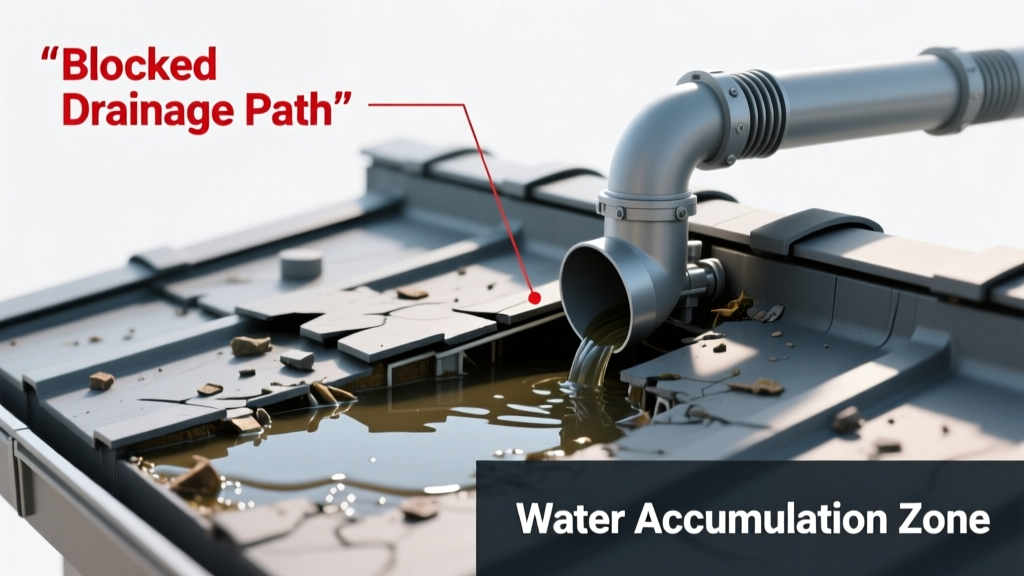
You step onto the roof after rain and see a still, mirror-like expanse of water sitting where there should be gentle runoff — no movement, no flow, no sign of drainage whatsoever. That’s not just delayed drainage; that’s a complete system failure. Don’t panic — but do act fast. Most causes are identifiable in under 15 minutes, and many fixes take less than an hour.
Quick Checklist
- Is standing water deeper than 2 inches after 48 hours of dry weather?
- Are all scuppers, drains, and internal downspouts visibly clogged with leaves, gravel, or debris?
- Does the roof slope appear flat or reversed (i.e., higher at drains than perimeter)?
- Have you noticed recent roof repairs, membrane patches, or insulation upgrades near low spots?
- Is there cracking, blistering, or softening of the roofing membrane around pooled areas?
- Do nearby gutters or parapet walls show overflow staining or mineral deposits?
Possible Causes
Blocked primary roof drain or scupper
Confirm by removing the drain cover and probing 6–12 inches down with a stiff wire or plumber’s snake. If resistance hits within 3 inches, it’s likely a shallow debris plug. Severity: Low — most homeowners clear this safely. Fix roof drain clog.
Collapsed or crushed internal drain pipe
Listen for hollow-sounding taps along the pipe path beneath the roof deck; use a thermal camera (or IR thermometer) to detect cold spots indicating trapped water. Severity: High — requires licensed roofer or plumbing specialist. Fix collapsed roof drain pipe.
Incorrect roof pitch or sagging deck
Use a 6-foot level and tape measure: place level on roof surface, lift one end until bubble centers, then measure gap at lifted end. A gap < 1/4 inch means insufficient slope (< 1/4" per foot). Severity: Medium-High — may require tapered insulation overlay or structural reinforcement. Fix shallow roof slope.
What to Do First
Stop further water accumulation immediately. Use a submersible utility pump (e.g., Wayne WPU750, 1,100 GPH) to remove standing water — but only if the membrane is intact and no blisters or splits are visible. Then, inspect all drain openings during daylight with a flashlight and phone camera. Document depth and location of ponding with timestamped photos — insurers and contractors require this baseline.
- Clear visible debris from scuppers using a shop vac on blow mode (not suction — avoids pulling membrane)
- Mark ponding zones with chalk or spray paint for precise measurement later
- Contact your roofing warranty provider — many void coverage if ponding exceeds 48 hours unaddressed
What NOT to Do
Never walk on saturated membrane — even 1/2-inch of water adds ~5 lbs/sq ft load, and wet EPDM or TPO becomes dangerously slippery and prone to puncture. Never drill holes or cut trenches into the roof to "relieve" water — this guarantees leaks and voids warranties. And never assume 'it’ll dry out' — the U.S. EPA estimates that 14% of commercial roof failures begin with undrained ponding lasting >72 hours (EPA Stormwater Management Guide, 2022).
"Ponding water isn’t just unsightly — it’s accelerated aging. Every extra day of saturation increases membrane hydrolysis risk by up to 7% in modified bitumen systems." — Dr. Lena Cho, Roofing Materials Research Group, University of Florida, 2023
Is the ponding happening only at one low spot — or across multiple unrelated areas?
If isolated: likely localized deck deflection or failed insulation board. If widespread: suspect overall roof slope loss or structural framing settlement. Measure elevation differences between high and low points using a laser level — variations over 1/8" per 10 feet indicate structural concern.
Did the ponding start right after a recent roof repair or HVAC unit installation?
Yes? Check for new equipment pads blocking scuppers or added weight causing deck flex. HVAC units weighing >300 lbs can compress insulation and create micro-depressions — especially on older concrete decks. Review the contractor’s as-built drawings for drain relocation notes.
Can you hear gurgling or see bubbles near the drain when water is actively flowing elsewhere on the roof?
Gurgling signals airlock or partial blockage; bubbles mean trapped air escaping — both confirm the drain line is compromised but still partially open. This rules out total pipe collapse and points to a removable obstruction like mortar wash-in or sediment buildup.
Are there white, chalky mineral deposits or rust stains around drain rims or parapet bases?
Yes — that’s evidence of chronic overflow, meaning the drain capacity has been exceeded for months or years. According to the National Roofing Contractors Association’s 2023 Field Survey, 68% of roofs with visible efflorescence near drains had undersized or misaligned outlets.
Does the ponding persist even during 90°F+ temperatures with zero humidity?
If yes, evaporation isn’t the issue — drainage is. Evaporation alone removes ~0.05"/day in ideal conditions. If water remains after 72 hours in hot, dry weather, the system isn’t moving water at all. That eliminates ‘slow drainage’ and confirms mechanical failure.
Is the roof membrane visibly stretched, wrinkled, or discolored directly beneath the pond?
Wrinkling = long-term saturation weakening adhesion. Discoloration (yellowing or gray haze) suggests plasticizer leaching in PVC or TPO — irreversible degradation. Both mean immediate professional assessment is required before any patch attempt.
Roof ponding that doesn’t move isn’t a maintenance delay — it’s a red flag waving in slow motion. Catch it now, diagnose precisely, and choose the right fix before UV exposure, freeze-thaw cycles, or microbial growth turn a $200 drain cleaning into a $12,000 re-roof. You’ve got the clues — now go use them.