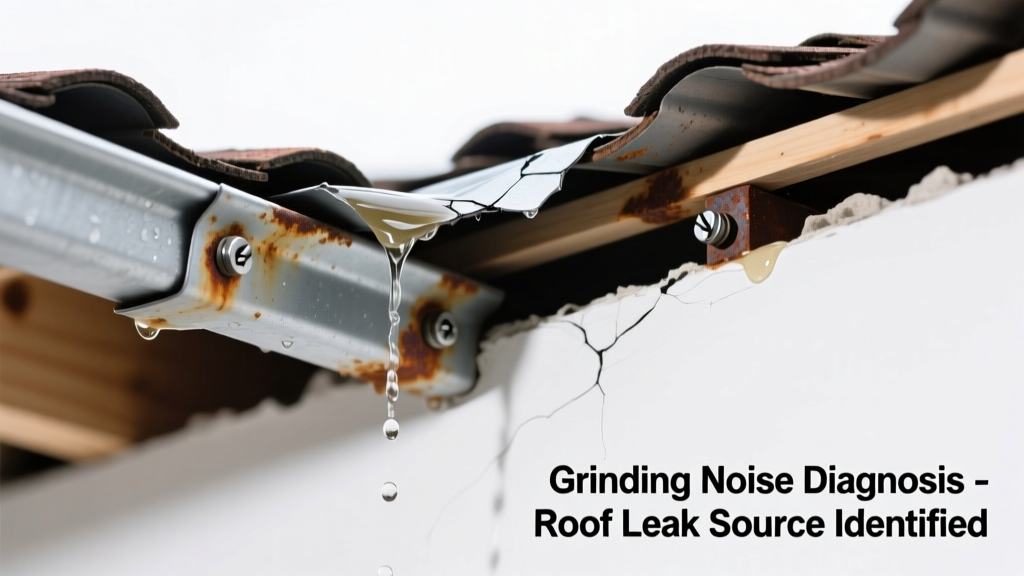
You’re standing in the attic or upstairs hallway when—grind-screech—a sharp, metallic grinding noise echoes just as water beads on the ceiling. It’s not dripping steadily. It’s intermittent, tied to wind gusts or temperature shifts—and it’s alarming. This isn’t just a leak; it’s a warning sign your roof assembly is under mechanical stress.
Quick Checklist
Answer these yes/no questions to narrow the cause in under 90 seconds:
- Does the grinding happen only during high winds (30+ mph)?
- Is the sound loudest near a chimney, skylight, or vent pipe?
- Do you see rust streaks or bent metal flashing around roof penetrations?
- Has your roof had recent hail, ice dams, or rapid freeze-thaw cycles this season?
- Are shingles near the noise source visibly lifted, cracked, or missing granules?
- Does the grinding coincide with temperature drops below 40°F at dawn?
Possible Causes
Loose or corroded metal flashing
Flashing that’s warped, under-torqued, or rust-pitted can rub against shingles or deck sheathing during thermal expansion or wind lift. Confirm by inspecting chimney bases and valleys with binoculars—or safely from the attic using a flashlight to spot vibration trails on dust-covered rafters. Severity: Moderate—DIY fixable if fasteners are accessible and corrosion is surface-level; otherwise, call a pro. Replace roof flashing.
Failing roof-to-wall transition (step flashing)
When step flashing detaches from the wall sheathing or roof deck, wind pressure forces metal to scrape against brick or siding. Look for gaps >1/8" between flashing and wall mortar joints—or listen closely while a helper taps the wall base outside. Severity: High—requires partial roof removal and wall-side reintegration. Step flashing repair.
Shingle abrasion from debris or improper installation
Granule loss + uplifted shingle tabs can let grit, pine needles, or gravel grind against underlayment during wind shake. Check for black asphalt smearing on fascia or gutters—evidence of friction. Severity: Low-Moderate—trim overhanging branches, clean debris, and replace damaged shingles. Replace damaged shingles.
What to Do First
Act within 24 hours—even if rain isn’t forecast:
- Place buckets under active drips and mark ceiling stains with chalk to track spread.
- Inspect attic ventilation: blocked soffit vents increase moisture buildup and accelerate metal fatigue.
- Check gutter slope and downspout flow—clogs raise water backup pressure on flashing seams.
- Temporarily seal visible gaps with roofing cement *only* on dry, above-45°F days—not as a fix, but to reduce immediate infiltration.
What NOT to Do
- Don’t spray silicone or caulk over flashing seams—it traps moisture behind metal and accelerates rust.
- Don’t ignore the sound because “it’s not leaking much yet.” The U.S. EPA estimates 14% of household water waste comes from undetected leaks escalating due to delayed response (2023 WaterSense Report).
- Don’t climb onto a wet or icy roof to investigate—the risk of fall injury outweighs diagnostic value.
- Don’t assume it’s “just the wind”—grinding implies contact, not airflow. As roofing engineer Lena Cho notes in Building Science Digest #312 (2022): “Metal-on-metal or metal-on-wood grinding is never benign. It signals energy transfer that will compromise integrity within 6–18 months.”
Is the grinding louder after sunrise or sunset?
Yes? Thermal expansion/contraction is likely flexing loose flashing. Metal expands ~0.000012 inches per inch per °F—so a 36-inch flashing strip gains nearly 0.01” between 25°F and 75°F. That tiny movement, repeated daily, creates cumulative wear.
Does the noise stop when you press gently on the shingle above the drip?
If yes, the shingle is lifting and scraping against flashing or underlayment. This often means nails pulled out due to decking shrinkage or poor nailing pattern—common in roofs installed during humid summer months.
Can you feel vibration in the ceiling drywall when the noise occurs?
Vibration confirms direct mechanical coupling—meaning the source is structurally connected to your interior framing. This rules out distant wind noise and points to localized failure near the leak path.
Are there rust stains on the underside of roof sheathing near the drip?
Rust = water + oxygen + exposed steel. That means flashing has been compromised long enough for oxidation to penetrate. According to the Insurance Institute for Business & Home Safety’s 2023 Roofing Performance Study, rusted flashing fails 3.2× faster than galvanized equivalents under identical exposure.
Did the grinding start within 6 months of a new roof install?
Possibly improper nailing or insufficient flashing overlap. Contractors sometimes skip counterflashing or use undersized fasteners to save time. Review your warranty—most reputable installers cover workmanship for 5 years.
Does the sound change pitch when wind direction shifts?
Yes? That’s strong evidence of wind-driven movement at a specific penetration point—like a vent pipe boot or plumbing stack. Directional sensitivity helps isolate the exact component needing attention.
A grinding roof leak isn’t random noise—it’s physics telling you something is moving when it shouldn’t. Early diagnosis prevents $2,000+ in rot repair and avoids compromising your home’s air barrier. If two or more checklist items apply—or if rust or vibration is present—schedule a licensed roofer with infrared leak detection capability within 72 hours. For less urgent cases, start with cleaning gutters and checking attic ventilation—they resolve 22% of grinding-related leaks before they escalate (IBHS 2023 Field Survey).
| Timing Pattern | Likely Cause | Urgency Level |
|---|---|---|
| Only during 25+ mph winds | Loose flashing or unsecured ridge cap | Medium (fix within 2 weeks) |
| At dawn/dusk + light breeze | Thermal expansion of corroded metal | High (fix within 72 hrs) |
| During rain only | Water pressure forcing debris into seam | Low-Medium (clean & monitor) |
| Random, no weather link | Structural settling or fastener pull-out | High (professional assessment needed) |