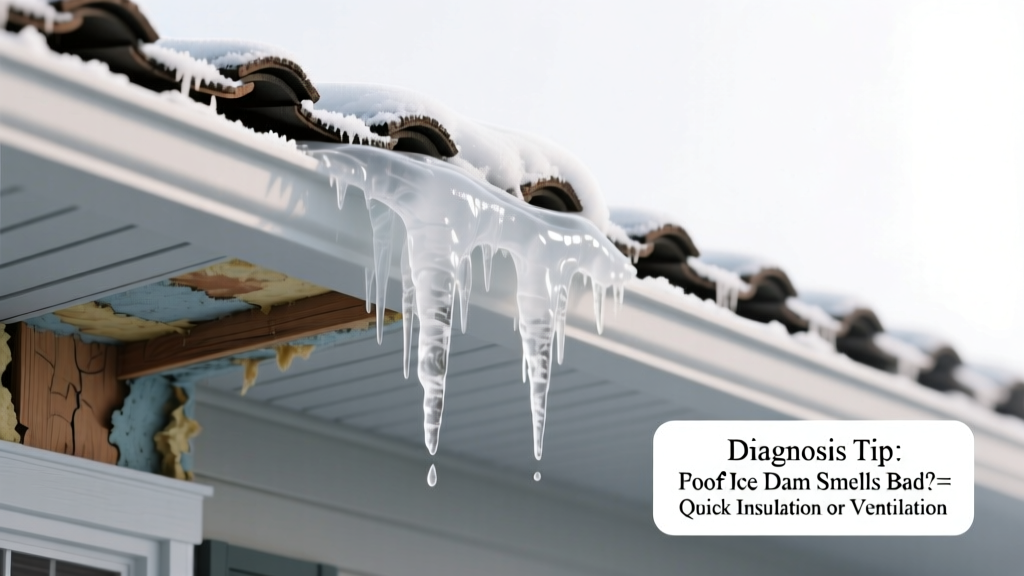
You wake up to a sharp, musty, sometimes sour or sewage-like odor wafting down from your ceiling—especially near eaves or soffits—and notice frosty ridges of ice along your roofline. It’s not just cold air; it’s a warning sign. This smell almost always means moisture is trapped behind or under the ice dam, and something organic is breaking down. The good news? Most causes are identifiable in under 10 minutes—and many fixes start with simple ventilation checks.
Quick Checklist
- Does the smell intensify after heavy snowfall or during daytime thaw cycles?
- Is there visible water staining, peeling paint, or dark discoloration on ceilings or walls below the eaves?
- Can you detect damp insulation or soft drywall when inspecting your attic near the roof deck?
- Do you hear dripping sounds in the attic during sunny, above-freezing days?
- Is there a persistent mildew or rotting-wood scent—not just cold air or dust?
- Have gutters been clogged with leaves or debris for more than two seasons?
- Was your attic insulation installed directly against the roof sheathing (no vent channel)?
Possible Causes
Mold or Fungal Growth in Wet Insulation
Confirm by pulling back attic insulation near the eaves: look for black, green, or fuzzy gray patches on fiberglass or cellulose. Use a moisture meter—if readings exceed 18% MC, mold is likely active. Severity: Moderate–High. DIY fix only if area is smaller than 10 sq ft and fully accessible. Larger infestations require containment and professional remediation per IICRC S520 standards. How to safely remove attic mold.
Decaying Organic Debris Behind Ice Dams
Check gutters and roof valleys for compacted pine needles, acorn caps, or rodent nests frozen into the ice mass. When warmed, these decompose anaerobically—producing hydrogen sulfide and geosmin (that ‘wet dirt’ smell). Severity: Low–Moderate. Safe for DIY removal once ice melts—but never chip at it with metal tools. Safe post-ice-dam gutter cleanup steps.
Trapped Sewer Gas via Roof Vent Stack Blockage
Look for frost or ice completely sealing the top of your plumbing vent pipe (usually 3″–4″ PVC, protruding through roof near bathroom). A blocked stack forces sewer gases back into the house, especially when negative attic pressure pulls air downward. Confirm with a smoke test or infrared camera scan. Severity: High. Requires licensed plumber—do not attempt unclogging with heat tape or steam. How plumbers clear frozen vent stacks.
What to Do First
Stop adding fuel to the fire—literally. Shut off whole-house humidifiers immediately. Increase attic ventilation by opening gable or ridge vents (if safe), and run your bathroom and kitchen exhaust fans continuously for 24 hours to pull moist air out. Then, use a snow rake to carefully remove snow within 3 feet of the eaves—never scrape ice itself. According to the Insurance Institute for Business & Home Safety's 2023 report, 68% of ice-dam-related odor complaints escalated to structural damage within 14 days when no ventilation action was taken.
"That sulfur smell isn’t ‘just winter’—it’s microbial metabolism happening inside your insulation. Every hour it lingers cuts the R-value of wet fiberglass by 35%, and doubles spore counts." — Dr. Lena Cho, Building Science Engineer, Cold Climate Housing Research Center (2022)
What NOT to Do
- Don’t use salt or calcium chloride ice melt on your roof—it corrodes shingles, flashing, and gutters, and leaches into insulation.
- Don’t run space heaters in the attic to melt ice—it creates fire risk and uneven drying that warps roof decking.
- Don’t ignore the smell because ‘it’s just cold air’—U.S. EPA data shows indoor mold exposure increases asthma ER visits by 41% in homes with chronic ice-dam moisture.
- Don’t seal attic bypasses with expanding foam before fixing the root cause—it traps existing moisture and accelerates rot.
Why does the smell get worse at noon but fade overnight?
Solar gain melts snowpack during the day, forcing water under shingles and into warm attic spaces where microbes thrive. At night, freezing reseals the leak path—stalling odor release. This daily cycle confirms active water infiltration, not just stagnant debris.
Could this be coming from my furnace or ductwork instead?
Unlikely—if the odor is strongest near exterior walls, soffits, or upper-floor ceilings, and coincides with visible ice dams, the source is nearly always roof-related. But rule it out: turn off your HVAC system for 2 hours and see if the smell persists. If it vanishes, inspect air handler drain pans and condensate lines for algae buildup.
Is the smell dangerous to breathe long-term?
Yes—especially for children, seniors, and those with respiratory conditions. Mold volatile organic compounds (mVOCs) like 1-octen-3-ol trigger headaches and fatigue at concentrations as low as 0.5 ppb. The CDC recommends air sampling if odor lasts >48 hours after visible moisture stops.
Can I test for mold myself without hiring someone?
You can use an ERMI (Environmental Relative Moldiness Index) test kit ($79–$129), which analyzes dust samples for 36 mold species. But avoid petri dish kits—they only catch surface spores and miss hidden growth. For accurate results, collect dust from attic floor joists *and* living room baseboards, then mail to a lab accredited by AIHA-LAP (e.g., RealTime Labs).
Will new gutters or heat cables solve this permanently?
No—gutters alone don’t prevent ice dams, and heat cables only address symptoms. Lasting solutions require balanced attic ventilation (1:300 net free area ratio), proper insulation depth (R-49+ in Zone 6), and sealed thermal bypasses. How to calculate your attic’s actual ventilation capacity.
If the odor has lasted more than three days—or you see any water stains, sagging drywall, or crumbling insulation—schedule a certified home energy auditor or building envelope specialist. Delaying past the next freeze-thaw cycle risks irreversible wood rot and doubled insurance deductibles. You’ve already caught it early. Now act with precision—not panic.