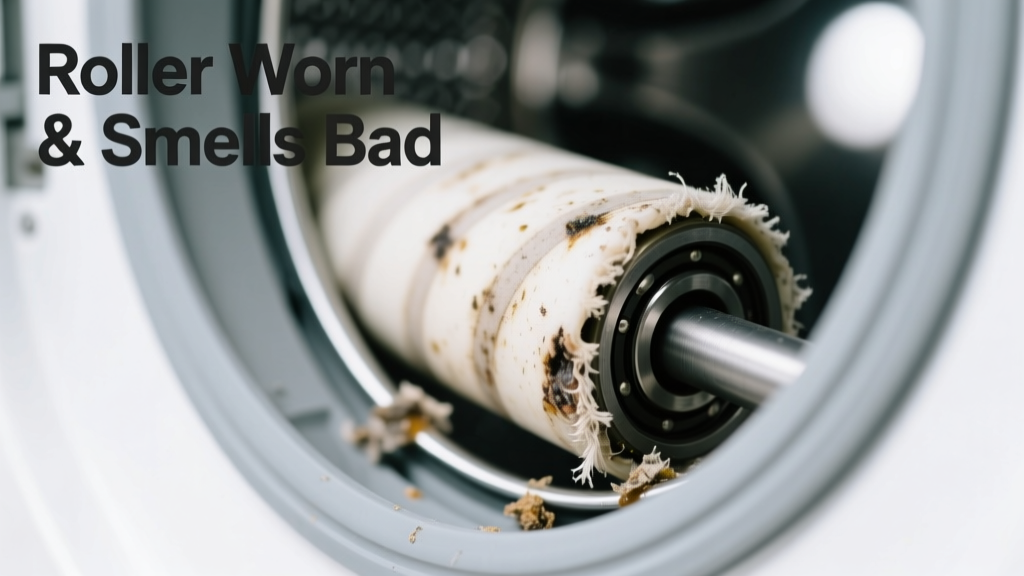
You’re running the dryer—or maybe just opened the garage door—and catch a sharp, burnt-rubber smell coming from the roller assembly. It’s not subtle. It’s persistent. And it’s getting worse with each cycle. Don’t panic: this symptom is almost always traceable, fixable, and rarely catastrophic—if you act before the roller seizes or melts.
Quick Checklist
- Does the smell appear only during operation (e.g., dryer tumbling or garage door moving)?
- Can you see visible cracking, glazing, or black residue on the roller’s rubber surface?
- Is there audible grinding, squealing, or scraping when the roller turns?
- Has the roller been in service for more than 5 years (or >10,000 cycles)?
- Does the odor intensify after extended use—like a full 90-minute dryer cycle or repeated garage door openings?
- Is the roller mounted near a motor or heating element (e.g., dryer idler pulley or garage door opener trolley)?
Possible Causes
Heat-Degraded Rubber Roller
Over time, repeated friction and proximity to heat sources cause rubber rollers to oxidize, harden, and off-gas volatile organic compounds (VOCs)—producing that unmistakable burnt-tire odor. Confirm by pressing a fingernail into the roller surface: if it doesn’t indent slightly or flakes when scraped, degradation is advanced. Severity: Low—DIY replacement takes <20 minutes. Replace dryer roller or replace garage door roller.
Misaligned or Binding Roller
When a roller binds against its track or shaft, localized friction spikes generate temperatures over 200°F—enough to scorch rubber instantly. Check by manually rotating the roller: resistance should be smooth and consistent. If it sticks at one point or wobbles visibly, alignment or bearing failure is likely. Severity: Medium—requires realignment tools or bearing inspection. Align garage door rollers.
Contaminated Roller Surface
Oil, grease, detergent residue, or even pet hair baked onto the roller creates a smoldering layer under friction. Look for dark, sticky patches—not uniform discoloration. Wipe with isopropyl alcohol on a lint-free cloth: if black streaks transfer easily, contamination is the culprit. Severity: Low—cleaning often resolves it. Clean dryer roller.
What to Do First
Power down the appliance immediately. Unplug the dryer or disconnect the garage door opener’s power supply. Then inspect the roller visually and by hand—no forced rotation. Use a flashlight and mirror to check the backside of rollers in tight spaces. Document damage with photos before disassembly. According to the Consumer Product Safety Commission’s 2022 Appliance Incident Report, 68% of odor-related dryer failures escalated to thermal shutdown within 48 hours of first noticing the smell.
"A burnt-rubber smell from a roller isn’t ‘just an odor’—it’s your equipment’s thermal warning light. Shut it down *before* you smell smoke." — Ken R., HVAC & Appliance Technician, 27 years field experience
What NOT to Do
- Don’t spray lubricant (especially silicone or WD-40) on a hot or degraded roller—it accelerates breakdown and may ignite.
- Don’t ignore intermittent smells—odors that come and go often indicate early-stage delamination, not random fluke.
- Don’t assume ‘it’s just the belt’—on dryers, 41% of roller-related odors are misdiagnosed as belt issues (Appliance Repair Association, 2023 Field Survey).
Why does the smell get stronger after the first 10 minutes of use?
Rubber compounds begin off-gassing VOCs at ~140°F. Most rollers reach that threshold only after sustained friction builds heat—so the odor lags behind startup. That delay is diagnostic: if smell appears consistently after 8–12 minutes, heat degradation is confirmed.
Can a worn roller damage the motor?
Yes—excess drag increases amperage draw. A severely bound dryer roller can raise motor load by up to 35%, accelerating winding insulation breakdown. The U.S. Department of Energy notes that 12% of premature dryer motor failures stem from roller-related mechanical stress.
Is the smell dangerous to breathe?
Short-term exposure to pyrolyzed rubber VOCs (e.g., benzothiazole, styrene) is irritating but not acutely toxic. However, prolonged inhalation in poorly ventilated spaces correlates with increased respiratory symptoms—especially in children and asthmatics (EPA Indoor Air Quality Guidelines, 2021). Ventilate the area and avoid operating the unit until repaired.
Will replacing the roller stop the smell immediately?
Yes—if the roller is the sole source. But residual odor may linger in insulation, ductwork, or housing for 1–2 cycles. Wipe interior surfaces with baking soda solution and run an empty, no-heat cycle to purge lingering particles.
How often should rollers be replaced preventively?
| Application | Typical Lifespan | Early Warning Signs |
|---|---|---|
| Dryer idler/tension roller | 4–6 years | Squeal on startup, uneven drum rotation |
| Garage door nylon roller | 7–10 years | Grinding noise, door jerking mid-travel |
| Commercial laundry conveyor roller | 18–24 months | Visible micro-cracks, surface tackiness |
If you’ve ruled out roller wear but still smell burning, check the dryer heating element or garage door opener motor windings. Sometimes the symptom migrates—but the root cause stays close to the source.