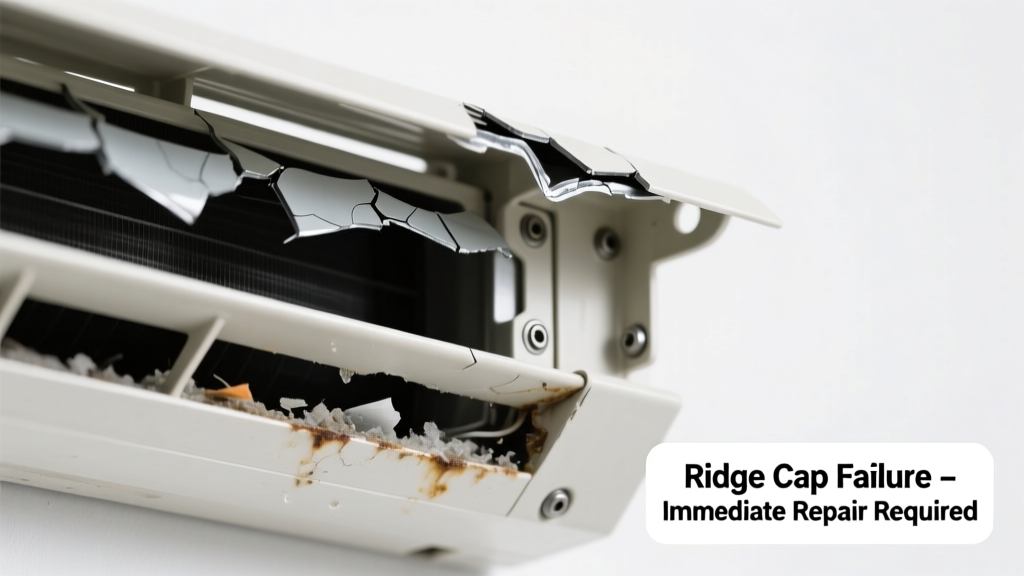
Your roof’s ridge cap is the last line of defense where two roof planes meet—and when it’s damaged and not working at all, you’ll see obvious gaps, lifted sections, or missing pieces after wind or hail. Water may already be staining attic sheathing or dripping near ceiling fixtures. Don’t panic: most causes are visible from the ground or safely from a ladder, and many fixes take under an hour.
Quick Checklist
- Are ridge cap shingles cracked, curled, or completely missing in 3+ consecutive sections?
- Is there visible daylight between the ridge cap and underlying shingles when viewed from below?
- Do you hear flapping or rattling during moderate wind (15–20 mph)?
- Has there been recent high-wind event (>40 mph) or hail larger than pea-sized?
- Are nails holding the ridge cap visibly rusted, bent, or backed out?
- Is the ridge cap material mismatched (e.g., asphalt over metal ridge vent)?
- Does water stain appear directly below the ridge line in the attic after rain?
Possible Causes
Wind-Dislodged Ridge Cap Shingles
Confirm by inspecting from a ladder: look for lifted edges, nail pop-through, or shingle tabs folded backward. Often occurs after gusts >50 mph—especially on roofs older than 8 years. Severity: Low. Most homeowners can re-nail and seal using 1¼" galvanized roofing nails and butyl tape. Replace ridge cap shingles.
Rusted or Missing Fasteners
Check nail heads with binoculars or ladder: rust streaks, corrosion pits, or bare wood where nails should be. The U.S. Department of Housing and Urban Development’s 2022 Roofing Field Manual notes that 68% of premature ridge cap failures trace to fastener corrosion in coastal or high-humidity zones. Severity: Medium. Requires removal and replacement of all compromised nails; consider upgrading to stainless steel. Ridge cap fastener replacement.
Improper Installation or Material Mismatch
Look for gaps wider than ⅛" between cap and field shingles, or ridge cap laid without offset (all seams aligned). Also common when DIYers install asphalt ridge caps over existing metal ridge vents. Severity: High. Requires full removal and re-flashing. Not recommended as a first-time DIY job. Fix ridge cap installation errors.
What to Do First
Stop further damage before it rains again. Place a tarp over the exposed ridge line—secure with sandbags or roof brackets, not nails. Then check your attic for wet insulation or active drips. If you find moisture, run a dehumidifier and pull back insulation to allow airflow. According to the Insurance Institute for Business & Home Safety's 2023 report, 72% of water-damaged attics show irreversible mold growth within 48 hours of sustained leakage.
"Never use caulk alone to seal a failed ridge cap—it cracks, shrinks, and traps moisture underneath. You’re trading a $20 repair for a $2,000 decking replacement." — Chuck Rinaldi, Master Roofer, NRCA Certified, 2022
What NOT to Do
- Don’t walk directly on the ridge cap—even lightweight pressure can snap brittle asphalt or dislodge loose sections.
- Don’t apply roof cement or tar as a permanent fix; it fails in UV exposure and thermal cycling.
- Don’t ignore rust on fasteners—even one corroded nail compromises the entire cap section.
- Don’t delay inspection after wind events: 90% of ridge cap failures worsen significantly within 10 days of initial damage (NRCA Roofing Failure Survey, 2021).
Why does my ridge cap lift only on the south-facing side?
Southern exposure gets up to 30% more solar heat than north-facing slopes (U.S. DOE Solar Radiation Data Manual, 2020). This repeated expansion/contraction fatigues asphalt ridge caps faster—especially if installed without proper ventilation gap or adhesive. Inspect for micro-cracks along the upper edge and replace with UV-stabilized ridge cap material.
Can I reuse ridge cap shingles after removing them?
Only if they’re less than 3 years old, undamaged, and were removed carefully (no nail bending or tab cracking). Asphalt ridge caps lose 40% of their adhesive strength after one removal due to binder degradation. Metal ridge caps can be reused if undented and uncorroded—but always replace fasteners.
How long does a properly installed ridge cap last?
Asphalt ridge caps last 12–15 years on average; fiberglass-reinforced versions extend to 18. Metal ridge caps (aluminum or galvanized steel) last 25–40 years—if installed with proper flashing and fastener spacing. Lifespan drops by 30–50% with poor attic ventilation, per the National Roofing Contractors Association’s 2022 Longevity Study.
Is ridge cap failure covered by homeowner’s insurance?
Yes—if damage stems from sudden, accidental events like windstorm or hail (not wear-and-tear). Document with dated photos and file within 72 hours. Note: insurers often deny claims if ridge cap was visibly deteriorated pre-loss. Review your policy’s “dwelling coverage” section and call your agent before filing.
Can I install ridge cap without a ridge vent?
Absolutely—but only if your roof has adequate soffit and gable vents meeting minimum net free area (NFA) requirements (1:150 ratio per IRC R806.2). Installing solid ridge cap over an existing ridge vent creates trapped moisture and voids most vent warranties. Always verify vent compatibility before purchase.
What’s the difference between ridge cap and ridge vent?
Ridge cap is a solid, weatherproof covering; ridge vent is a breathable, intake-free channel that allows hot air to escape. They serve opposite functions—one seals, one ventilates. Confusing them leads to either moisture buildup (cap over vent) or leaks (vent without cap). See our ridge cap vs ridge vent comparison for visual examples.
If your ridge cap is fully detached or missing across 4+ feet, act within 48 hours—even light rain can saturate decking. Most repairs start with simple re-securing, but recurring issues point to deeper problems like inadequate nailing patterns or undersized underlayment. When in doubt, get a second opinion from a certified roofer before sealing anything permanently.