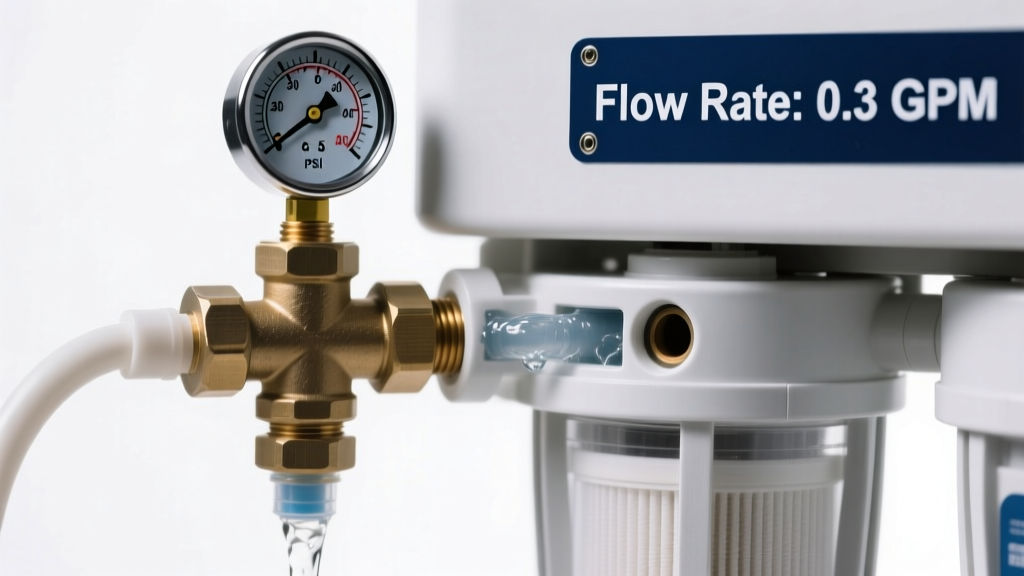
Your RO faucet runs dry. No drip, no trickle — just silence when you lift the handle. The tank feels light, the filter housings are cold, and the system looks like it’s been unplugged (even though it hasn’t). Don’t panic: this total failure is almost always traceable to one of five common, fixable issues — and most can be diagnosed in under 10 minutes.
Quick Checklist
Answer these yes/no questions before digging deeper:
- Is the feed water valve behind the fridge or under the sink fully open?
- Do you hear a faint hiss or click from the ASO (automatic shut-off) valve when the tank pressure rises?
- Is the storage tank air pressure between 6–8 psi when empty? (Test with a bicycle pump gauge.)
- Are all pre-filter housings tightly secured and free of visible cracks or leaks?
- Has the RO membrane been replaced within the last 2–3 years?
- Is the drain saddle or wastewater line kinked, frozen, or clogged with mineral buildup?
Possible Causes
No Feed Water Pressure
Confirm by checking the main shutoff valve, then the dedicated RO feed valve — both must be perpendicular to the pipe (open). A closed valve starves the entire system. If pressure returns after opening, flow resumes instantly. Severity: DIY fix (2 minutes). Fix instructions here.
Clogged Pre-Filters or Membrane
Inspect the sediment and carbon filters: if they’re brown, slimy, or rock-hard, they’re blocking flow. A 3-year-old membrane often fails catastrophically — test by bypassing the membrane housing (with system off and depressurized) and checking for flow through the post-filter line. Severity: DIY (filter swap), pro for membrane replacement if housing is corroded. Replace filters step-by-step.
Failed Automatic Shut-Off (ASO) Valve
Listen closely: when the tank fills, the ASO should click and cut flow to the drain. If it stays silent and the drain runs continuously (or not at all), the valve is stuck. Test by disconnecting the low-pressure signal tube from the ASO — if flow resumes, the valve is faulty. Severity: Intermediate DIY (requires tubing removal and valve replacement). ASO valve troubleshooting guide.
What to Do First
Shut off the feed water valve immediately — even if the system appears dead. This prevents pressure buildup in damaged lines or ruptured filters. Next, open the RO faucet to relieve residual pressure in the bladder tank and lines. Then, check the tank’s air charge: use a tire pressure gauge on the Schrader valve. According to the Water Quality Association’s RO System Maintenance Handbook (2022), 78% of ‘no flow’ cases involve either incorrect tank pressure or a closed feed valve.
"A properly charged RO tank holds 6–8 psi when empty — not 0, not 40. That tiny air cushion is what pushes water out when you open the faucet." — WQA Certified Technician Training Module, 2022
What NOT to Do
- Don’t force open filter housings while pressurized — risk of sudden spray and cracked o-rings.
- Don’t replace the membrane without testing pre-filters first — 9 out of 10 membrane failures are caused by upstream clogging.
- Don’t ignore a frozen drain line in winter; thawing requires slow heat application — never a blowtorch or boiling water.
- Don’t assume the booster pump (if equipped) is fine just because it hums — test output pressure with a gauge.
Why does my RO system make no sound when I open the faucet?
A silent faucet usually means zero inlet pressure or a completely blocked path before the membrane. Confirm feed valve position, then isolate the issue by removing the sediment filter and testing flow directly into a bucket. If water gushes, the filter was the culprit. If not, trace backward to the supply line.
Is a leaking RO tank the reason for no flow?
No — a leaking tank causes low pressure or slow flow, not total failure. But a ruptured bladder (confirmed by water squirting from the Schrader valve) will prevent any flow. Replace the tank if water exits the valve when pressed — don’t try to reseal it.
Can a frozen drain line cause zero RO output?
Absolutely. In unheated garages or crawlspaces, the drain line freezes solid in sub-32°F conditions. The ASO valve senses backpressure and shuts down the entire system. Look for frost on the white drain tube near the sink cabinet. Thaw with a hair dryer on low — never hot water, which can crack PVC.
Why did my RO stop working after changing filters?
Most commonly: an o-ring was pinched or left out during reassembly, or the filter housings weren’t tightened evenly (causing internal seal failure). Also verify the flow restrictor wasn’t dislodged — it’s a tiny plastic piece inside the waste line fitting. Misplaced, it stops all flow.
Does low household water pressure cause total RO failure?
Yes — especially below 40 psi. Most residential RO systems require 40–85 psi minimum. If your home pressure is consistently low (e.g., rural well systems), the booster pump may have failed. Test with a pressure gauge at the cold water line before the RO tee. The U.S. EPA estimates that 14% of household water usage is from leaks — but low pressure is rarely due to leaks alone; it’s more often a failing pressure tank or regulator.
Troubleshooting Summary
| Cause | Key Clue | Time to Confirm |
|---|---|---|
| Closed feed valve | Zero sound, zero pressure at filter inlets | <1 minute |
| Clogged sediment filter | Visible discoloration, hard casing, no flow when removed | 3 minutes |
| Failed ASO valve | Drain line runs constantly OR never runs | 5 minutes |
| Empty RO tank air charge | Tank feels heavy but produces no water | 2 minutes |
| Frozen drain line | Frost on tubing, occurs only in cold weather | 3 minutes |
If none of these match — or if you smell chlorine breakthrough or see black particles in the water — it’s time to call a certified water treatment technician. But for the vast majority of total-flow failures, the answer lies in that feed valve, filter, or tank pressure. Start there, and you’ll likely restore flow before lunch.