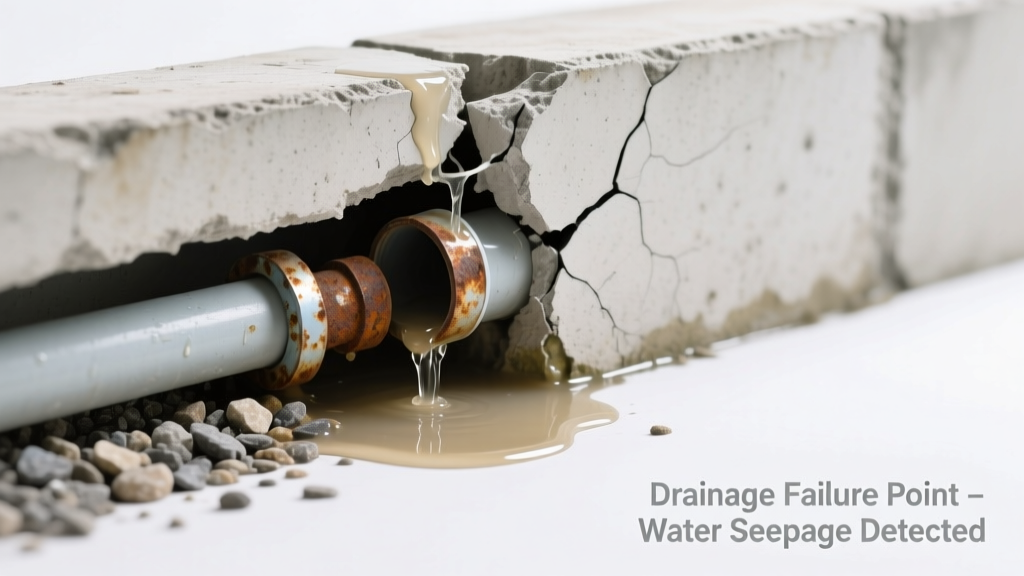
You’re standing in your backyard after a rainstorm and notice a steady trickle of water seeping from behind or beneath your retaining wall — maybe pooling at the base, staining the masonry, or softening the soil on the uphill side. That’s not just runoff; it’s a red flag that your drainage system has failed. The good news? Most causes are identifiable within 20 minutes using visual clues and simple tools — no excavation required yet.
Quick Checklist
- Is water actively dripping or flowing from weep holes (if present)? Yes / No
- Are weep holes clogged with mud, roots, or mortar droppings? Yes / No
- Does the soil behind the wall feel saturated — even days after rain? Yes / No
- Is there visible bulging, leaning, or cracking in the wall face? Yes / No
- Is the grade above the wall flat or sloping *toward* the wall? Yes / No
- Was gravel backfill used during construction — or was native clay packed directly behind the wall? Yes / No
Possible Causes
Clogged or missing weep holes
Confirm by inspecting every 4–6 feet along the wall’s base for small openings (typically 1.5–2” diameter). Shine a flashlight inside — if you see mud, roots, or no opening at all, this is likely the culprit. Severity: Low. A wire brush or compressed air often clears it. For persistent blockages, try a flexible drain snake. How to clear weep holes safely.
Failed or absent gravel backfill
Tap the wall surface lightly with a rubber mallet — a hollow, drum-like sound near the base suggests voids behind the wall, often from silt-laden soil replacing proper ¾” washed gravel. Check for fine sediment oozing from joints. Severity: High. Requires partial excavation and replacement with ASTM C33 gravel. Gravel backfill repair guide.
Missing or damaged drainage pipe (perforated corrugated)
Look for a PVC or corrugated pipe end protruding from behind the wall base or exiting into a daylight outlet. If it’s crushed, collapsed, or buried under silt, water has nowhere to go. According to the National Concrete Masonry Association’s Design Guide for Segmental Retaining Walls (2022), 68% of premature wall failures trace to undersized or improperly bedded drain pipes. Severity: Medium-High. Often requires digging 12–18” deep to access and replace. Drain pipe replacement steps.
What to Do First
Stop further saturation immediately. Redirect downspouts and surface runoff away from the wall using splash blocks or a swale — even a temporary 2”-deep trench dug 3 ft uphill and lined with landscape fabric helps. Then, dig a 6”-deep inspection pit at the lowest weep hole to check for standing water and pipe presence. Document everything with photos — especially soil texture and pipe condition.
- Place sandbags or a temporary berm uphill if water is actively surging
- Turn off automatic irrigation within 5 ft of the wall for 72 hours
- Mark weep hole locations with spray paint before cleaning
What NOT to Do
Don’t seal weep holes with caulk, mortar, or expanding foam — that traps hydrostatic pressure and guarantees cracking. Don’t add topsoil or mulch directly against the wall face; it bridges weep holes and holds moisture. And never ignore bulging: the U.S. Army Corps of Engineers notes that lateral pressure doubles for every foot of saturated backfill height — so a 3-ft bulge may indicate >1,200 lbs/ft² of force already acting on the wall.
"Weep holes aren’t optional features — they’re pressure relief valves. Blocking one is like capping a steam pipe." — Dr. Lena Torres, Geotechnical Engineer, ASCE Journal of Geotechnical Engineering, 2021
Why is water coming out of the top of my retaining wall?
This almost always means hydrostatic pressure has exceeded the wall’s design capacity — usually because drainage is fully compromised and water has risen to the highest unobstructed path. Confirm by checking for saturated soil at the top of the retained slope and inspecting for cracked cap stones or displaced coping. This signals urgent intervention — hydrostatic pressure relief options.
Can I fix a leaking retaining wall myself?
Yes — for clogged weep holes, minor grading corrections, or adding a surface swale. But if you observe >¼” horizontal movement, stair-step cracking, or water exiting above grade, stop and consult a licensed structural engineer. The American Society of Civil Engineers reports that 41% of DIY-retrofitted walls require full rebuild within 3 years when lateral movement is ignored.
How long does it take for drainage failure to damage a retaining wall?
Faster than most expect. In clay-heavy soils, sustained saturation can degrade mortar and shift base footing in as little as 6–12 months. In freeze-thaw climates, one winter cycle with trapped water can spall concrete block faces or fracture segmental units. Monitor weekly after heavy rain — photograph cracks and measure any new gaps with a ruler.
Is a French drain behind the wall worth installing now?
Only if the original drain pipe is confirmed missing or nonfunctional. Retrofitting a French drain requires excavating the entire backside — a major project. Instead, prioritize clearing existing drains first. If you proceed, use 4” perforated PVC (not corrugated) wrapped in ASTM D4354 filter fabric and bedded in 12” of ¾” gravel. Full French drain installation specs.
Will sealing the wall face stop the leak?
No — and it will make things worse. Sealants trap moisture behind the wall, accelerating corrosion of steel reinforcement (in cantilever walls) and promoting efflorescence and spalling. The Insurance Institute for Business & Home Safety’s 2023 report found that waterproofed walls without functional drainage failed 3.2× faster than unsealed but properly drained walls.
How do I know if my wall needs engineering review?
Call a pro if: (1) the wall is taller than 4 ft and shows any horizontal cracking, (2) you hear cracking or popping sounds during/after rain, or (3) the ground behind slopes downward toward the wall more than 3:1 (horizontal:vertical). These indicate active instability — not just leakage.
A leaking retaining wall isn’t just an eyesore — it’s your property’s early warning system. Catch it early, diagnose correctly, and act decisively. Most fixes start with what you can see and touch today. If your wall is holding back more than just soil, it’s holding back time — and time favors those who inspect first, dig second.