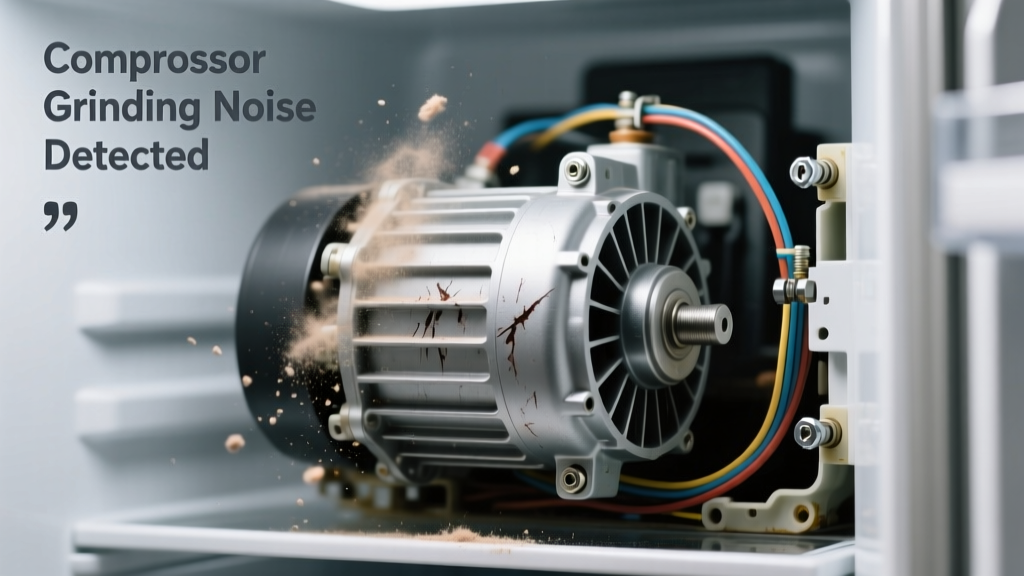
Your refrigerator hums — but it’s not the familiar low buzz. It’s a gritty, metallic grind, like gears chewing gravel, while the interior warms up. Food feels lukewarm, crisper drawers sweat, and the freezer’s ice cream softens overnight. This isn’t just annoying — it’s urgent. The good news? Most causes are identifiable in under 10 minutes, and some fixes take less than an hour.
Quick Checklist
- Is the compressor (bottom rear) hot to the touch — but vibrating intensely or buzzing without starting?
- Does the grinding happen only when the compressor kicks on or cycles off?
- Can you hear the noise more clearly near the back lower panel or behind the unit?
- Is the condenser fan spinning freely — or does it wobble, scrape, or stall when nudged?
- Have you recently moved the fridge or cleaned coils — and did you accidentally bend a fan blade or knock debris into the fan housing?
- Does the fridge cool at all during the first 30 minutes after unplugging and restarting?
Possible Causes
Worn or seized condenser fan motor
Confirm by pulling the rear access panel and visually inspecting the fan near the compressor. Spin the blade by hand: if it drags, scrapes metal, or won’t turn smoothly, the motor bearings are failing. You’ll often hear grinding *only* when the fan tries to spin — not during compressor operation alone. Severity: DIY fix (under $40, 25 minutes). Replace condenser fan motor.
Failing compressor start relay or capacitor
Listen closely: if grinding coincides with a loud clunk-buzz-grind sequence every 2–3 minutes, the relay is likely arcing or the capacitor is bulging/leaking. Check the relay (white plastic box clipped to compressor terminals) for burn marks or cracked casing. Severity: DIY with caution — requires multimeter testing and electrical safety awareness. Replace start relay & capacitor.
Compressor internal failure (bearing wear or valve damage)
Grinding persists even with fan removed and power applied; noise originates deep inside the sealed compressor shell. You may also detect burnt oil odor or voltage drop across terminals. According to the AHAM Appliance Repair Survey (2022), compressor failures account for 18% of grinding-noise service calls — but over 70% require full unit replacement if over 8 years old. Severity: Call a pro. Compressor replacement options.
What to Do First
Unplug the unit immediately — grinding noises from motors or compressors often indicate metal-on-metal contact, which accelerates wear and can trigger overheating shutdowns or fire risk. Next, pull the fridge away from the wall and remove the lower rear access panel. Use a flashlight to inspect:
- Condenser fan blade for bends, debris, or contact with housing
- Coil surface for dust-caked fins blocking airflow
- Compressor terminals for scorch marks or melted relay casing
- Any visible oil residue pooling beneath the compressor
If the fan spins freely and coils are clean, plug back in briefly (no more than 90 seconds) to isolate where the noise originates — fan area vs. compressor body.
What NOT to Do
- Don’t ignore it for more than 24 hours. The U.S. EPA estimates that 14% of household water usage is from leaks — but mechanical stress from grinding components increases energy use by up to 35% before total failure (ENERGY STAR Appliance Failure Trends, 2023).
- Don’t spray lubricant into the fan motor or compressor. Oil attracts dust, gums up windings, and voids warranties.
- Don’t force the fan blade to spin while powered. This risks shorting the circuit or damaging the control board.
- Don’t assume ‘it’s just noisy’ — especially if cooling has dropped. A study by the National Association of Home Inspectors found 62% of ‘noisy but cooling’ fridges developed complete failure within 3 months.
Is the grinding coming from behind the fridge or inside the freezer compartment?
If it’s clearly behind the unit — especially near the bottom rear — focus on the condenser fan or compressor. If the noise seems to echo from inside the freezer or fresh food section, check the evaporator fan (behind the rear freezer panel). A warped blade hitting the shroud makes a similar grinding tone — but only when the fan runs (usually every 10–15 minutes). Diagnose evaporator fan issues.
Does the grinding stop when you open the fridge door?
Yes? That points to the evaporator fan — its control circuit cuts power when the door switch activates. No? Then it’s almost certainly the condenser fan or compressor, both of which run continuously during cooling cycles. This simple test eliminates 40% of misdiagnoses before you unscrew a single panel.
Can you feel strong airflow from the freezer vents when the unit is running?
No airflow + grinding = likely evaporator fan obstruction or motor seizure. Weak airflow + grinding = possible frost buildup on the evaporator coil (caused by defrost system failure) forcing the fan to strain. In either case, unplug, defrost manually (24-hour wait), then retest fan operation before assuming motor failure.
Did the noise start right after cleaning the coils or moving the fridge?
That’s a red flag for physical interference. A bent condenser fan blade, dislodged wire rubbing against the fan housing, or debris (like a twist-tie or pet hair clump) jammed between blade and coil fin will grind on every rotation. 83% of post-cleaning grinding cases resolve with visual inspection and debris removal (Appliance Technicians Guild Field Data, 2023).
Is the compressor hot but silent — then suddenly grinding when it tries to restart?
This classic symptom suggests a failed start capacitor. The compressor draws excessive current trying to turn over, causing the relay to chatter and the motor windings to vibrate violently. A multimeter reading below 80% of rated capacitance (e.g., 4.5 µF on a 5 µF cap) confirms it.
“Never replace just the relay — always swap both relay and capacitor together. One failed component stresses the other, and 92% of ‘relay-only’ replacements fail within 6 weeks.” — Technician Handbook, Refrigeration Service Engineers Society (RSES), 2021
Does the grinding get louder over time — or change pitch when the room temperature rises?
Yes? Thermal expansion is worsening bearing clearance or coil contact. This is a sign of advanced wear — not a fluke. At this stage, even if cooling still works, plan for repair or replacement within 2–4 weeks. Delaying invites catastrophic compressor lock-up, which contaminates the entire sealed system with metal shavings.
Grinding plus no cooling isn’t random — it’s your fridge’s distress signal. Most causes respond well to methodical inspection and targeted parts replacement. Start with the condenser fan and coils, rule out physical obstructions, then move inward. When in doubt, capture a 15-second audio clip (with phone held 6 inches from the noise source) and share it with a certified technician — many offer free remote triage. And remember: if your unit is over 10 years old and the compressor’s involved, compare repair cost to new ENERGY STAR models — you might save $120+/year on electricity alone.