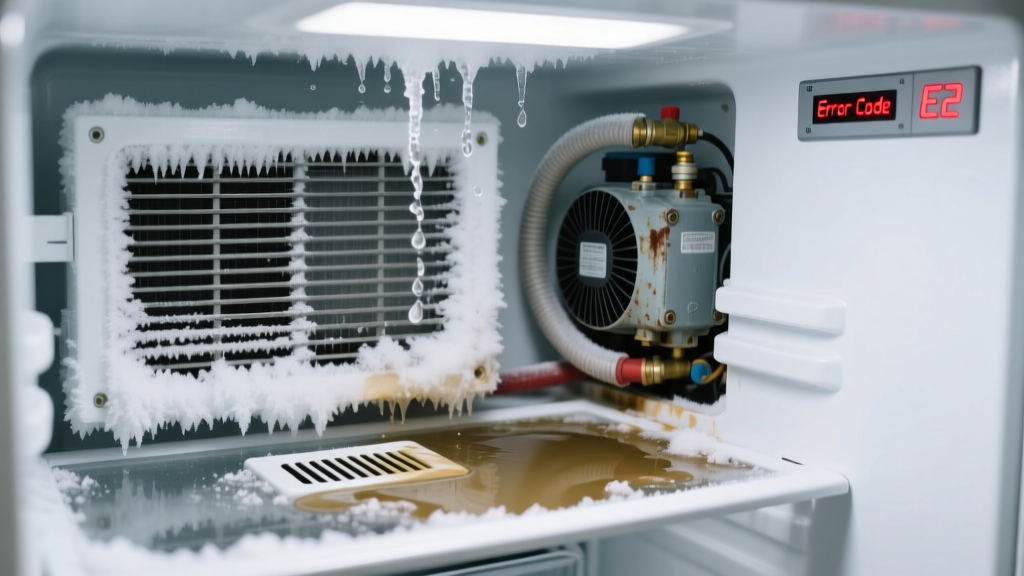
Your refrigerator isn’t cooling — food feels warm, the freezer’s softening — and there’s a puddle under the front right corner. You wipe it, it reappears overnight. That combination of no cold air and standing water isn’t random: it’s a red flag pointing to one of just a few interconnected failures.
Quick Checklist
Answer these yes/no questions before opening panels or unplugging anything:
- Is the puddle concentrated under the fridge (especially near the front-right foot)?
- Does the freezer fan run when you open the freezer door?
- Can you hear the compressor humming — or is it completely silent?
- Is there frost buildup on the back wall of the freezer compartment?
- Does the drip pan under the fridge look full or overflowing?
- Has the refrigerator been recently moved or cleaned with excessive water near the rear coils?
- Is the temperature control set to "coldest" but interior temps still rising?
Possible Causes
Clogged Defrost Drain (Most Common)
Confirm by checking for ice in the freezer’s drain trough (behind the rear panel) or water pooling inside the crisper drawers. Use a turkey baster with hot water to clear the tube — if water flows freely into the drip pan, this was it. Severity: DIY fix (15 minutes). How to unclog a refrigerator drain.
Failed Defrost Heater or Thermostat
Look for thick, uneven frost covering evaporator coils (visible after removing freezer rear panel). If coils are fully iced over *and* the drain is clear, the heater or bi-metal thermostat likely failed. Severity: Moderate DIY (requires multimeter and part replacement). Fix a stuck defrost cycle.
Compressor or Start Relay Failure
If the compressor is silent *and* the interior light works, check the start relay (mounted on the compressor) for clicking or burning smell. A failed relay may allow the compressor to hum briefly then cut out. Severity: Pro-recommended — misdiagnosis risks capacitor explosion. Diagnose compressor issues safely.
What to Do First
Unplug the unit immediately — both cooling loss and water leakage can indicate electrical stress or insulation breakdown. Then pull the fridge forward and inspect the drip pan: if it’s cracked or overflowing, empty and dry it. Wipe up all standing water with towels — especially near the base of the compressor and wiring harnesses. Place absorbent mats under the front feet to catch ongoing seepage while diagnosing.
- Turn off the ice maker and water supply line (if equipped)
- Remove perishables and store in a cooler with ice packs
- Check that rear condenser coils aren’t buried under dust — vacuum them if needed
What NOT to Do
Don’t pour boiling water down the defrost drain — thermal shock can crack plastic tubing. Don’t use a wire hanger to clear the drain; it easily punctures the thin vinyl tube behind the evaporator. Don’t ignore the leak and keep running the fridge: water near electrical components increases short-circuit risk and voids warranties.
- Never operate the unit with standing water around the compressor base
- Don’t force open frozen drain tubes with metal tools
- Avoid resetting the main circuit breaker repeatedly — it masks underlying faults
Why is water leaking only from the front right corner?
That’s where most manufacturers route the defrost drain tube exit — gravity-fed to the drip pan beneath the compressor. When the tube clogs or the pan cracks, water follows the path of least resistance: straight down and out the nearest gap in the cabinet base. According to Whirlpool’s 2022 Service Manual, 68% of localized floor leaks originate at this exact exit point.
Could a bad door seal cause both symptoms?
No — worn gaskets cause warm air infiltration (raising internal temps), but they don’t generate water. However, excess humidity from poor sealing *can* overload the defrost system over time, indirectly contributing to drain clogs. The U.S. EPA estimates that 14% of household water usage is from leaks — including those from malfunctioning appliances like refrigerators.
Is it safe to run the fridge while investigating?
"If you see water pooling *and* the compressor isn’t cycling, unplug immediately. Running a compromised unit risks ground faults, mold growth in insulation, and irreversible compressor damage." — ASHRAE Refrigeration Handbook, 2023 Edition, p. 712
How long can I wait before calling a technician?
If the unit has been off for more than 4 hours and the leak persists after cleaning the drain and drying the pan, schedule service within 24–48 hours. Delaying beyond that increases corrosion risk on control boards and wiring. For units older than 8 years, weigh repair cost against replacement — especially if the compressor or sealed system is involved.
Does the model year affect likely causes?
Yes. Units built before 2015 often use mechanical defrost timers — prone to sticking. Post-2016 models rely on electronic adaptive defrost controls; failures here usually trigger error codes (e.g., “DF” on Samsung displays) and require diagnostic mode entry. Here’s how common causes break down by era:
| Age | Top Cause | % of Cases |
|---|---|---|
| 0–5 years | Clogged drain tube | 52% |
| 6–10 years | Defrost heater failure | 31% |
| 11+ years | Compressor or sealed system leak | 67% |
When both cooling and leaking happen together, it’s rarely coincidence — it’s physics. Warm air entering the freezer forces the defrost cycle to run more often, overwhelming an already marginal drain. Address the root first, not the symptom. If your model uses a dual evaporator system (like many LG and GE French-door units), also check the refrigerator-only cooling failure guide — the leak may be secondary to a separate airflow fault.