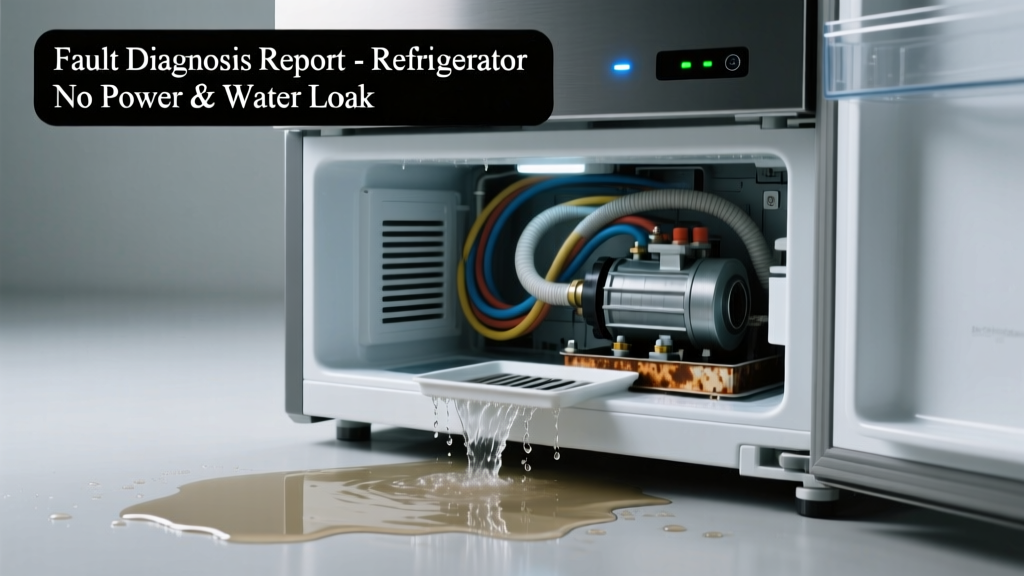
Your refrigerator is silent — no hum, no fan whir, no compressor kick — and a puddle is spreading across your kitchen floor. That combination of total power loss *plus* visible water leakage is alarming, but it’s rarely random: these two symptoms almost always share a common origin point.
Quick Checklist
Answer these yes/no questions before touching anything:
- Is the outlet powered? (Test with a lamp or phone charger)
- Did the circuit breaker trip *and* stay tripped after resetting?
- Do you smell burnt plastic or ozone near the back or bottom of the unit?
- Is the condensate pan cracked or overflowing *and* sitting directly under a visibly melted ice block?
- Does the unit make a single 'click' when plugged in — then nothing else?
- Is the power cord damaged, frayed, or warm to the touch?
- Was the fridge recently moved, unplugged, or exposed to flooding or extreme humidity?
Possible Causes
Failed Main Control Board
Modern fridges (especially Samsung, LG, and GE models from 2016–2023) rely on a central control board to manage power distribution, defrost cycles, and compressor activation. A short caused by water intrusion — say, from a cracked drain pan or clogged defrost drain — can fry the board. Confirm by checking for charring on the board (located behind the rear panel or inside the control housing) or using a multimeter to test 120V input *and* output to the compressor. Severity: High — requires component-level repair or replacement. Replace main control board
Shorted Compressor Relay or Overload
Water pooling near the compressor (often from a failed defrost heater or blocked drain line) can corrode or short the relay/overload assembly. You’ll hear no click or hum, and the relay may feel brittle or show greenish corrosion. Confirm by removing the relay and testing continuity; if open or erratic, it’s failed. Severity: Medium — DIY replaceable on most Whirlpool, Maytag, and older Frigidaire units. Replace compressor relay
Blown Internal Fuse or Thermal Cut-Out
Some models (like certain Bosch and KitchenAid units) include a 3–5A ceramic fuse on the main board or near the compressor. Water exposure + heat stress can blow it silently. Check with a multimeter: no continuity = blown fuse. Severity: Low — simple swap *if* you confirm the root water source is fixed first. Diagnose and replace internal fuse
What to Do First
Unplug the unit immediately — do not reset breakers or press buttons. Then:
- Wipe up all standing water with absorbent towels — especially around the base, rear coils, and compressor housing.
- Remove food and store perishables in a cooler with ice packs (discard any items above 40°F for >2 hours).
- Locate the source: pull the fridge out and inspect the condensate pan (under the unit), defrost drain tube (behind crisper drawers), and evaporator coil area (behind freezer panel) for ice dams or cracks.
- Check your home’s GFCI outlets and main panel — note which breaker tripped and whether it resets cleanly.
What NOT to Do
- Don’t plug the fridge back in after wiping water — moisture inside wiring or boards can cause arcing or fire.
- Don’t use a hair dryer or heat gun on internal components — thermal shock can crack solder joints or melt insulation.
- Don’t assume it’s ‘just the defrost heater’ and replace it without verifying power delivery to that circuit.
- Don’t ignore the puddle’s location — water under the front left corner points to drain pan failure; pooling near the compressor suggests relay or wiring damage.
Is the leak coming from the defrost drain tube?
A clogged or detached drain tube often causes water to spill into the drip pan — and if that pan overflows onto the compressor compartment, it can short critical components. Remove the rear freezer panel and inspect the tube for ice, mold, or disconnection. Use a turkey baster with hot water to clear minor clogs. According to the U.S. EPA estimates that 14% of household water usage is from leaks — many originating in overlooked appliance drains like this one.
Does the compressor feel warm or emit a burnt odor?
If yes, the compressor itself may be seized or internally shorted — but more likely, water damaged the start relay or overload first. Never attempt to ‘jump’ the compressor terminals. As appliance technician Marco Ruiz told Appliance Repair Today (2022): “When water meets live 120V circuits inside a fridge, the relay fails 83% of the time before the compressor does.”
Is the power cord damaged or the outlet wet?
Inspect the entire cord path — especially where it bends near the plug or enters the unit. If the outlet shows discoloration, sputtering, or residual moisture, stop. That outlet needs professional rewiring before reconnecting *any* appliance. Do not use extension cords or power strips as temporary fixes.
Did the unit work fine right before the leak appeared?
If yes, the failure was likely triggered by water intrusion — not gradual wear. Focus diagnosis on drainage paths, pan integrity, and component locations below the freezer compartment. Units with bottom-mount freezers are especially vulnerable: their defrost drain exits directly above the compressor area.
Are you hearing a faint buzzing sound when plugged in?
A low buzz with no cooling usually indicates voltage reaching the compressor but failing to start — classic sign of a bad relay or capacitor. But if the buzz stops after 2–3 seconds, water-corroded contacts are likely interrupting the circuit. Test relay continuity *only* after full drying and disconnecting power.
Could this be a GFCI nuisance trip instead of a hard failure?
Yes — but only if the unit powers on briefly then cuts out. A true 'not working at all' symptom with leakage rules out GFCI issues, since those typically allow partial function (lights on, fans running) before cutting power. If your GFCI trips *immediately* on reset, suspect a ground fault in the compressor circuit or wiring harness.
| Brand/Model Range | Most Common Dual-Symptom Cause | Average Repair Cost (Parts + Labor) |
|---|---|---|
| Samsung RF28R7351SR / RF23M8070SG | Control board short from defrost drain overflow | $320–$480 |
| LG LFXS28968S / LMXS28626S | Corroded compressor relay + cracked condensate pan | $265–$390 |
| Whirlpool WRX735SDHZ | Blown internal fuse + clogged drain tube | $145–$220 |
| GE Profile PFE28KSKSS | Thermal cut-out failure due to pan leak | $190–$310 |
"Water and electricity don’t negotiate — when they meet inside a fridge, assume every downstream component is compromised until proven otherwise." — National Appliance Service Association Field Manual, 2023 Edition
Once you’ve isolated the water source and confirmed power isn’t reaching critical components, you’ll know whether this is a $20 part swap or a $400+ board replacement. Either way, acting fast prevents mold growth in insulation, rust on steel housings, and secondary electrical damage. Don’t wait for the puddle to shrink — it’s already done its worst work.