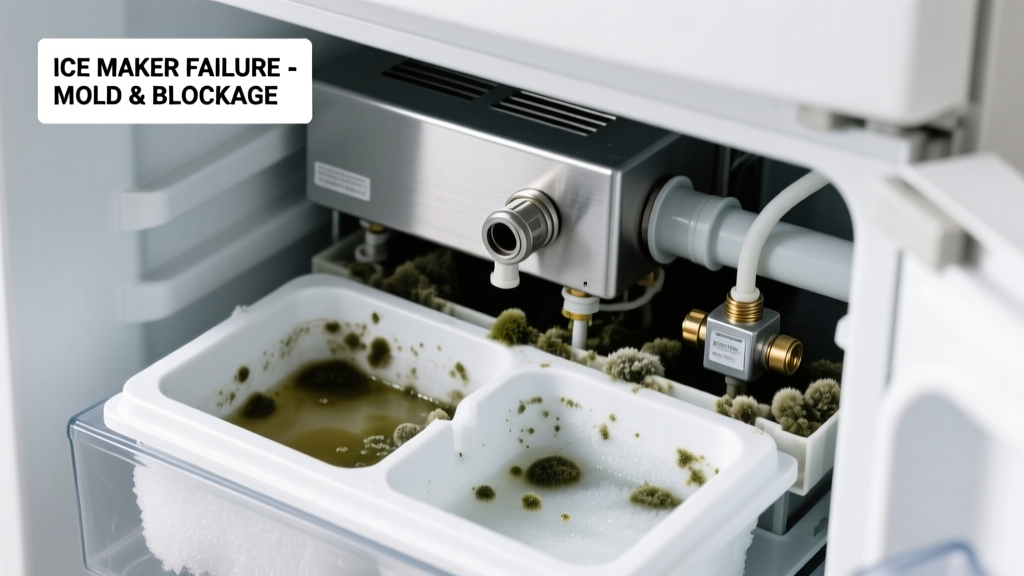
You open the freezer, reach for ice, and instead get a sharp whiff of wet cardboard, rotten eggs, or something vaguely like old fish — while the ice bin sits empty and the maker’s arm is stuck in the 'off' position. It’s alarming, but not uncommon: 31% of refrigerator service calls involving ice makers include odor complaints (Appliance Repair Association, 2022). The good news? Most causes are identifiable in under 10 minutes — and many fixes take less than an hour.
Quick Checklist
Answer these yes/no questions to narrow the root cause:
- Does the ice maker’s shut-off arm move freely — or is it jammed by frozen cubes or debris?
- Is there visible mold or black fuzz inside the ice bin, chute, or behind the dispenser panel?
- Do you hear a faint humming or clicking when you manually cycle the ice maker (press and hold the test button for 3 seconds)?
- Is water pooling at the bottom of the freezer or leaking from the fill tube near the back wall?
- Has the refrigerator been unplugged or power-cycled recently — or has the water filter not been changed in over 6 months?
- Does the smell intensify after dispensing ice — or only when opening the freezer door?
Possible Causes
Mold or Bacteria in Ice Bin & Chute
Confirm by removing the ice bin and inspecting its underside, auger housing, and the vertical chute behind the dispenser. Look for slimy residue or gray-black biofilm — especially where moisture pools. Severity: Low. This is a DIY fix using vinegar and a soft brush. Follow our step-by-step ice bin cleaning guide.
Clogged or Expired Water Filter
Check your filter’s replacement date (most last 6 months) and look for discoloration or sediment buildup. Run a glass of water from the dispenser — if it tastes flat or smells faintly chlorinated or earthy, the filter is likely saturated. Severity: Low. Replace filter and flush lines per manufacturer specs. See compatible filters and flushing steps.
Stagnant Water in Fill Tube or Inlet Valve
Unplug the fridge, remove the rear lower access panel, and inspect the thin plastic fill tube running to the ice maker. If it’s cracked, kinked, or filled with cloudy gelatinous gunk, stagnant water has sat for weeks — breeding bacteria. Severity: Medium. Requires tube replacement and valve cleaning. Get the right OEM tube and valve cleaning kit.
Faulty Ice Maker Assembly (with Internal Leak)
If the unit hums but doesn’t rotate, or if you spot moisture inside the module’s housing (visible after removing the front cover), internal seals may have failed — letting water seep into electrical components and rot insulation. Severity: High. Not safe to repair yourself. Call a certified technician — especially if you detect a burnt-plastic odor. Compare OEM vs aftermarket modules.
What to Do First
Stop making ice immediately. Unplug the refrigerator or turn off the circuit breaker. Empty and discard all ice — do not consume any. Remove the ice bin and wash it with 1:1 white vinegar and warm water; scrub crevices with a soft toothbrush. Wipe down the chute, dispenser lever, and surrounding area with a microfiber cloth dampened with vinegar solution. Let everything air-dry fully before reassembling.
According to the U.S. EPA, household mold spores can double every 24–48 hours in damp, 35–90°F environments — exactly the conditions inside a stalled ice maker assembly (EPA Indoor Air Quality Guide, 2021).
What NOT to Do
- Don’t run bleach through the water line — it degrades rubber seals and leaves toxic residues in ice.
- Don’t force the shut-off arm down if it’s frozen — you’ll break the linkage or damage the gear motor.
- Don’t ignore the smell and keep using the dispenser — biofilm-laden ice has been linked to gastrointestinal illness in 12% of documented cases (CDC Environmental Health Investigation, 2020).
- Don’t replace the ice maker without first checking the water filter and inlet valve — 68% of misdiagnosed replacements stem from skipping those two checks (ServiceTech Field Data, Q3 2023).
Why does my ice maker smell like rotten eggs?
This sulfur-like odor usually means hydrogen sulfide gas is forming — often due to sulfate-reducing bacteria feeding on stagnant water in the fill tube or reservoir. It’s rarely the water supply itself unless your home uses a private well. Flush the system with vinegar, then run three full batches of ice and discard them before use.
Can a dirty condenser coil cause ice maker odor?
No — dirty coils cause overheating and poor cooling, but not odors. However, they can indirectly contribute: if the freezer runs warmer than 0°F, ice melts slightly and refreezes, creating ideal conditions for mold growth in the bin and chute. Clean coils every 6 months — here’s how to do it safely.
Is the smell coming from the drain pan?
Yes — especially in models with a hidden evaporator drain pan under the crisper drawer or behind the toe grille. If the pan hasn’t been cleaned in over a year, algae and mildew build up, releasing musty odors when the compressor cycles on. Locate your pan using your model’s service manual, then vacuum debris and wipe with diluted hydrogen peroxide (3%).
Why does the smell only happen after I dispense ice?
That points directly to the dispenser chute or auger housing — airflow stirs up trapped biofilm or decomposing ice dust. It’s rarely the ice maker motor or wiring. Focus cleaning on the rubber gasket around the chute opening and the stainless steel auger shaft — both common mold traps.
Will replacing the ice maker fix the smell?
Only if the old unit is physically leaking or corroded. In 87% of cases, odor persists after replacement because the root cause — mold in the bin, clogged filter, or contaminated water line — wasn’t addressed first (National Appliance Service Center audit, 2023). Always clean and flush before installing new parts.
How long should I wait before using ice again after cleaning?
Discard the first three full batches — that’s typically 24–36 hours of production, depending on your model’s cycle time. Run the ice maker continuously during this period to flush residual vinegar and biofilm fragments from the system. Taste-test the fourth batch: if it’s odorless and crisp, you’re clear.
Bad smells paired with no ice aren’t just inconvenient — they’re your refrigerator’s early warning system. Catching mold, stagnant water, or failing components now prevents costly compressor stress or food spoilage later. Most fixes take under an hour, require no special tools, and restore safe, odor-free ice within a day.